featurestoreorg/serverless-ml-course
MLOps for Python Developers Who'd Rather Not Touch Kubernetes
A self-paced course that teaches Python developers how to build and operate batch and real-time prediction services using only notebooks, GitHub Actions, and a managed feature store.
Not currently ranked — collecting fresh signals.
star history
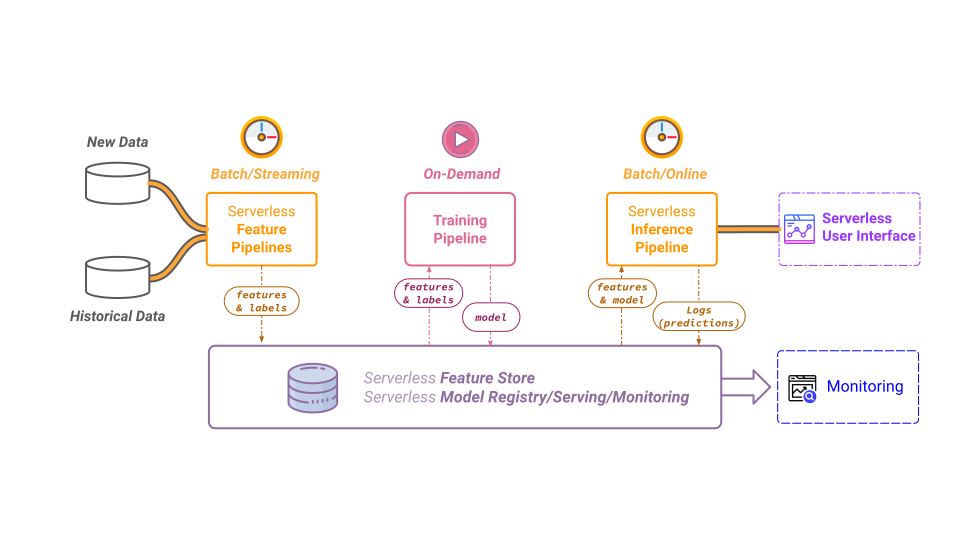
What it does This repository is a self-paced curriculum—videos, slides, and Jupyter notebooks—that teaches developers how to move beyond static model training and build end-to-end prediction services. It covers feature engineering, training and inference pipelines, model registries, and even user interfaces, all using Python and serverless infrastructure rather than Kubernetes or cloud ops.
The interesting bit Instead of asking learners to provision clusters, the course treats GitHub Actions as the compute layer and Hopsworks as the managed feature store and model registry. It is an explicit bet that you can teach legitimate MLOps—versioning, testing, validation, and monitoring—without forcing students to become infrastructure engineers first.
Key highlights
- Teaches both batch and real-time machine learning systems on a fully serverless stack.
- Uses GitHub Actions for pipeline orchestration and Hopsworks’ free tier for feature storage and model management.
- Includes modules on building UIs with Gradio, Streamlit, and GitHub Pages.
- Targets developers who already know Python and Pandas but have no operations background.
- All materials are free and self-paced, relying on time-unlimited free tiers for compute and storage.
Caveats
- The “serverless” stack is tightly coupled to Hopsworks and GitHub Actions, with free-tier limits (2,000 GitHub Actions minutes, 10 GB Hopsworks storage).
- Because it is a course rather than a framework, the repository is primarily syllabus material and example notebooks, not a reusable deployment tool.
Verdict Worth bookmarking if you are a Python developer looking to ship prediction services without learning Kubernetes first. Skip it if you are already comfortable with containerized MLOps or need a standalone library rather than a curriculum.
Frequently asked
- What is featurestoreorg/serverless-ml-course?
- A self-paced course that teaches Python developers how to build and operate batch and real-time prediction services using only notebooks, GitHub Actions, and a managed feature store.
- Is serverless-ml-course open source?
- Yes — featurestoreorg/serverless-ml-course is open source, released under the CC0-1.0 license.
- What language is serverless-ml-course written in?
- featurestoreorg/serverless-ml-course is primarily written in Jupyter Notebook.
- How popular is serverless-ml-course?
- featurestoreorg/serverless-ml-course has 686 stars on GitHub.
- Where can I find serverless-ml-course?
- featurestoreorg/serverless-ml-course is on GitHub at https://github.com/featurestoreorg/serverless-ml-course.