facebookresearch/ai4animationpy
Killing the Unity-to-Python pipeline for AI animation
A research framework that trains neural networks on motion capture and renders results without leaving PyTorch.
Not currently ranked — collecting fresh signals.
star history
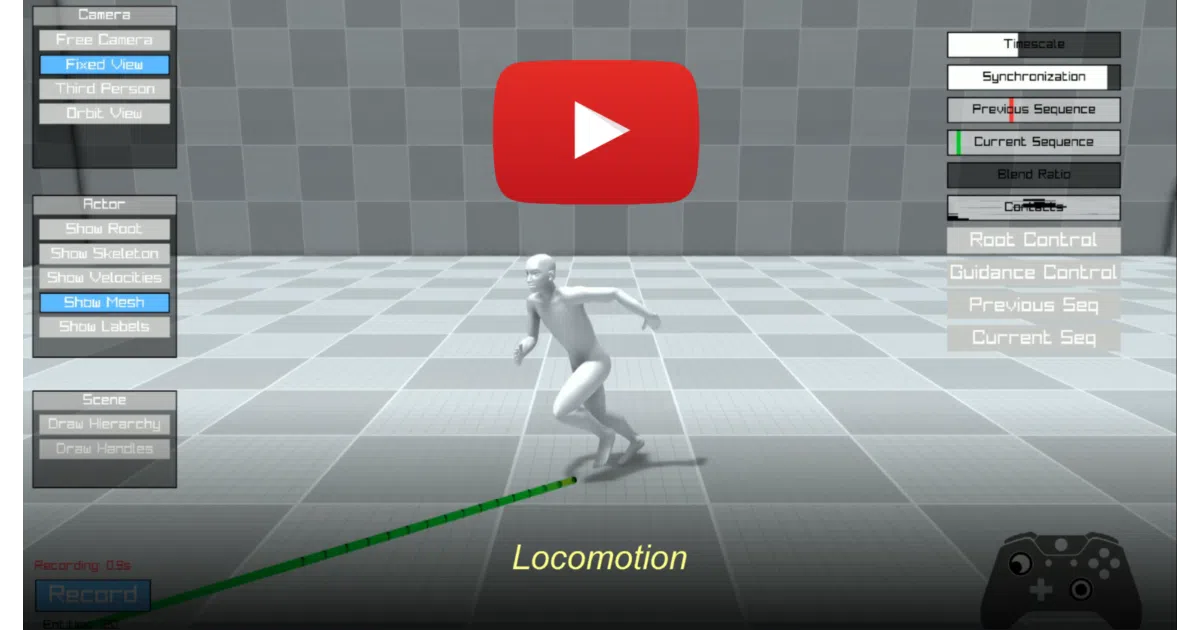
What it does AI4AnimationPy is a Python-native toolkit for AI-driven character animation. It ingests motion capture data (GLB, FBX, BVH), trains neural networks on it, and visualizes the results — all inside a single NumPy/PyTorch environment. The framework replicates a game-engine architecture (ECS, update loops, rendering pipeline) without the game engine.
The interesting bit The original AI4Animation relied on Unity for visualization, forcing researchers to shuttle data through ONNX or streaming pipes. This version cuts Unity out entirely, replacing it with a built-in deferred renderer. The payoff is concrete: generating 20 hours of training data drops from over 4 hours to under 5 minutes, and new experiments go from half a day to about 10 minutes of setup.
Key highlights
- Built-in real-time renderer with deferred shading, shadow mapping, SSAO, bloom, and FXAA
- Game-engine-style ECS architecture with automatic or manual update loops
- Neural network modules including MLPs, autoencoders, and codebook matching
- FABRIK inverse kinematics solver and GPU-accelerated skinned mesh rendering
- Headless, standalone, or manual execution modes for local or remote training
- Direct backpropagation through inference — something the Unity version couldn’t support
Caveats
- Licensed CC BY-NC 4.0, so commercial use is off the table
- Physics simulation, path planning, and audio support are marked as upcoming, not available
- Requires Python 3.12 specifically
Verdict Researchers working on neural character animation who are tired of Unity-Python glue code should look here. If you need commercial licensing or a full physics engine today, this isn’t it yet.
Frequently asked
- What is facebookresearch/ai4animationpy?
- A research framework that trains neural networks on motion capture and renders results without leaving PyTorch.
- Is ai4animationpy open source?
- Yes — facebookresearch/ai4animationpy is an open-source project tracked on heatdrop.
- What language is ai4animationpy written in?
- facebookresearch/ai4animationpy is primarily written in Python.
- How popular is ai4animationpy?
- facebookresearch/ai4animationpy has 2.1k stars on GitHub.
- Where can I find ai4animationpy?
- facebookresearch/ai4animationpy is on GitHub at https://github.com/facebookresearch/ai4animationpy.