dexmal/opendm
A robot VLA model that ships weights, code, and benchmarks
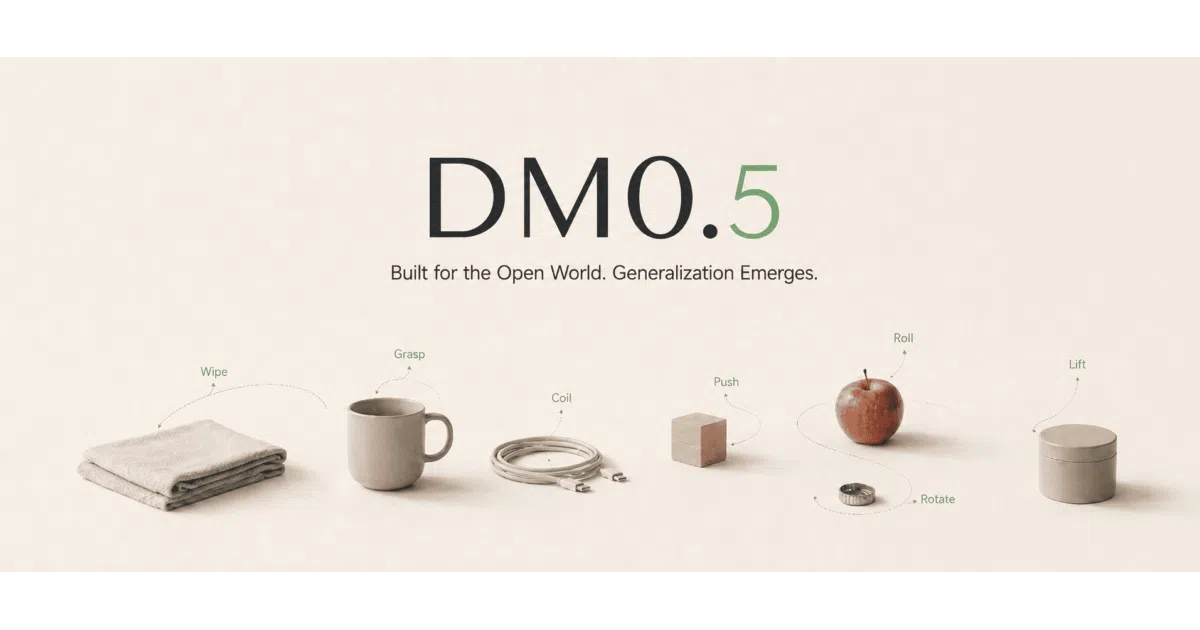
Dexmal’s OpenDM releases the DM0.5 vision-language-action model, complete with pretrained weights, fine-tuned checkpoints, training scripts, and benchmark tables for researchers building general-purpose embodied agents.
Collecting fresh signals — velocity needs a few days of history.
collecting data…
star history
What it does
OpenDM is Dexmal’s open-source release of DM0.5, a Vision-Language-Action model built for open-world robot control across multiple embodiments. The repository includes the base pretrained weights, several task-specific fine-tuned checkpoints, and the full training and inference stack for researchers who want to adapt or deploy embodied agents. It targets long-horizon tasks, open-ended language instructions, and dynamic disturbances rather than narrow, scripted behaviors.
The interesting bit
Most VLA research stops at the architecture diagram; OpenDM publishes the weights, the LoRA workflows, and the evaluation guides for physical robots like the AgileX COBOT Magic. The README even includes head-to-head benchmark tables against Pi0, Pi0.5, and GROOT-N1.7 across simulated and real-world manipulation tasks, which is rarer than it should be in this field.
Key highlights
- Releases base DM0.5 weights plus fine-tuned variants for LIBERO, RoboTwin2.0, VLA-Arena, RoboDojo-Sim, and real-world Table30v2 tasks.
- Ships with both full supervised fine-tuning and LoRA workflows for adapting to new robots or tasks.
- Offers a fast inference backend built on TensorRT and Triton kernels, though it requires a specific PyTorch environment with FlexAttention support.
- Provides HTTP inference endpoints (
/v1/inferand a legacy/process_framepath) for integration with external robot stacks. - Includes hardware guides for physical platforms such as the AgileX COBOT Magic and DOS-W1, covering camera modifications and robot naming conventions.
Caveats
- The RoboDojo-Sim leaderboard scores come from the released
DM05-MEM-Robodojo-Simgeneralist checkpoint; the linked training guide explicitly notes its settings do not reproduce those table scores. - Full supervised fine-tuning can exhaust memory on lower-end GPUs such as the RTX 4090 during FSDP initialization, so the project recommends LoRA fine-tuning for modest hardware.
- The fast inference backend is not a simple acceleration toggle: it requires TensorRT, Triton, and PyTorch FlexAttention, and the first launch for each checkpoint spends extra time building engines before the service is ready.
Verdict
Robotics researchers and embodied-AI teams who need a working VLA baseline with published weights and evaluation protocols should look here. If you are just looking for a drop-in robot controller without handling CUDA, FSDP, and TensorRT dependencies, this is still very much a research-grade stack.
Frequently asked
- What is dexmal/opendm?
- Dexmal’s OpenDM releases the DM0.5 vision-language-action model, complete with pretrained weights, fine-tuned checkpoints, training scripts, and benchmark tables for researchers building general-purpose embodied agents.
- Is opendm open source?
- Yes — dexmal/opendm is open source, released under the Apache-2.0 license.
- What language is opendm written in?
- dexmal/opendm is primarily written in Python.
- How popular is opendm?
- dexmal/opendm has 1.1k stars on GitHub.
- Where can I find opendm?
- dexmal/opendm is on GitHub at https://github.com/dexmal/opendm.