ddPn08/Radiata
A web UI for Stable Diffusion built atop diffusers
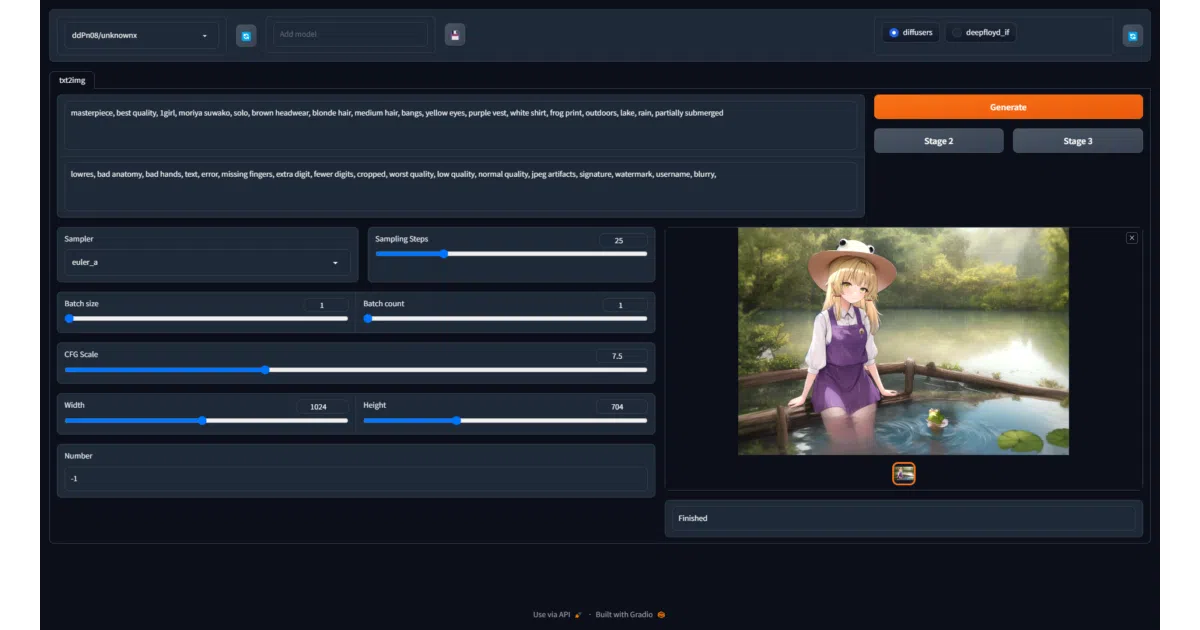
It gives the Hugging Face diffusers library a point-and-click web interface for local image generation, plus TensorRT acceleration and SDXL support.
Not currently ranked — collecting fresh signals.
star history
What it does
Radiata is a browser-based frontend for generating images with Stable Diffusion and Stable Diffusion XL. It wraps the Hugging Face diffusers library into a clickable interface, handling LoRA and Lycoris weights without forcing you to write PyTorch scripts. The README is thin on architecture details, but the feature list covers txt2img, optional TensorRT speedups, and a plugin hook for ControlNet.
The interesting bit
Radiata treats diffusers as its sole engine, which is the distinguishing feature in a crowded field of Stable Diffusion UIs. The README also claims TensorRT acceleration is available via a single --tensorrt flag, suggesting the project values inference speed without extra conversion boilerplate.
Key highlights
- Native support for both Stable Diffusion and SDXL pipelines
- TensorRT acceleration available via
--tensorrtflag - LoRA and Lycoris weight loading built in
- ControlNet support through an external plugin
- Runs locally on Windows and Linux with Python 3.10
Caveats
- The README has visible rough edges, including typos like “Stable Siffusion” and almost no explanation of how features are implemented.
- ControlNet requires installing a separate plugin instead of working out of the box.
- Python support is locked to version 3.10; the authors explicitly warn that other versions are unsupported.
Verdict
Try it if you want a lightweight web UI that treats diffusers as a first-class citizen. Skip it if you need extensive documentation, built-in ControlNet, or guaranteed support beyond Python 3.10.
Frequently asked
- What is ddPn08/Radiata?
- It gives the Hugging Face diffusers library a point-and-click web interface for local image generation, plus TensorRT acceleration and SDXL support.
- Is Radiata open source?
- Yes — ddPn08/Radiata is open source, released under the Apache-2.0 license.
- What language is Radiata written in?
- ddPn08/Radiata is primarily written in Python.
- How popular is Radiata?
- ddPn08/Radiata has 959 stars on GitHub.
- Where can I find Radiata?
- ddPn08/Radiata is on GitHub at https://github.com/ddPn08/Radiata.