datvodinh/rag-chatbot
A pragmatic experiment in chatting with PDFs locally
Query multiple PDFs from a local Gradio UI without committing to a single model provider.
Not currently ranked — collecting fresh signals.
star history
What it does
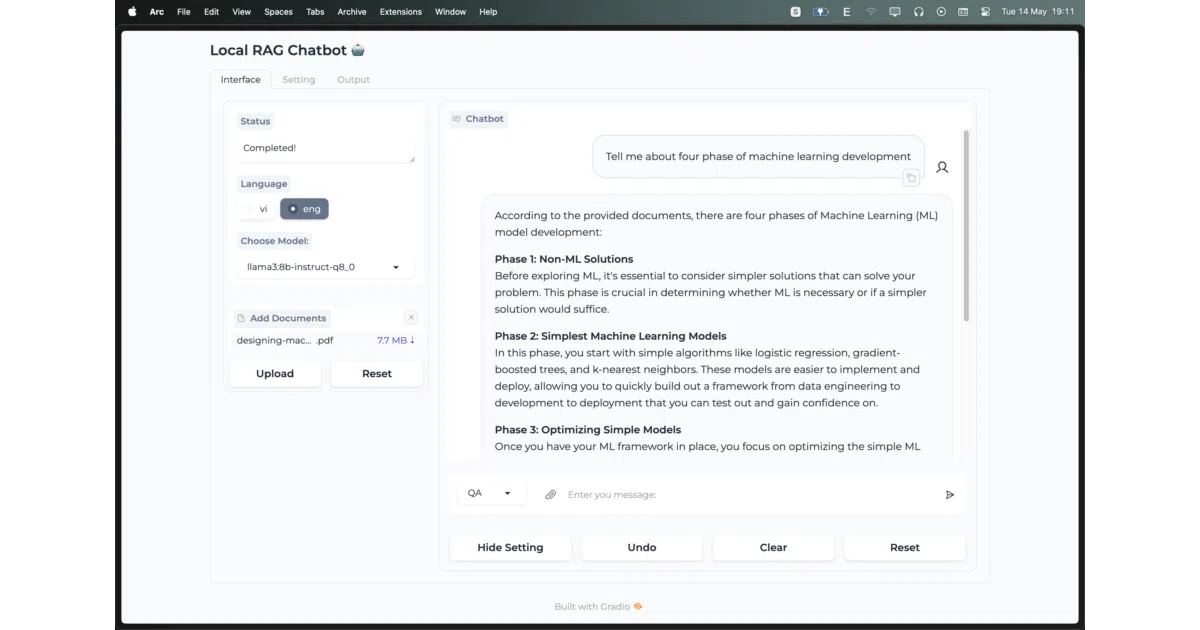
This is a retrieval-augmented generation chatbot that ingests multiple PDFs and answers questions based on their contents. It wraps the pipeline in a simple Gradio web interface and targets fully local execution via Ollama, with Hugging Face models available as an alternative backend. You can run it on your own machine or inside a Kaggle notebook tunneled through Ngrok.
The interesting bit
The README labels the whole thing an “experiment” in wiring together existing parts—document retrieval, local inference, and a lightweight UI—rather than claiming to invent new retrieval algorithms. That transparency is welcome; the project is essentially a pragmatic reference implementation for developers who want to see how the pipes fit without reading separate docs for each component.
Key highlights
- Runs fully offline through Ollama, with Hugging Face models as an alternative backend.
- Accepts multiple PDF inputs in a single session.
- Browser-based UI via Gradio.
- Kaggle notebook path for users who want to experiment before committing to a full local install.
- Multilingual chat is listed as a coming-soon feature.
Caveats
- Multilingual support is marked “Coming soon,” so the interface appears to be English-first for now.
- The README is heavy on setup scripts and environment provisioning, but light on architecture details; the RAG flow diagrams are shown without much explanation of what differentiates this specific pipeline.
- It is fundamentally glue code connecting a UI to local inference backends—useful, but not a novel framework.
Verdict
Worth a look if you need a quick, local PDF Q&A prototype and prefer to assemble proven components rather than build from scratch. Skip it if you are after rigorous citation accuracy or a mature multilingual pipeline.
Frequently asked
- What is datvodinh/rag-chatbot?
- Query multiple PDFs from a local Gradio UI without committing to a single model provider.
- Is rag-chatbot open source?
- Yes — datvodinh/rag-chatbot is open source, released under the Apache-2.0 license.
- What language is rag-chatbot written in?
- datvodinh/rag-chatbot is primarily written in Python.
- How popular is rag-chatbot?
- datvodinh/rag-chatbot has 689 stars on GitHub.
- Where can I find rag-chatbot?
- datvodinh/rag-chatbot is on GitHub at https://github.com/datvodinh/rag-chatbot.