cswry/SeeSR
Teaching Stable Diffusion to read before it upscales
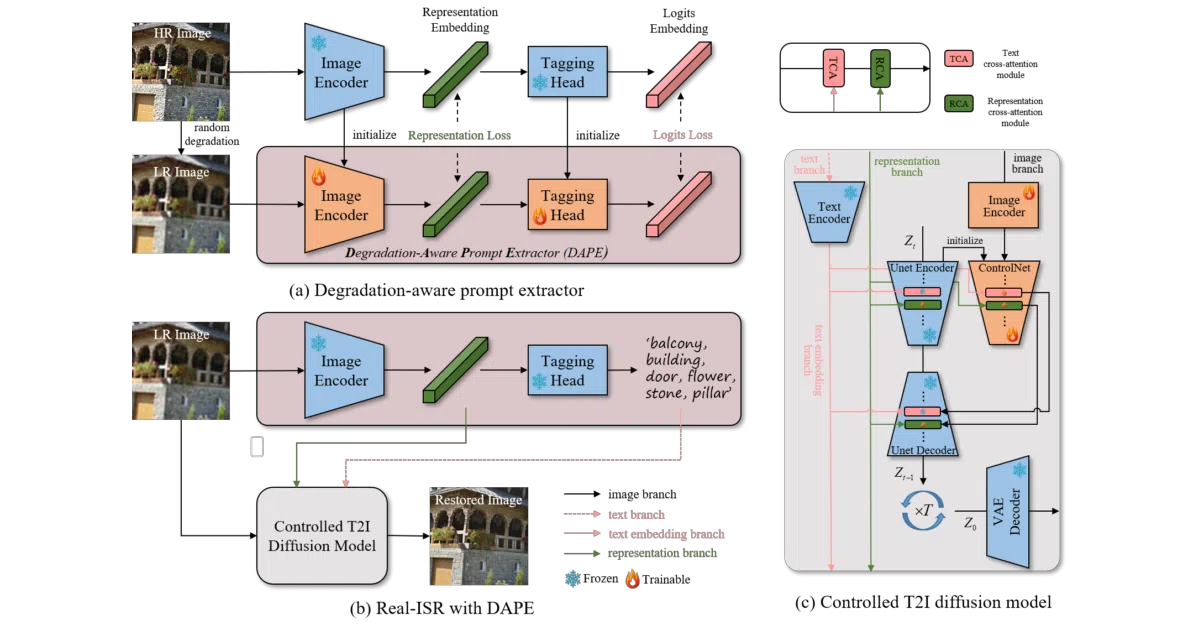
SeeSR uses an image recognition model to tag low-res inputs before upscaling, aiming to keep Stable Diffusion from inventing details on real-world photos.
Not currently ranked — collecting fresh signals.
star history
What it does SeeSR is a research pipeline for real-world image super-resolution that wraps Stable Diffusion 2-base around a semantic understanding layer. It leverages the RAM recognition model alongside a companion DAPE module to extract tags describing the low-resolution scene, then feeds those tags into the diffusion process as conditioning. The hope is that when the model hallucinates high-frequency detail, it at least hallucinates the right kind of detail for the objects actually present.
The interesting bit
Real-world super-resolution is harder than the synthetic benchmark game because actual photos contain complex, unknown degradations. SeeSR’s answer is to give the diffusion model a literal cheat sheet of recognized semantics before generation starts. If you are in a hurry, there is a turbo variant that swaps in sd-turbo and drops inference to two steps.
Key highlights
- Built on
diffusersand Stable Diffusion 2-base, with training code included - Ships with a Gradio demo and pretrained weights for inference
- Provides
RealLR200, a dataset of 200 real-world low-resolution test images - Uses tiled VAE decoding to keep memory usage manageable on large inputs
- The authors’ follow-up OSEDiff (NeurIPS 2024) reportedly hits similar quality at 30× the speed
Caveats
- The README is long on setup commands and short on quantitative results; no benchmarks or metrics are provided
- Requires juggling several external model checkpoints (SD 2-base, RAM, DAPE) and careful directory layout
- Active development has shifted to newer successors, so SeeSR reads more like a reproducible CVPR baseline than a maintained product
Verdict Grab it if you need a semantics-conditioned diffusion baseline for real-world upscaling research. Look elsewhere if you want a polished, one-click consumer tool.
Frequently asked
- What is cswry/SeeSR?
- SeeSR uses an image recognition model to tag low-res inputs before upscaling, aiming to keep Stable Diffusion from inventing details on real-world photos.
- Is SeeSR open source?
- Yes — cswry/SeeSR is open source, released under the Apache-2.0 license.
- What language is SeeSR written in?
- cswry/SeeSR is primarily written in Python.
- How popular is SeeSR?
- cswry/SeeSR has 658 stars on GitHub.
- Where can I find SeeSR?
- cswry/SeeSR is on GitHub at https://github.com/cswry/SeeSR.