context-labs/HALO
An optimizer that makes your agent eat its own telemetry
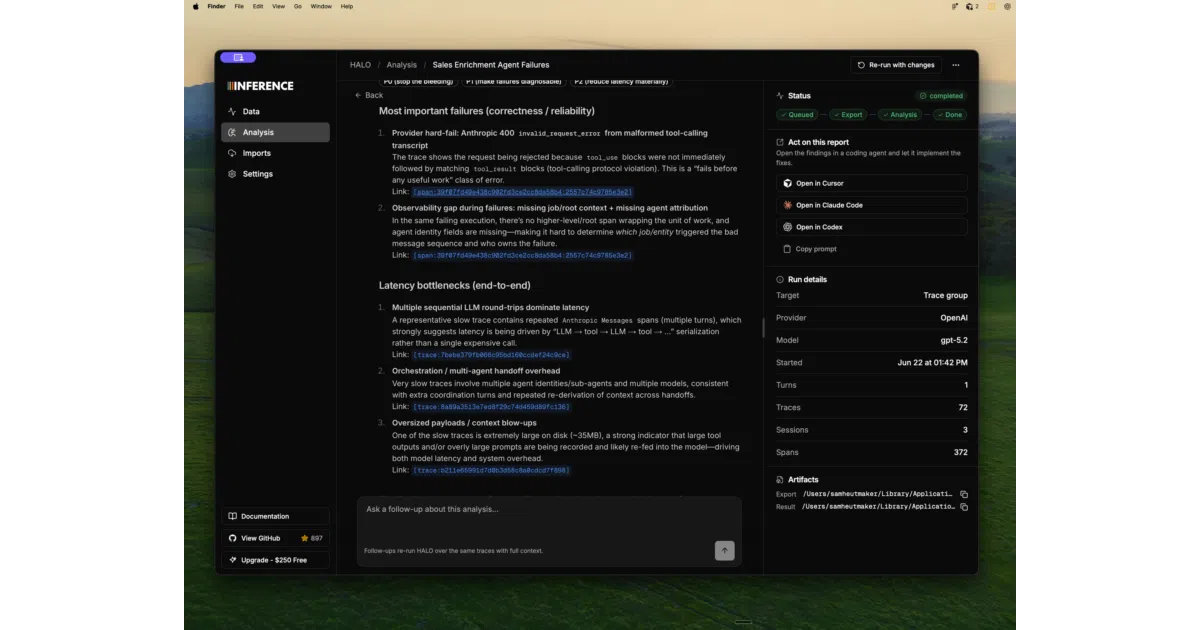
HALO recursively improves agent harnesses by analyzing production traces for systemic failures, then hands the diagnosis to coding agents like Cursor or Claude Code to apply fixes.
Not currently ranked — collecting fresh signals.
star history
What it does
HALO is a desktop app and Python engine that ingests OpenTelemetry-compatible execution traces from your agent harness. It decomposes them to find common failure modes, bottlenecks, and expensive spans, then emits a ranked report of findings. That report is fed into coding agents such as Cursor or Claude Code, which generate and apply harness fixes; the harness is redeployed, new traces are collected, and the cycle repeats.
The interesting bit
The authors built a specialized RLM to avoid the overfitting problem they observed when throwing raw traces at general-purpose coding agents—those tended to fix one-off errors instead of spotting harness-level systemic issues. The README repeatedly references RLMs but never defines the acronym or explains the underlying architecture, so the exact mechanics remain opaque despite the clear conceptual pitch.
Key highlights
- Ships as a signed desktop app for local trace visualization and as the
halo-enginePyPI package for headless CLI analysis. - Imports traces from Langfuse, Arize, JSONL, or local agents; supports any OpenAI-compatible provider via configurable base URLs.
- Uses tiered model selection: cheap models can handle synthesis and compaction while a stronger model runs root analysis, which keeps token costs down on large trace volumes.
- Includes demo integrations and benchmarking examples (though the README truncates before showing detailed results).
Caveats
- The README name-drops “RLM” and links to an external repository, but never actually defines the term or details how the specialized variant works.
- Benchmark and deep methodology sections are referenced but cut off in the provided source, so performance claims are hard to verify from the text alone.
Verdict
Worth a look if you are running agent harnesses in production and want a structured loop for turning telemetry into code changes. Skip it if you are looking for a fully explained, standalone research paper—this is clearly a product-oriented repo with methodology left mostly to external links.
Frequently asked
- What is context-labs/HALO?
- HALO recursively improves agent harnesses by analyzing production traces for systemic failures, then hands the diagnosis to coding agents like Cursor or Claude Code to apply fixes.
- Is HALO open source?
- Yes — context-labs/HALO is an open-source project tracked on heatdrop.
- What language is HALO written in?
- context-labs/HALO is primarily written in TypeScript.
- How popular is HALO?
- context-labs/HALO has 1.1k stars on GitHub.
- Where can I find HALO?
- context-labs/HALO is on GitHub at https://github.com/context-labs/HALO.