chu0119/Pojun
An autonomous pentest agent that refuses to call a job done until it can prove it
Pojun turns a one-line target into a deliverable vulnerability report, with evidence gates and honest "not finished" labels instead of model self-assessment.
Too new to rank. Velocity needs a few days of history.
not enough history yet
star history
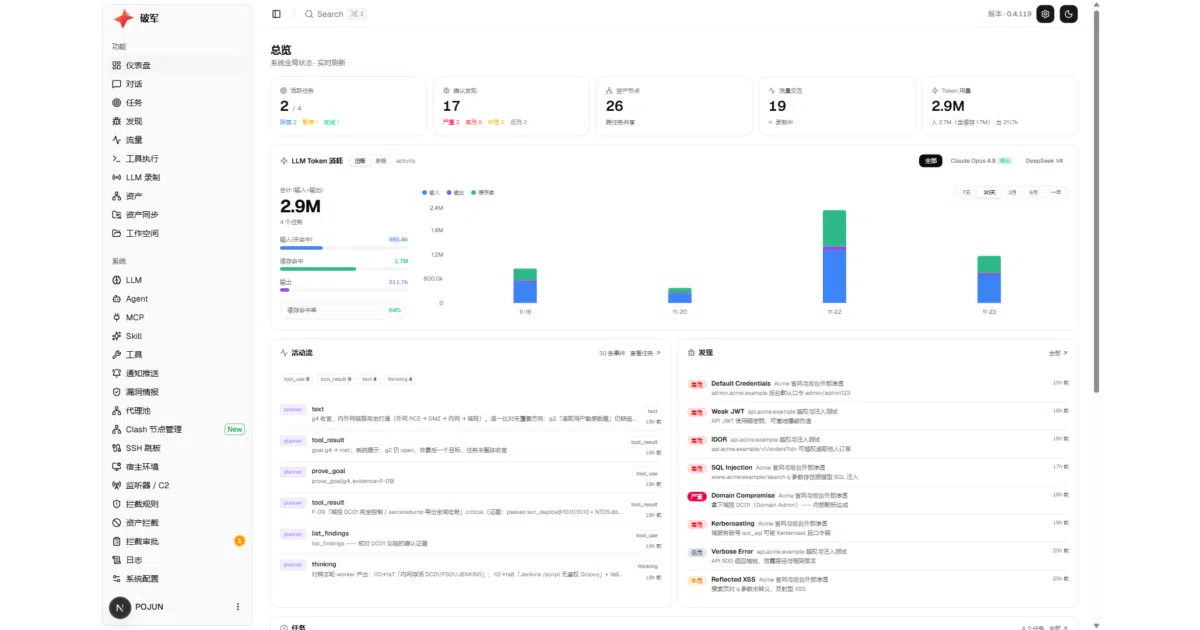
What it does: Pojun (破军) is a Go monolith with an embedded Next.js frontend and PostgreSQL, running multi-agent autonomous penetration testing. You give it a one-sentence target plus an authorized scope, and its planner, frontier and worker agents decompose the goal, run tools, chain follow-up attacks after confirmed high/critical findings, and produce Word or Markdown reports with reproducible evidence. It covers far more than web scanning: WeChat mini-programs, APK reversing, source/JS/OpenAPI contracts, cloud/K8s, Active Directory, 15 middleware protocols, wireless, and smart contracts, each with its own skill and toolchain.
The interesting bit: The whole design pushes back on the “AI plus scanner” pattern. A task only lands in done when every goal passes a goal_met gate; otherwise it is honestly marked as timeout. Findings are graded by evidence class (baseline / proof / verification / supporting), and critical/high findings must be mechanically reproducible. Scope enforcement lives in code as native HTTP hard constraints, with a read-only egress receipt per task recording proxies, captures and user agents.
Key highlights
- Multi-channel LLM polling with circuit breaking, role routing, budget gates and tool-routing learning across Anthropic, OpenAI and compatible endpoints.
- Three-layer context (Index / Summary / Raw) with compression and a value watchdog for long tasks.
- 24 skills, 10 MCP servers, 92 tools, 5 playbooks, all configurable in the UI.
- Egress infrastructure: proxy pools, Clash/mihomo, SSH jump hosts, C2 in three forms.
- Quality loop of 20 built-in evaluation scenarios plus a deterministic finding regression library; the authors report 295 confirmed vulnerabilities across 12 unattended real authorized tasks.
Caveats
- The headline benchmark numbers come from the authors’ own authorized engagements, not an independent evaluation.
- Console binds to localhost by default; remote use requires a tunnel or an explicit listen change plus your own firewalling.
- AGPL-3.0 licensed, worth checking against your org’s policy before embedding.
Verdict: Red teamers and pentest teams doing authorized work who are tired of agents that hallucinate findings will find the evidence-first discipline refreshing. Anyone wanting a one-click “pwn everything” button should look elsewhere, by the project’s own admission.
Frequently asked
- What is chu0119/Pojun?
- Pojun turns a one-line target into a deliverable vulnerability report, with evidence gates and honest "not finished" labels instead of model self-assessment.
- Is Pojun open source?
- Yes — chu0119/Pojun is open source, released under the AGPL-3.0 license.
- What language is Pojun written in?
- chu0119/Pojun is primarily written in Go.
- How popular is Pojun?
- chu0119/Pojun has 520 stars on GitHub.
- Where can I find Pojun?
- chu0119/Pojun is on GitHub at https://github.com/chu0119/Pojun.