chrisworsey55/atlas-gic
Trading bots that rewrite their own prompts when they lose money
An open-core framework where LLM agents evolve through market feedback, git-committed survival, and simulated futures.
Not currently ranked — collecting fresh signals.
star history
What it does
ATLAS is a multi-agent trading system where 25+ LLM agents debate markets across four layers — macro, sector, “superinvestor” personas, and a final decision layer — then improve themselves based on real outcomes. The worst performer by rolling Sharpe gets its prompt rewritten; if results improve, the change survives via git commit, otherwise git revert. The authors claim it runs live with real capital and has spawned new specialist agents autonomously when it detects knowledge gaps.
The interesting bit
The project treats prompts as weights and Sharpe ratio as loss function, running on a $20/month Azure VM instead of GPUs. More unusually, it trains separate agent cohorts on distinct historical regimes (bull, COVID crash, rate tightening, euphoria), then lets a meta-layer called JANUS weight them by recent accuracy — which emergently detects whether current markets match historical patterns or something novel. The README also claims the system independently discovered its own CIO agent was its weakest component and downweighted it before humans noticed.
Key highlights
- Darwinian prompt evolution: 54 prompt modifications attempted over 18 months, 30% survived, 70% reverted
- Autonomous agent spawning: grew from 25 to 31 agents during a 6-month test, 3 went “extinct”
- Regime-specific training (PRISM): same starting prompts evolved completely different survival strategies in different markets
- MiroFish integration: runs overnight swarm simulations with thousands of synthetic agents to train on hypothetical futures
- Soros reflexivity engine: models feedback loops like price → fundamentals and narrative → flows
- What’s actually in the repo: framework architecture, design docs, backtest results, placeholder prompts — not the trained prompts, which are held as proprietary IP
Caveats
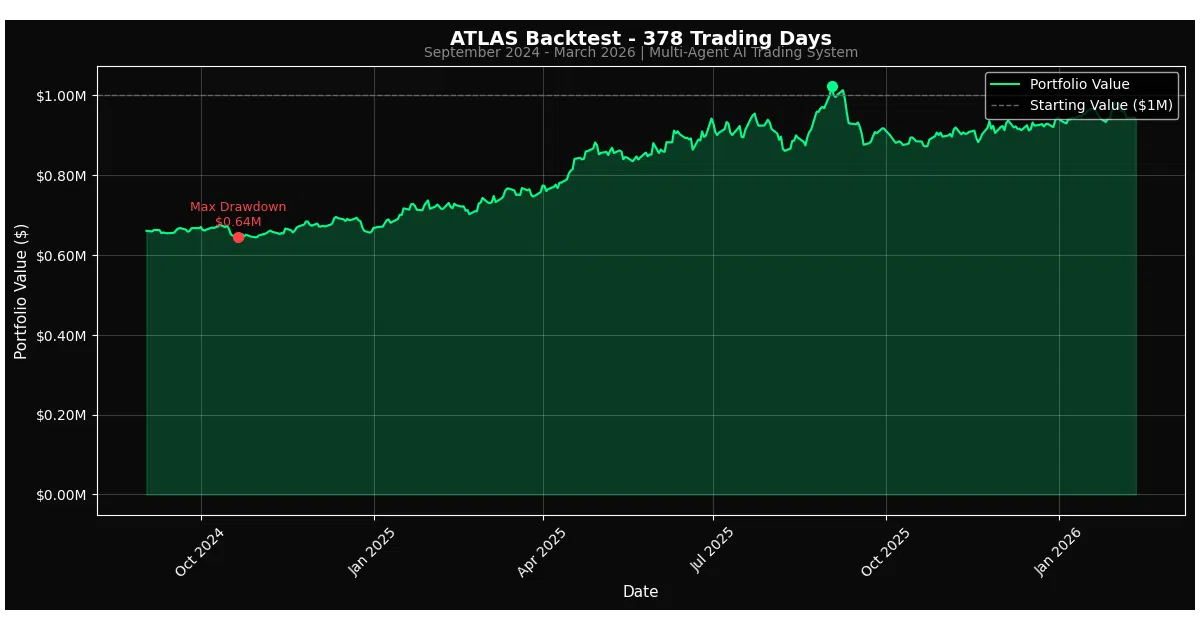
- The backtest period is listed as “September 2024 - March 2026” (378 trading days), which is a future date range; this appears to be a typo or placeholder, but the README presents it as completed results
- The “up 30% since launch” and “60% win rate” claims for the live platform lack verifiable detail or third-party confirmation
- The repo contains framework and methodology, not runnable trained agents — the actual prompts are explicitly excluded as “core IP”
- Several performance metrics (22% return in 173 days, AVGO +128%) are presented without risk-adjusted context beyond the Sharpe-based selection process
Verdict
Worth studying if you’re building agent orchestration systems, evolutionary LLM pipelines, or regime-aware trading infrastructure. Not useful if you want to clone a working money-printing bot — the trained weights are private and the open-core release is essentially a detailed recipe without the secret sauce.
Frequently asked
- What is chrisworsey55/atlas-gic?
- An open-core framework where LLM agents evolve through market feedback, git-committed survival, and simulated futures.
- Is atlas-gic open source?
- Yes — chrisworsey55/atlas-gic is an open-source project tracked on heatdrop.
- What language is atlas-gic written in?
- chrisworsey55/atlas-gic is primarily written in Python.
- How popular is atlas-gic?
- chrisworsey55/atlas-gic has 2.3k stars on GitHub.
- Where can I find atlas-gic?
- chrisworsey55/atlas-gic is on GitHub at https://github.com/chrisworsey55/atlas-gic.