chainloop-dev/chainloop
Chainloop: a bouncer for your AI coding agents
Signed, tamper-proof records of what your agents and pipelines actually did, checked against policies in git — with the loop closed in CI/CD.
Not currently ranked.
star history
What it does
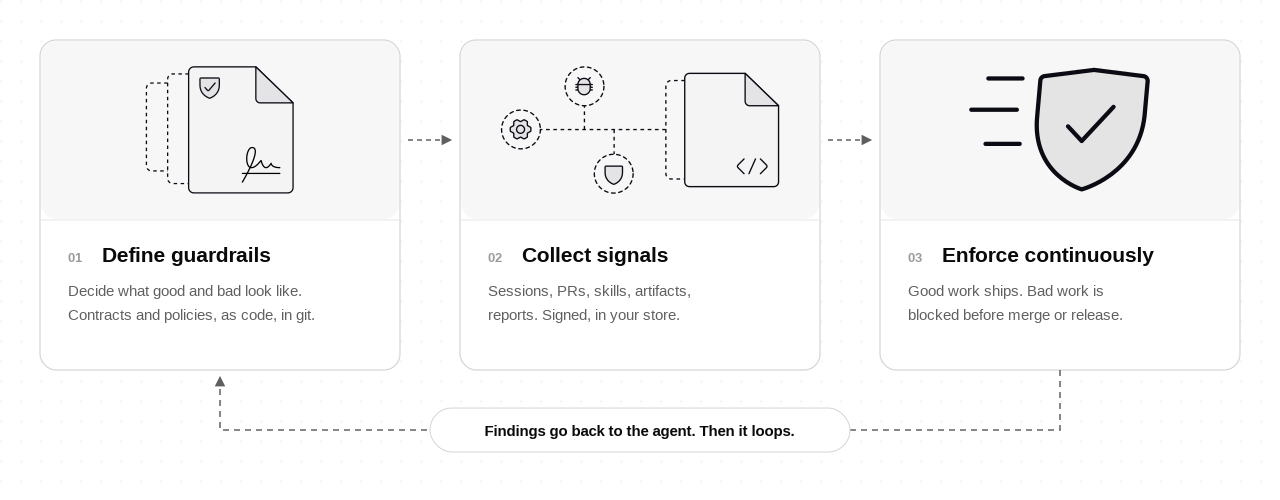
Chainloop turns every AI coding session, build, SBOM, scan, and test report into a signed, timestamped in-toto attestation stored in your own OCI registry, S3, or Azure Blob. A “contract” (YAML) declares what each run must hand in; policies written in Rego or WASM declare what those records must satisfy. If a gated rule breaks, the pipeline fails and prints every violation — where the agent that opened the PR can read it and try again.
The interesting bit
The verifier lives outside the agent. A self-check written by the agent, running inside the agent’s process, can be gamed — Chainloop runs the gate in CI/CD, on signed evidence the agent can’t edit, with any bypass recorded in the attestation itself. The same contract gates a Claude Code session and a Jenkins job, so there’s no separate “AI governance” track.
Key highlights
- Policies are code, not prompts: deterministic Rego/WASM, testable locally before they gate anything
chainloop traceattests the ticket or plan an agent worked from, next to the session itself- Report-only mode (
gate: false) lets you roll rules out without breaking pushes on day one - Ships with example policies: SBOM presence, banned licenses, SBOM freshness, Trivy vulns, SARIF errors
- Built on Sigstore and in-toto; evidence is verifiable with standard tools — audit material falls out of enforcement for free
Caveats
- The CLI sends records to Chainloop Cloud by default and phones home with anonymous usage stats (
DO_NOT_TRACK=1disables it); self-hosting is free but you’ll want to check what the hosted tier gates - PR merge blocking and the AI Session Score are Platform features, not the OSS core
Verdict
Worth a look if AI agents now write code you ship and you want enforcement that isn’t a prompt. If your pipeline is three shell scripts and no compliance obligations, this is machinery you don’t need yet.
Frequently asked
- What is chainloop-dev/chainloop?
- Signed, tamper-proof records of what your agents and pipelines actually did, checked against policies in git — with the loop closed in CI/CD.
- Is chainloop open source?
- Yes — chainloop-dev/chainloop is open source, released under the Apache-2.0 license.
- What language is chainloop written in?
- chainloop-dev/chainloop is primarily written in Go.
- How popular is chainloop?
- chainloop-dev/chainloop has 615 stars on GitHub.
- Where can I find chainloop?
- chainloop-dev/chainloop is on GitHub at https://github.com/chainloop-dev/chainloop.