chainer/chainer-chemistry
Deep learning for molecules, back when Chainer was a thing
A now-maintenance-mode library that bundled a dozen graph neural network architectures for chemistry and biology researchers.
Not currently ranked — collecting fresh signals.
star history
What it does
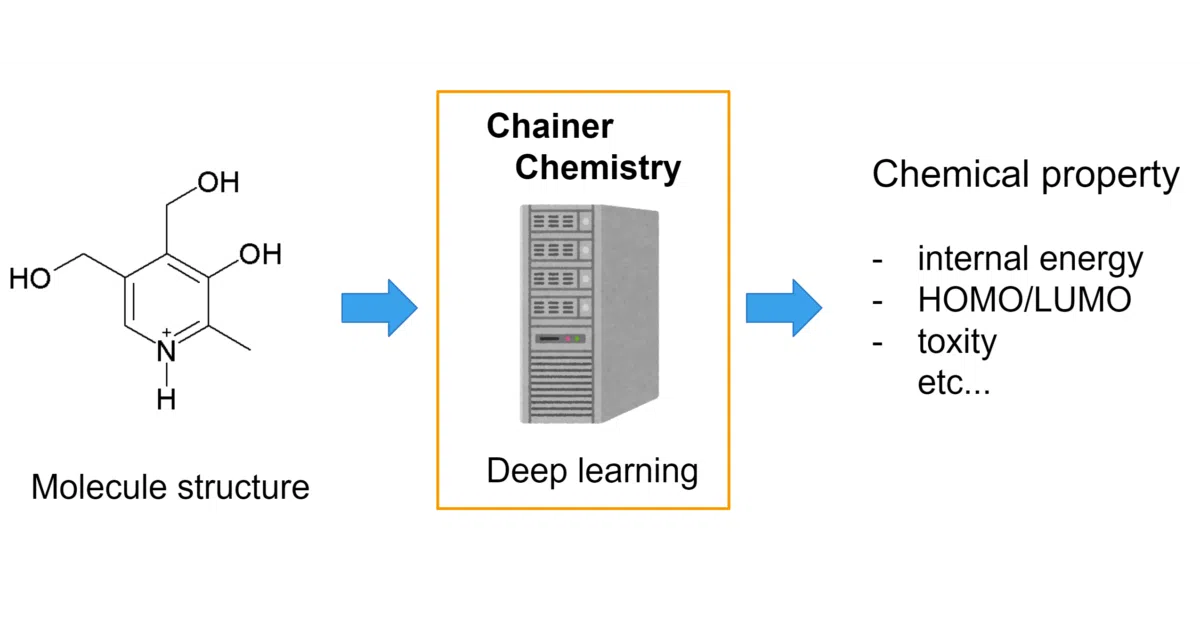
Chainer Chemistry is a Python toolkit for training graph neural networks on molecular data. It wraps implementations of NFP, GGNN, SchNet, GAT, GIN, MPNN, and several other GNN variants, plus loaders for standard chemistry benchmarks like QM9, Tox21, and MoleculeNet. The pitch: feed it a molecule, get a property prediction.
The interesting bit
The library sits at an awkward historical intersection. It was built on Chainer—once PyTorch’s Japanese rival, now itself in maintenance mode—and the README explicitly warns that “further development will be limited to only serious bug-fixes and maintenance.” The footnotes are a miniature archaeology of a framework’s decline: Python 2 support dropped, ChainerX migration breaking compatibility, pinned RDKit versions from 2017.
Key highlights
- Bundles 13+ GNN architectures including newer additions like MEGNet and CGCNN for materials science
- Supports the Graph Warp Module (GWM), an auxiliary module for boosting GNN power
- Includes Weisfeiler-Lehman Embedding preprocessing for molecular graphs
- Has been used in published research projects including molecular graph generation with normalizing flows
- Requires manual RDKit installation; dependency matrix shows tight version coupling with Chainer releases
Caveats
- Active development has ceased; the project is in maintenance-only mode
- Chainer itself is no longer actively developed, making this a dependency on a deprecated framework
- The README states it “cannot guarantee the reproducibility of any results published in papers”
Verdict
Worth studying if you’re surveying historical GNN implementations or maintaining legacy Chainer-based research code. Everyone else should look to PyTorch Geometric, DGL, or Hugging Face’s chemistry tools for active development and modern performance.
Frequently asked
- What is chainer/chainer-chemistry?
- A now-maintenance-mode library that bundled a dozen graph neural network architectures for chemistry and biology researchers.
- Is chainer-chemistry open source?
- Yes — chainer/chainer-chemistry is open source, released under the MIT license.
- What language is chainer-chemistry written in?
- chainer/chainer-chemistry is primarily written in Python.
- How popular is chainer-chemistry?
- chainer/chainer-chemistry has 710 stars on GitHub.
- Where can I find chainer-chemistry?
- chainer/chainer-chemistry is on GitHub at https://github.com/chainer/chainer-chemistry.