cft0808/edict
If AI Agents Were a Tang Dynasty Court
It bolts Tang Dynasty bureaucracy onto OpenClaw so your agents can’t execute a plan until a dedicated censor approves it.
Not currently ranked — collecting fresh signals.
star history
What it does
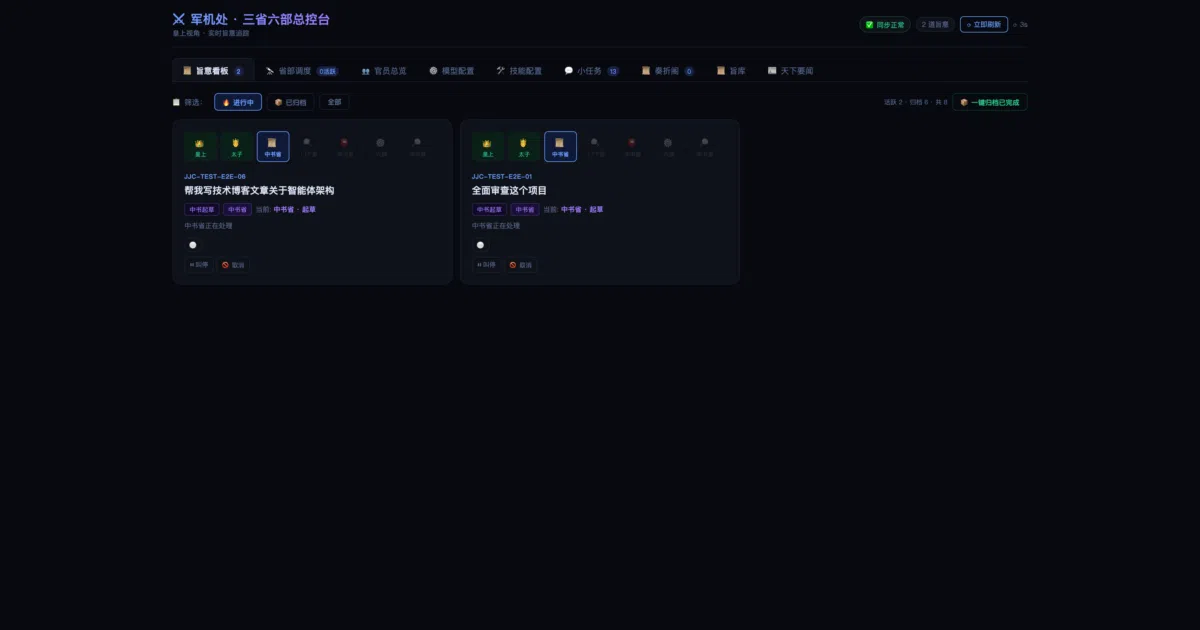
Edict is an orchestration layer for OpenClaw that routes user tasks through twelve specialized agents arranged as an imperial bureaucracy. Requests flow from intake through planning, a mandatory review stage that can reject and return work, dispatch, and finally parallel execution by specialized ministries. A bundled React dashboard tracks the entire lifecycle, including health, token usage, and state transitions.
The interesting bit
The core mechanism is the review gate: every plan must pass a dedicated auditing agent before execution, and the auditor can send flawed plans back for rework. The README compares this to engineers shipping code without QA, emphasizing that the audit is architecturally mandatory rather than an optional plugin.
Key highlights
- Mandatory audit gate: a dedicated agent reviews all plans before dispatch; rejected tasks loop back until they pass.
- Real-time “war room” dashboard with Kanban boards, health heartbeats, live session monitoring, and one-click model switching per agent.
- Strict state machine:
kanban_update.pyenforces legal task transitions and rejects invalid jumps. - Full archival audit trail (“memorials”) documenting the five-stage flow from decree to final report.
- Per-agent workspaces, skill registries, and independent LLM configurations.
Caveats
- Requires OpenClaw as a hard dependency; it is governance and visualization glue on top of that framework, not a standalone agent system.
- The imperial metaphor is pervasive and deeply embedded in the codebase and UI, which may delight or confuse depending on your tolerance for historical roleplay.
- First-time setup requires manually configuring an API key for the initial agent before the install script can synchronize the remaining eleven.
Verdict
Worth a look if you are already running OpenClaw and want observable, interruptible agent workflows with forced plan validation. Skip it if you need a framework-agnostic solution or find historical metaphors in your infrastructure alarming.
Frequently asked
- What is cft0808/edict?
- It bolts Tang Dynasty bureaucracy onto OpenClaw so your agents can’t execute a plan until a dedicated censor approves it.
- Is edict open source?
- Yes — cft0808/edict is open source, released under the MIT license.
- What language is edict written in?
- cft0808/edict is primarily written in Python.
- How popular is edict?
- cft0808/edict has 17k stars on GitHub.
- Where can I find edict?
- cft0808/edict is on GitHub at https://github.com/cft0808/edict.