camel-ai/owl
A multi-agent framework that ranks #1 on GAIA
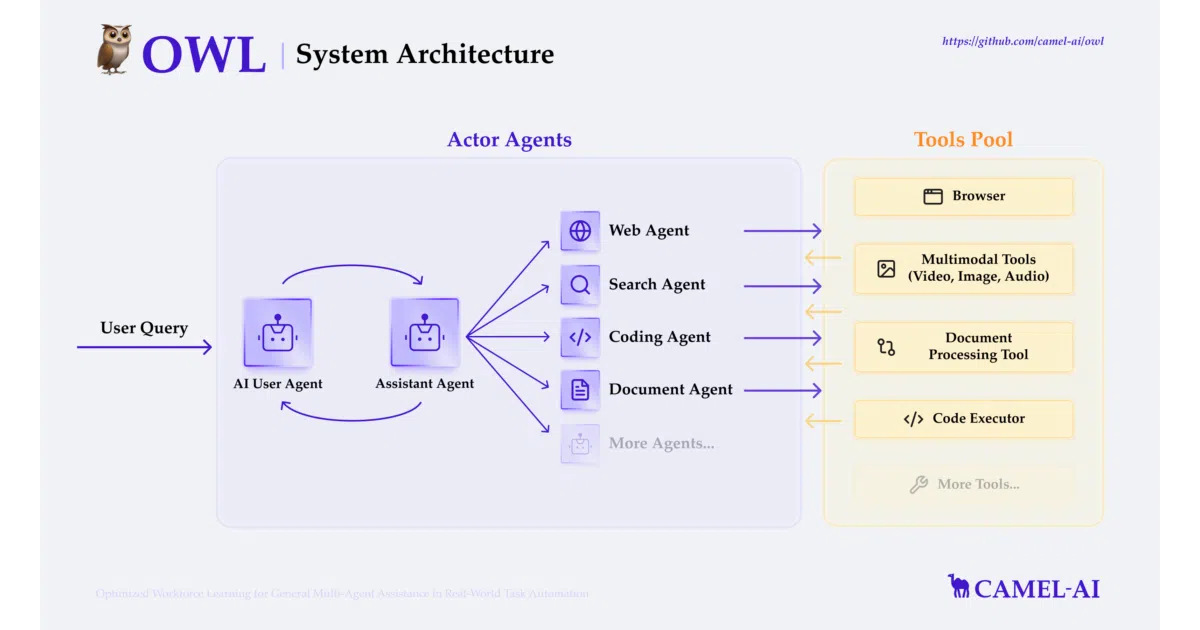
OWL orchestrates multiple AI agents to tackle real-world tasks by handing them browsers, file parsers, and code interpreters.
Not currently ranked — collecting fresh signals.
star history
What it does
OWL is a multi-agent collaboration framework built on CAMEL-AI. It breaks complex jobs into sub-tasks and delegates them to specialized agents equipped with toolkits for web browsing, document parsing, code execution, and multimodal analysis. The system is designed to handle end-to-end automation workflows that single models typically botch because they lack external tool access or persistent state.
The interesting bit
The framework treats browser automation as a first-class citizen via Playwright, letting agents scroll, click, and download rather than just hallucinating web content. It also implements the Model Context Protocol (MCP) as a universal adapter layer, which means new tools and data sources can be wired in without rewriting agent logic. The authors claim a 69.09% average score on the GAIA benchmark, ranking it #1 among open-source frameworks at the time of writing.
Key highlights
- Claims a 69.09% score and #1 rank among open-source frameworks on the GAIA benchmark.
- Ships with over 20 built-in toolkits covering search, maps, GitHub, Notion, arXiv, and office document parsing.
- Supports multimodal inputs: local or remote video, image, and audio analysis.
- Includes a web-based UI and a dedicated branch (
gaia58.18) with a stabilized toolkit set specifically for benchmark reproduction. - Integrates MCP (Model Context Protocol) to standardize how models talk to external tools and data sources.
Caveats
- The GAIA-optimized toolkit set lives on a separate branch (
gaia58.18), implying the default CAMEL dependency may not be benchmark-hardened. - MCP and browser automation require external runtimes (Node.js, Playwright), so the “batteries included” surface comes with a tangle of prerequisites.
Verdict
Worth a look if you are building autonomous research assistants or back-office automation that needs to read PDFs, search the web, and write code in a single session. Skip it if you want a lightweight, single-purpose agent; this is a heavy, kitchen-sink framework that thrives on complexity.
Frequently asked
- What is camel-ai/owl?
- OWL orchestrates multiple AI agents to tackle real-world tasks by handing them browsers, file parsers, and code interpreters.
- Is owl open source?
- Yes — camel-ai/owl is an open-source project tracked on heatdrop.
- What language is owl written in?
- camel-ai/owl is primarily written in Python.
- How popular is owl?
- camel-ai/owl has 20.2k stars on GitHub.
- Where can I find owl?
- camel-ai/owl is on GitHub at https://github.com/camel-ai/owl.