camel-ai/oasis
A million LLM agents, one synthetic social network
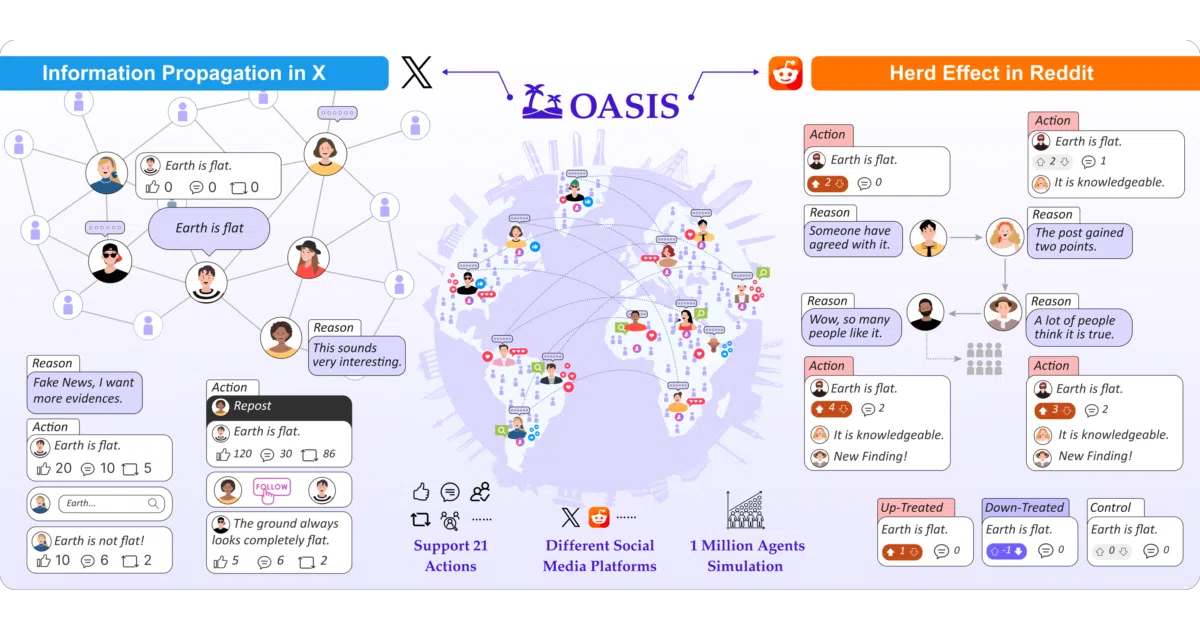
It models viral dynamics and group polarization by letting up to a million LLM agents loose on synthetic Twitter and Reddit feeds.
Velocity · 7d
+23
★ / day
Trend
↗accelerating
star history
What it does
OASIS is a social media simulator that turns large language models into platform users. Researchers can spawn agents on Twitter- or Reddit-like environments to observe emergent phenomena such as information cascades, group polarization, and herd behavior. It handles the full stack: agent profiles, social graphs, content generation, and platform-specific recommendation feeds.
The interesting bit
Instead of scripting crowd behavior, OASIS lets algorithmic feedback do the work. Agents choose from 23 actions—follow, mute, repost, search, create_post—while built-in interest-based and hot-score recommendation algorithms shape what they see next. The project also publishes surprisingly frank token-consumption and Yuan-cost tables for Qwen, which is a rare dose of financial realism in agent-framework READMEs.
Key highlights
- Claims architectural support for one million agents, with environments mimicking Twitter and Reddit dynamics.
- Agents draw from a palette of 23 actions, including social (
follow,mute), content (create_post,create_comment), and discovery (search,trend,refresh). - Includes recommendation algorithms (interest-based and hot-score-based) that drive content discovery rather than leaving it to chance.
- Provides token and cost benchmarks for 100 to 10,000-agent runs using Qwen models, making API burn predictable.
- Recent refactor adopts a PettingZoo-style interface and allows per-agent customization of models, tools, and system prompts.
Caveats
- The “one million agents” figure is a scalability target, but the README only supplies concrete token and cost data for up to 10,000 agents, leaving the price tag of full-scale runs unstated.
- All documented benchmarks assume external cloud LLM APIs (OpenAI, Qwen), meaning simulation costs scale directly with every agent action.
- The quickstart examples and current API surface are heavily centered on Reddit, making the maturity and feature parity of the Twitter/X platform mode less obvious.
Verdict
Social scientists, misinformation researchers, and recommendation-system engineers should bookmark this. Skip it if you are looking for cheap chatbot automation or a lightweight offline sandbox.
Frequently asked
- What is camel-ai/oasis?
- It models viral dynamics and group polarization by letting up to a million LLM agents loose on synthetic Twitter and Reddit feeds.
- Is oasis open source?
- Yes — camel-ai/oasis is open source, released under the Apache-2.0 license.
- What language is oasis written in?
- camel-ai/oasis is primarily written in Python.
- How popular is oasis?
- camel-ai/oasis has 5.3k stars on GitHub and is currently accelerating.
- Where can I find oasis?
- camel-ai/oasis is on GitHub at https://github.com/camel-ai/oasis.