calesthio/Crucix
A self-hosted Jarvis for the paranoid and the curious
Aggregates 27 open-source intelligence feeds into a single local dashboard, then optionally pipes them through an LLM to bark alerts at your phone.
Velocity · 7d
+1.6
★ / day
Trend
↘cooling
star history
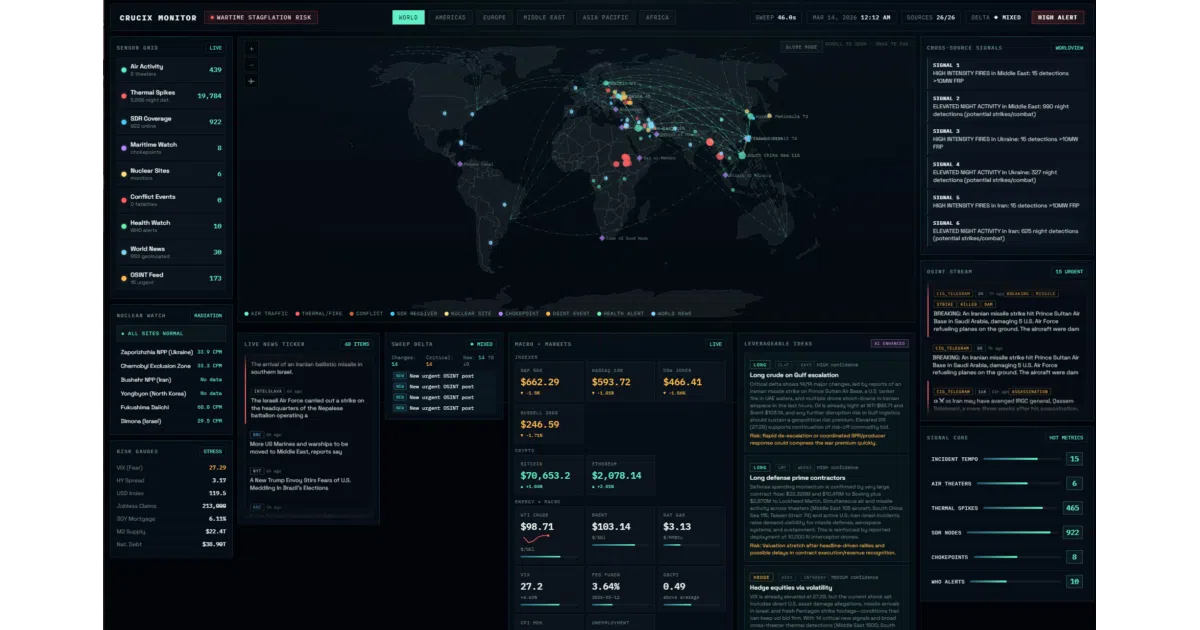
What it does Crucix is a Node.js server that polls 27 public data sources — satellite fire detection, radiation levels, flight tracking, conflict events, economic indicators, market prices — every 15 minutes. It renders everything on a browser dashboard with a 3D globe, flat map, news ticker, and risk gauges. Add API keys for Telegram or Discord and it pushes tiered alerts (FLASH / PRIORITY / ROUTINE) when signals change. Add an LLM and it will chat back, generate trade ideas, and classify alerts with cross-domain correlation.
The interesting bit The “sweep delta” panel: instead of drowning you in raw feeds, Crucix computes what actually changed since the last run — escalations, de-escalations, new signals — and surfaces only the diff. That turns a firehose of OSINT into something you can scan in seconds. The LLM layer is optional and gracefully degrades to rule-based alerting if your API key expires or the provider is down.
Key highlights
- Single dependency: Express. Everything else is native Node.js 22+ (fetch, ESM, top-level await).
- 3D WebGL globe with flight corridor arcs, plus a “VISUALS LITE” mode that strips animations for mobile or low-end hardware.
- Two-way Telegram and Discord bots:
/brief,/sweep,/status, plus portfolio tracking if you wire in Alpaca. - Docker-ready with volume-mounted persistence in
./runs/. - AGPL v3. No cloud, no telemetry, no subscription. The README includes a token scam warning, which is either admirable transparency or a sign of a community that needed the reminder.
Caveats
- The dashboard is empty for 30–60 seconds on first load while the initial sweep runs; the README admits this and suggests patience.
npm run devcan fail silently on Windows PowerShell; the workaround is runningnode --trace-warnings server.mjsdirectly or using a diagnostic script.- Three API keys (FRED, NASA FIRMS, EIA) are labeled “required for best results” — not strictly mandatory, but the economic and satellite data is significantly degraded without them.
Verdict Worth a spin if you are an OSINT hobbyist, a trader who distrusts SaaS dashboards, or a journalist who wants to self-host a world-monitoring stack. Skip it if you need enterprise SLAs, collaborative editing, or anything that isn’t fundamentally “read-only monitoring with chatbot garnish.”
Frequently asked
- What is calesthio/Crucix?
- Aggregates 27 open-source intelligence feeds into a single local dashboard, then optionally pipes them through an LLM to bark alerts at your phone.
- Is Crucix open source?
- Yes — calesthio/Crucix is open source, released under the AGPL-3.0 license.
- What language is Crucix written in?
- calesthio/Crucix is primarily written in JavaScript.
- How popular is Crucix?
- calesthio/Crucix has 12.1k stars on GitHub and is currently cooling off.
- Where can I find Crucix?
- calesthio/Crucix is on GitHub at https://github.com/calesthio/Crucix.