caiyuanhao1998/RSN
Winning pose estimation by keeping features local
RSN won the COCO 2019 keypoint challenge by aggregating same-scale features to preserve the low-level spatial information that precise joint localization demands.
Not currently ranked — collecting fresh signals.
star history
What it does
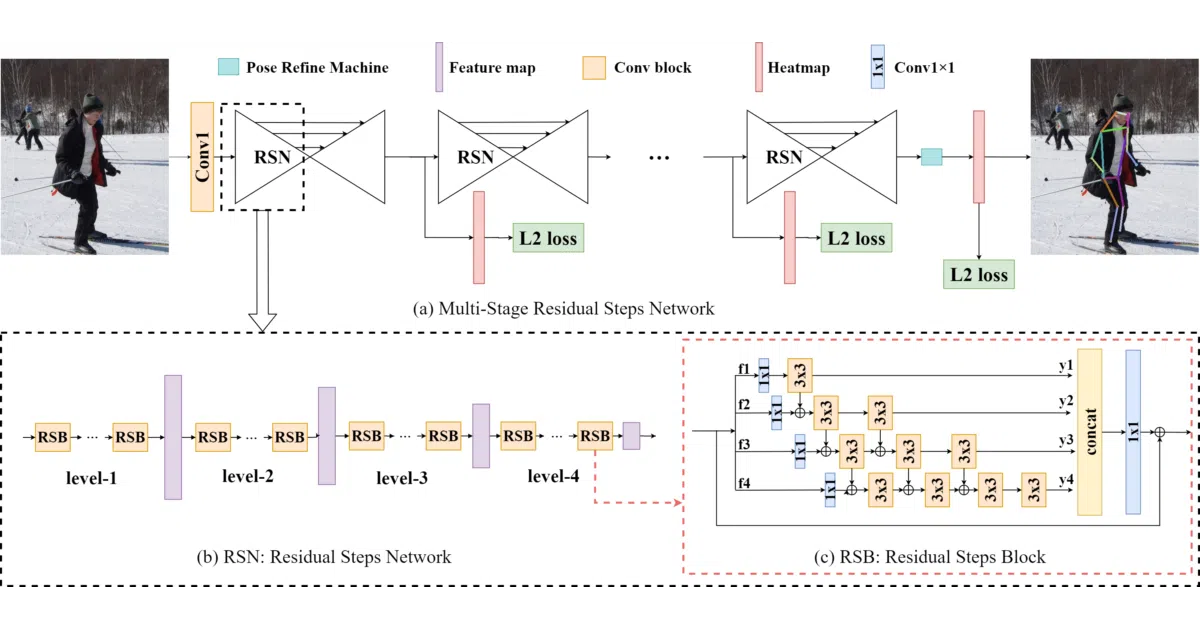
RSN is a PyTorch implementation of the multi-person pose estimator that won the COCO 2019 Keypoint Challenge and the COCO 2019 Best Paper Award. It locates human keypoints by preserving fine-grained spatial details rather than compressing them through repeated downsampling, and adds a Pose Refine Machine—an attention module—to sharpen joint coordinates.
The interesting bit
Instead of the classic pyramid that mixes features across wildly different resolutions, RSN aggregates “intra-level” features at the same spatial size. The authors argue that delicate local representations—rich in low-level texture—are what let the model place elbows, wrists, and ankles exactly where they belong.
Key highlights
- Took 1st place in the COCO 2019 Human Keypoint Detection Challenge and won the COCO 2019 Best Paper Award.
- Scored 78.6 AP on COCO test-dev with a single model, and 79.2 AP with an ensemble; also hits 93.0 mean accuracy on MPII test.
- Achieved these results without extra training data or pretrained backbones.
- The architecture has been upstreamed into the OpenMMLab
MMPoseframework. - The authors note their original experiments ran on an internal deep-learning platform, so this PyTorch reimplementation produces slightly different metrics.
Caveats
- The README explicitly warns that the PyTorch version’s numbers diverge from the paper because the original work used a custom DL platform.
- All models were trained on 8 V100 GPUs, so reproducing results demands serious hardware.
Verdict
A strong reference if you are researching keypoint architectures or spatial feature design; for production use, the authors themselves now direct users to the MMPose integration instead of this standalone repo.
Frequently asked
- What is caiyuanhao1998/RSN?
- RSN won the COCO 2019 keypoint challenge by aggregating same-scale features to preserve the low-level spatial information that precise joint localization demands.
- Is RSN open source?
- Yes — caiyuanhao1998/RSN is open source, released under the MIT license.
- What language is RSN written in?
- caiyuanhao1998/RSN is primarily written in Python.
- How popular is RSN?
- caiyuanhao1998/RSN has 503 stars on GitHub.
- Where can I find RSN?
- caiyuanhao1998/RSN is on GitHub at https://github.com/caiyuanhao1998/RSN.