bugbasesecurity/pentest-copilot
It connects to Kali and breaks things on purpose
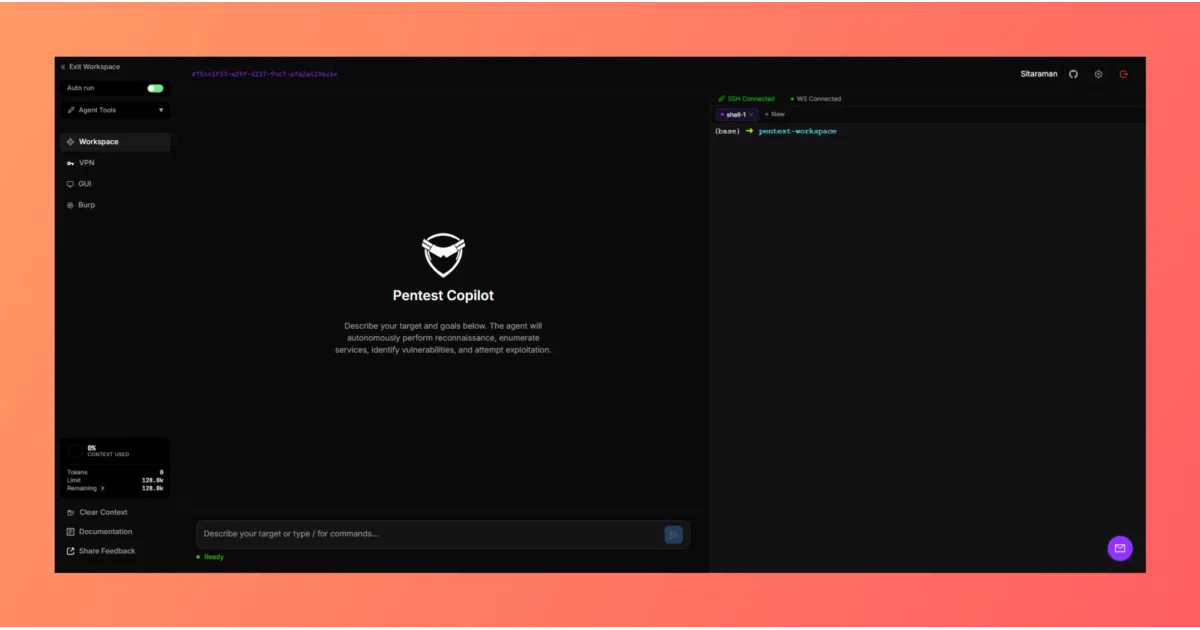
Pentest Copilot hands your Kali attack box to an AI agent so you can focus on exploitation rather than terminal babysitting.
Not currently ranked — collecting fresh signals.
star history
What it does Pentest Copilot is a browser-based AI agent that autonomously runs penetration tests through a linked Kali Linux instance. You define the target; the system selects tools from a curated registry of over 100 capabilities, executes commands, reads the output, and decides on the next step for up to 25 iterations per turn. It is designed for real-world engagements, boot-to-root challenges, and CTFs, with integrations for Burp Suite, browser automation, and VPN management built into the loop.
The interesting bit The agent isn’t just running shell commands in a vacuum. It can spawn parallel subagents to brute-force directories while enumerating subdomains, proxy browser traffic through Burp Suite to test JavaScript-heavy login flows, and manage multiple VPN connections from the UI. Even in full auto-run mode, dangerous commands like recursive deletes or fork bombs trigger an explicit approval gate, which is a rare admission that giving an LLM shell access is inherently terrifying.
Key highlights
- Autonomous agent loop with up to 25 iterations per turn, directly executing bash, Python, and security tools on the connected attack box.
- 16 built-in agent tools including Burp Suite proxy/repeater/intruder access, browser automation via Magnitude, Google search, and subagent spawning.
- Curated registry of 100+ security tools and Python packages across network, reverse engineering, forensics, and other categories; the agent installs missing ones on demand.
- Bring-your-own-model support for OpenAI, Anthropic, Google, Mistral, or any OpenAI-compatible endpoint.
- MCP server exposure so external clients like Claude Code can command the agent, with actions logged back to the Pentest Copilot session.
Caveats
- Requires Docker and at least 8 GB of RAM (10 GB with the built-in Kali container), so it is not a lightweight browser tool.
- The MCP endpoint exposes broad control over the attack box, Burp, browser automation, and VPN flows; the README explicitly warns to treat its bearer token as local admin access.
Verdict Worth a look if you are a pentester or CTF player who wants to automate reconnaissance and tool-chaining, but probably overkill if you only need to run one-off commands or lack the RAM to host the stack.
Frequently asked
- What is bugbasesecurity/pentest-copilot?
- Pentest Copilot hands your Kali attack box to an AI agent so you can focus on exploitation rather than terminal babysitting.
- Is pentest-copilot open source?
- Yes — bugbasesecurity/pentest-copilot is open source, released under the MIT license.
- What language is pentest-copilot written in?
- bugbasesecurity/pentest-copilot is primarily written in TypeScript.
- How popular is pentest-copilot?
- bugbasesecurity/pentest-copilot has 1.3k stars on GitHub.
- Where can I find pentest-copilot?
- bugbasesecurity/pentest-copilot is on GitHub at https://github.com/bugbasesecurity/pentest-copilot.