brycewang-stanford/Auto-Empirical-Research-Skills
A 23,000-skill curriculum for empirical research agents
It exists because AI assistants need structured methodological skills—not bigger models—to run complete empirical research pipelines without hand-holding.
Velocity · 7d
+15
★ / day
Trend
→steady
star history
What it does
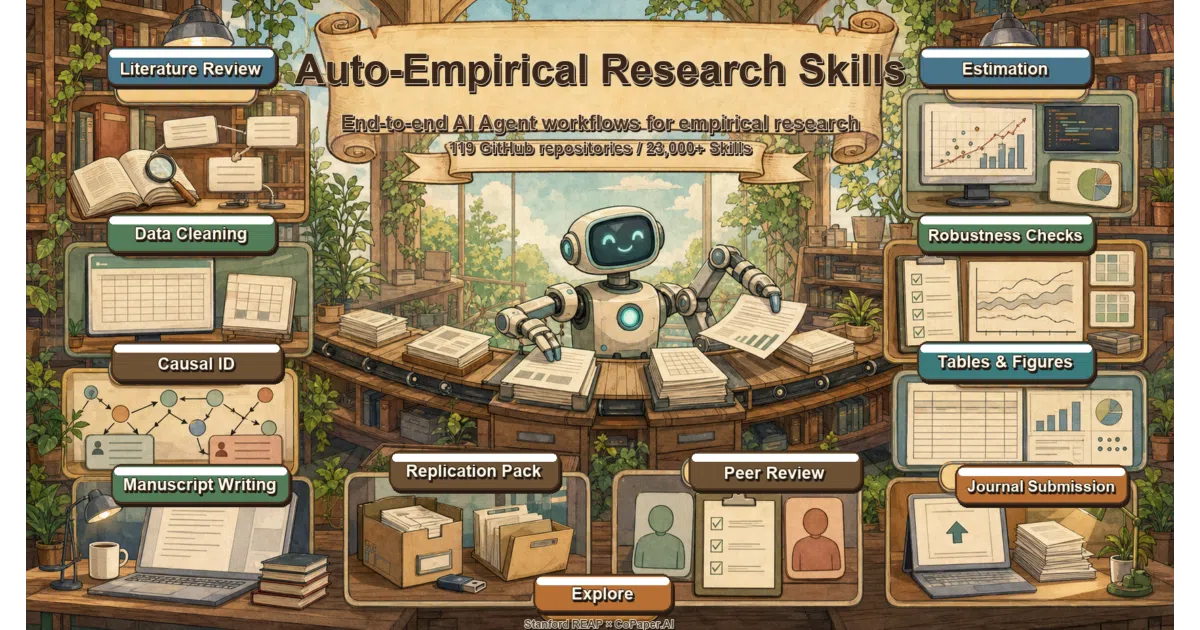
This repository curates over 23,000 AI agent skills from 119 GitHub repositories, organizing them by research workflow stage across eight social science disciplines including economics, political science, and sociology. Originally compiled as the skill landscape for Stanford REAP’s CoPaper.AI project, it packages methodological expertise—from data cleaning and causal inference to robustness checks and journal submission—into structured, reusable workflows. The collection includes a machine-readable catalog, golden workflows, and a vendored “AER-skills” stack targeting top-five economics journal standards.
The interesting bit
The maintainers treat empirical research as a decomposed pipeline of discrete, auditable skills rather than a single monolithic prompt. Each skill encodes domain-specific guardrails—such as referee-anticipating robustness matrices, AER booktabs formatting, or Keith Head five-paragraph introductions—complete with automated sync loops and a six-phase security audit across all 2,940-plus files.
Key highlights
- Curated from 119 repositories into a searchable local catalog with machine-readable
catalog/skills.json - Covers the full empirical pipeline: topic selection, identification strategy, estimation, robustness, tables and figures, replication packages, and rebuttal letters
- Includes a dedicated top-five economics submission stack (AER / AER:Insights / AEJ) with journal-specific constraints such as 100-word abstracts and mandatory replication packages
- All 52 bundled skills and 2,940-plus files passed a systematic security audit with zero flagged threats
- Maintained by Stanford REAP / SCCEI and designed to integrate with the open-source StatsPAI causal-inference engine
Caveats
- The “20-minute paper” claim and end-to-end automation refer to the commercial CoPaper.AI service; this repository is primarily the underlying skills landscape and catalog
- Most of the 23,000-plus skills are indexed from external repositories rather than authored in-house
Verdict
Social scientists and econometricians building AI research assistants should treat this as a methodological guardrail library; generalist developers looking for a turnkey causal-inference engine should head to StatsPAI instead.
Frequently asked
- What is brycewang-stanford/Auto-Empirical-Research-Skills?
- It exists because AI assistants need structured methodological skills—not bigger models—to run complete empirical research pipelines without hand-holding.
- Is Auto-Empirical-Research-Skills open source?
- Yes — brycewang-stanford/Auto-Empirical-Research-Skills is an open-source project tracked on heatdrop.
- What language is Auto-Empirical-Research-Skills written in?
- brycewang-stanford/Auto-Empirical-Research-Skills is primarily written in Stata.
- How popular is Auto-Empirical-Research-Skills?
- brycewang-stanford/Auto-Empirical-Research-Skills has 4.8k stars on GitHub and is currently holding steady.
- Where can I find Auto-Empirical-Research-Skills?
- brycewang-stanford/Auto-Empirical-Research-Skills is on GitHub at https://github.com/brycewang-stanford/Auto-Empirical-Research-Skills.