browser-use/jev-ultrafast
A web agent that skips screenshots and finds flights in 7 seconds
It exists to make browser agents fast and cheap by replacing screenshot analysis with a live, indexed table of DOM elements.
Collecting fresh signals — velocity needs a few days of history.
collecting data…
star history
What it does
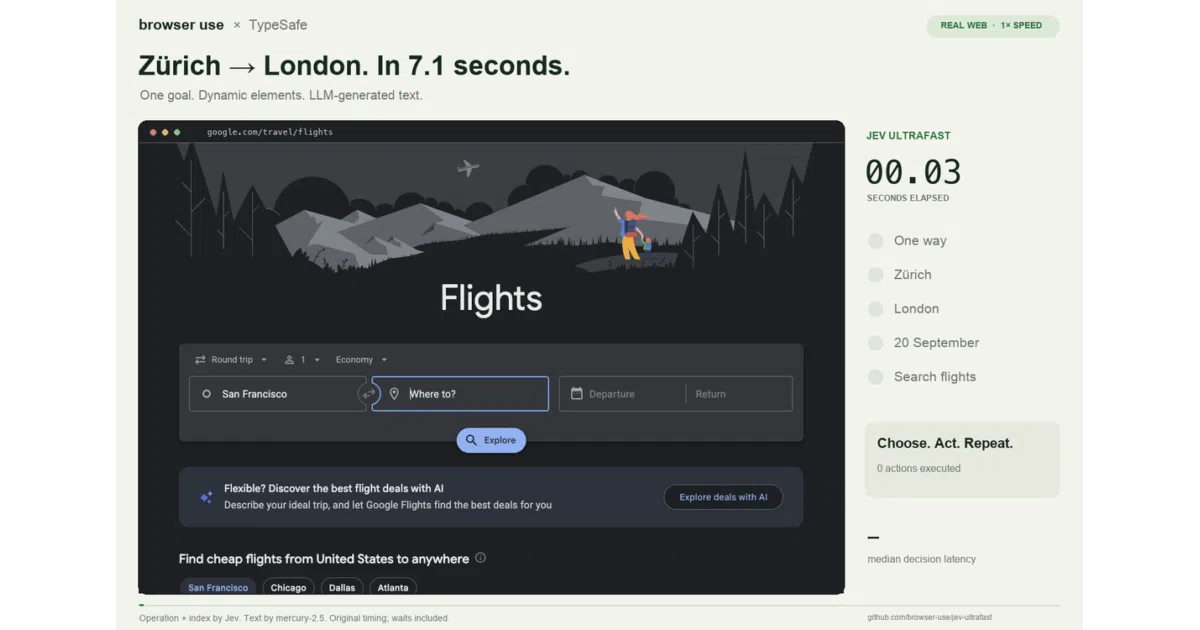
Jev Ultrafast is a browser agent that navigates the web by reading a live, indexed table of interactive elements rather than looking at screenshots. You give it a natural-language goal—like finding one-way flights from Zürich to London—and it loops through observations, picking an operation such as CLICK or TYPE_TEXT and a specific target element from a dynamically generated list. A small text-only LLM steps in only when the agent needs to type actual text.
The interesting bit
The clever part is the architecture: the model emits both an operation and a target in a single network round trip by using speculative heads that share the same observed state, and because the policy consumes structured DOM snapshots instead of pixels, the default loop contains no screenshots at all. This structured approach is what drives the published Google Flights demo end-to-end—including generated text and loading waits—in a little over seven seconds.
Key highlights
- One round trip per decision. The model chooses an operation and a compatible target element in a single request, with each target head filtered to only valid elements for that action.
- Atomic DOM snapshots. A single browser call reads visible controls, their names, values, and text, keeping direct references to actual DOM nodes for validation.
- Defensive execution. Before clicking, the executor rechecks page freshness and rejects covered or occluded controls; after typing, it waits up to 200 ms for suggestions.
- Small, readable core. The entire loop, snapshot logic, browser glue, model heads, and demo inspector fit into roughly half a dozen short files.
- Verified, narrow benchmarks. The repo publishes specific timings—7.073 s for the Flights demo, 2.798 s for a Wikipedia search—alongside independent outcome checks and raw measurement boundaries.
Caveats
- This is explicitly an MVP: shadow roots, frames, canvas, file uploads, pop-up tabs, nested scrolling, and arbitrary keyboard widgets are all out of scope.
- The DOM reader covers common HTML and ARIA controls but does not implement the full accessible-name specification, so unusual control patterns may confuse it.
- The published speed gains come from three repeats of a single task on one browser profile; the README itself notes this is not a general reliability benchmark.
Verdict
Developers building browser automation or agentic workflows should study this if they want a minimal, fast alternative to vision-heavy approaches. Anyone needing production-grade coverage of complex web apps—iframes, custom canvases, or dense keyboard navigation—should wait for a more mature iteration.
Frequently asked
- What is browser-use/jev-ultrafast?
- It exists to make browser agents fast and cheap by replacing screenshot analysis with a live, indexed table of DOM elements.
- Is jev-ultrafast open source?
- Yes — browser-use/jev-ultrafast is open source, released under the MIT license.
- What language is jev-ultrafast written in?
- browser-use/jev-ultrafast is primarily written in Python.
- How popular is jev-ultrafast?
- browser-use/jev-ultrafast has 20.3k stars on GitHub.
- Where can I find jev-ultrafast?
- browser-use/jev-ultrafast is on GitHub at https://github.com/browser-use/jev-ultrafast.