bmild/nerf
NeRF: a 5MB neural net that memorizes one 3D scene
This repository holds the original TensorFlow implementation of the ECCV 2020 paper that trains a single, scene-specific fully connected network to synthesize novel views of a 3D object or space from posed images.
Not currently ranked — collecting fresh signals.
star history
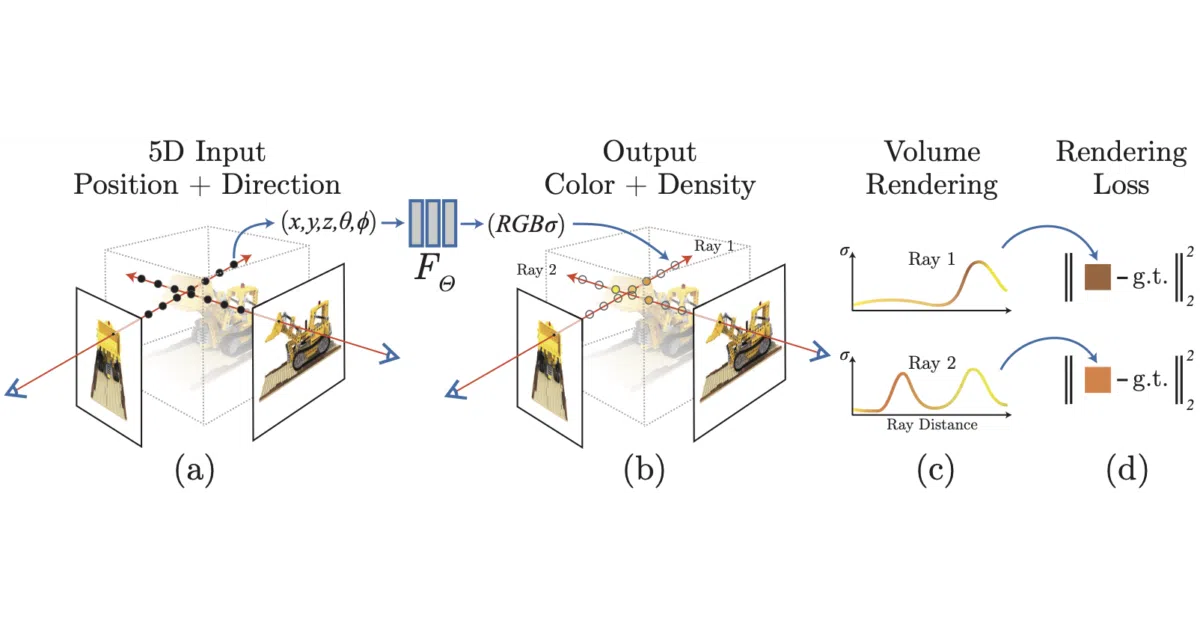
What it does NeRF treats a single scene as a continuous 5D function—spatial position plus viewing direction—that a small fully connected network learns to approximate. The repo implements the original training pipeline in TensorFlow 1.15, letting you optimize a ~5MB model for a specific scene and then render new views with differentiable volume rendering. It also ships with Jupyter notebooks for interactive rendering and for extracting explicit triangle meshes via marching cubes.
The interesting bit Instead of storing voxels or point clouds, the network itself becomes the scene representation: it outputs color and opacity for any coordinate you query, and the codebase turns those samples into images with classic volume-rendering integrals. The result is a neural field that trains on one consumer GPU and fits in an email attachment.
Key highlights
- Scene representation is a single small MLP (~5MB weights) trained per scene.
- Maps 5D coordinates to color and opacity, rendered with volume integration.
- Training takes a few hours to a day on one GPU; rendering a frame ranges from under a second to ~30 seconds depending on resolution.
- Includes
render_demo.ipynbfor novel-view synthesis andextract_mesh.ipynbfor mesh extraction. - Received ECCV 2020 Oral and Best Paper Honorable Mention.
Caveats
- Requires pre-computed camera poses; for your own real-world photos you must bring a COLMAP/LLFF pipeline.
- Built on TensorFlow 1.15, so you are committing to a legacy framework.
- Example configs train at lower resolution than the paper’s full results; reproducing the published numbers needs separate high-res configs.
Verdict Worth cloning if you need the canonical reference for neural radiance fields or want to reproduce the original view-synthesis and mesh-extraction pipeline. Look elsewhere if you need a modern, generalizable model that works across multiple scenes out of the box.
Frequently asked
- What is bmild/nerf?
- This repository holds the original TensorFlow implementation of the ECCV 2020 paper that trains a single, scene-specific fully connected network to synthesize novel views of a 3D object or space from posed images.
- Is nerf open source?
- Yes — bmild/nerf is open source, released under the MIT license.
- What language is nerf written in?
- bmild/nerf is primarily written in Jupyter Notebook.
- How popular is nerf?
- bmild/nerf has 10.9k stars on GitHub.
- Where can I find nerf?
- bmild/nerf is on GitHub at https://github.com/bmild/nerf.