billion-token-one-task/Deepgraph
An AI lab that retracts its own papers
DeepGraph runs the full research loop — literature, questions, experiments, verdicts — and audits itself when reality disagrees.
Collecting fresh signals — velocity needs a few days of history.
collecting data…
star history
What it does
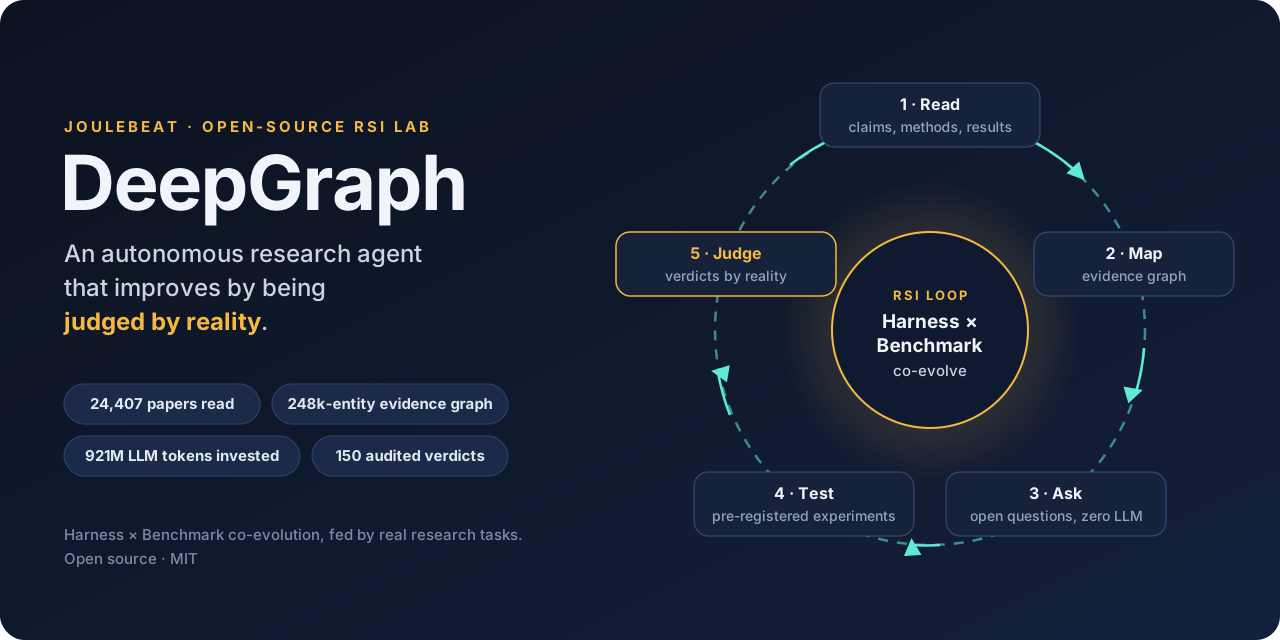
DeepGraph is the autonomous research agent of JouleBeat, an open-source lab pursuing recursive self-improvement. It harvests arXiv papers, merges claims into an evidence graph, detects open questions, runs budgeted experiments, and issues verdicts that feed back into what it searches next. The output is conclusions you can actually check — rerunnable code, held-out data, independent recomputation.
The interesting bit
The question-finding step is pure SQL: ten structural detectors scan the evidence graph with no LLM in the path, which keeps the “what should we investigate next” decision cheap and inspectable. And the self-audit is real — in August 2026 it retracted 11 of its own conclusions that rested on empty model outputs. A search loop is only as good as its truth filter, and this one polices itself.
Key highlights
- 24,407 papers harvested; evidence graph of 248,441 entities and 735,913 relations with 238 contradiction clusters
- 25,652 mapped research opportunities; 150 audited experiment verdicts across six agendas
- ~921M LLM tokens invested in production so far
- Every verdict is auditable, with an evidence ladder that only rules when the comparison is fair
- In service with paying research groups, MIT-licensed
Caveats
- The “self-improving” framing depends on JouleBeat’s harness × benchmark loop, and the benchmark-validation half of that stack is still listed as “in build” — the RSI story is partly promissory
- Requires an LLM API key and PostgreSQL for the full control plane; this is a production system, not a weekend script
- The August 2026 dates in the README read oddly, but that’s what the source says
Verdict
Worth a look if you’re curious about agentic science done with actual verification gates rather than vibes. If you wanted a lightweight paper-summarizer, this is considerably more machinery than that.
Frequently asked
- What is billion-token-one-task/Deepgraph?
- DeepGraph runs the full research loop — literature, questions, experiments, verdicts — and audits itself when reality disagrees.
- Is Deepgraph open source?
- Yes — billion-token-one-task/Deepgraph is open source, released under the MIT license.
- What language is Deepgraph written in?
- billion-token-one-task/Deepgraph is primarily written in Python.
- How popular is Deepgraph?
- billion-token-one-task/Deepgraph has 1k stars on GitHub.
- Where can I find Deepgraph?
- billion-token-one-task/Deepgraph is on GitHub at https://github.com/billion-token-one-task/Deepgraph.