bilibili/Index-Translate
Bilibili open-sources a translation family that counts syllables
Index-Translate covers 150 languages, plus speech, dubbing, and whole-document translation — with a model that hits a target syllable count.
Collecting fresh signals — velocity needs a few days of history.
collecting data…
star history
What it does
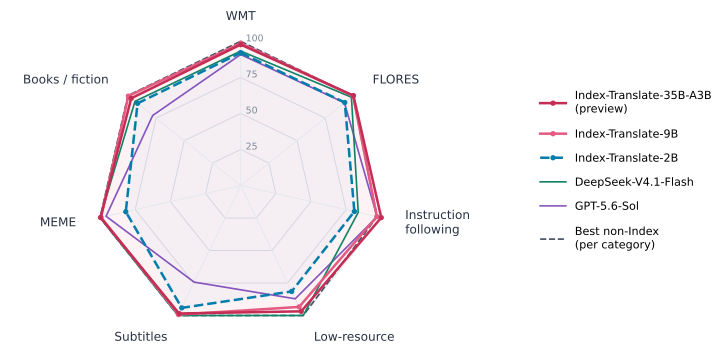
Index-Translate is a family of multilingual translation models built on Qwen3.5, released in 2B, 9B, and 35B-A3B (preview) sizes. The core text models translate across 150 languages and, unusually, treat translation instructions as first-class input: terminology glossaries, format preservation, tone, and domain hints. Around that core sit three specialists — Index-Echo (speech-to-subtitles and speech-to-speech in the source speaker’s voice), Index-Homura (translation steered toward a specified syllable count), and Index-NativeLong (whole-document translation with cross-passage context).
The interesting bit
The syllable-count model is the odd one worth a look: dubbing and subtitling live or die on timing, so a translation that can be told “land near N syllables” solves a real production problem that generic LLMs fumble. The instruction-following angle is similarly practical — glossary enforcement as a hard constraint, not a hopeful prompt.
Key highlights
- 150-language text translation with hard constraints (glossaries, format) and soft ones (tone, domain)
- Speech-to-subtitle and speech-to-speech dubbing conditioned on the source speaker’s voice
- Long-document translation that keeps context across passages
- Free OpenAI-compatible API for the 35B-A3B preview, plus GGUF/FP8/FP4 builds for llama.cpp and vLLM
- Four released benchmarks (instTrans, MEME, SandGlass, NAtIveLong) with data and eval code
Caveats
- The 35B-A3B model is explicitly a preview; the official version is still on the TODO list
- Speech and long-document models cover far fewer languages than the text models (e.g., Index-NativeLong ships fixed zh↔en and zh↔ja templates)
- The Echo GGUF builds contain only the text LLM backbone — the full speech pipeline needs the FP8/FP4 variants
Verdict
Worth a look if you build localization, subtitling, or dubbing tooling and want models that respect constraints instead of vibes. If you just need casual one-off translation, a general-purpose LLM still does fine.
Frequently asked
- What is bilibili/Index-Translate?
- Index-Translate covers 150 languages, plus speech, dubbing, and whole-document translation — with a model that hits a target syllable count.
- Is Index-Translate open source?
- Yes — bilibili/Index-Translate is open source, released under the Apache-2.0 license.
- What language is Index-Translate written in?
- bilibili/Index-Translate is primarily written in Python.
- How popular is Index-Translate?
- bilibili/Index-Translate has 602 stars on GitHub.
- Where can I find Index-Translate?
- bilibili/Index-Translate is on GitHub at https://github.com/bilibili/Index-Translate.