benderandrew069/deepseek-api-pricing-2026
A pricing guide that admits cache hits won't save you
A worked, assumption-testing walkthrough of DeepSeek's 2026 rate card — where the real money is output tokens, not clever caching.
★520 stars Learning
Collecting fresh signals — velocity needs a few days of history.
collecting data…
star history
What it does
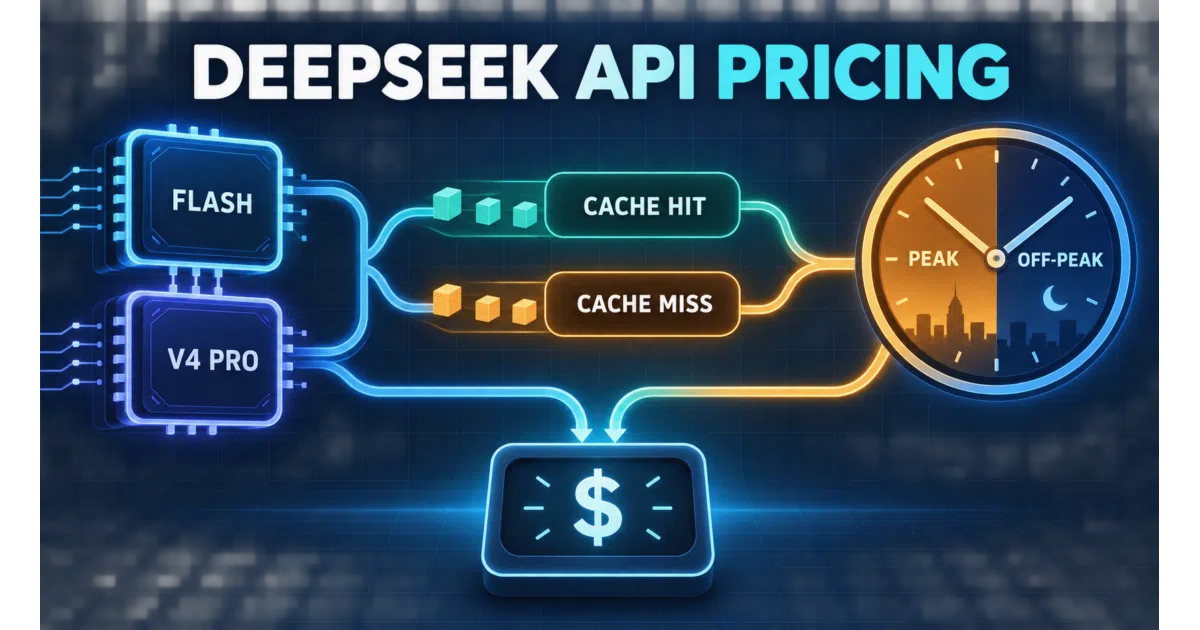
This is a documentation-only repo: no code, just a careful guide to estimating DeepSeek API costs for deepseek-flash and deepseek-v4-pro as of October 27, 2026. It covers the three billing lines (cache-hit input, cache-miss input, output), the peak/off-peak split, and how to sanity-check a budget with low/base/high scenarios. The author explicitly notes no accounts, requests, or bills were actually tested.
The interesting bit The most useful finding is counterintuitive: in the worked example, output costs $300 while all input costs $123.60. Doubling output length adds more to the bill than losing the cache entirely — so obsessing over cache-hit rates can distract from the line that actually dominates.
Key highlights
- Full rate table per 1M tokens, with peak rates exactly double off-peak across every category
- Peak windows defined in UTC (01:00–04:00 and 06:00–10:00, weekdays, excluding Chinese public holidays)
- A shortcut multiplier (
1 + p) for when all token categories share the same peak share - Emphasizes measuring
prompt_cache_hit_tokensandprompt_cache_miss_tokensrather than labeling whole requests as hits - Warns that caching is best-effort and that aggregator billing paths need separate verification
Caveats
- Prices are a snapshot; the README itself says to recheck DeepSeek’s pricing page before approving a budget
- No empirical validation — all numbers are hypothetical arithmetic, and no model quality or latency comparison is offered
- The date (October 2026) and model names should be treated as the repo’s claims, not independently confirmed here
Verdict Worth a read if you’re budgeting DeepSeek usage and want a framework instead of a single blended rate. Skip it if you want code, benchmarks, or anything you can run — this is an article wearing a repo’s clothes.
Frequently asked
- What is benderandrew069/deepseek-api-pricing-2026?
- A worked, assumption-testing walkthrough of DeepSeek's 2026 rate card — where the real money is output tokens, not clever caching.
- Is deepseek-api-pricing-2026 open source?
- Yes — benderandrew069/deepseek-api-pricing-2026 is an open-source project tracked on heatdrop.
- How popular is deepseek-api-pricing-2026?
- benderandrew069/deepseek-api-pricing-2026 has 520 stars on GitHub.
- Where can I find deepseek-api-pricing-2026?
- benderandrew069/deepseek-api-pricing-2026 is on GitHub at https://github.com/benderandrew069/deepseek-api-pricing-2026.