autonomous-ai/lampOS
An OS that gives Claude Code a body and a desk lamp
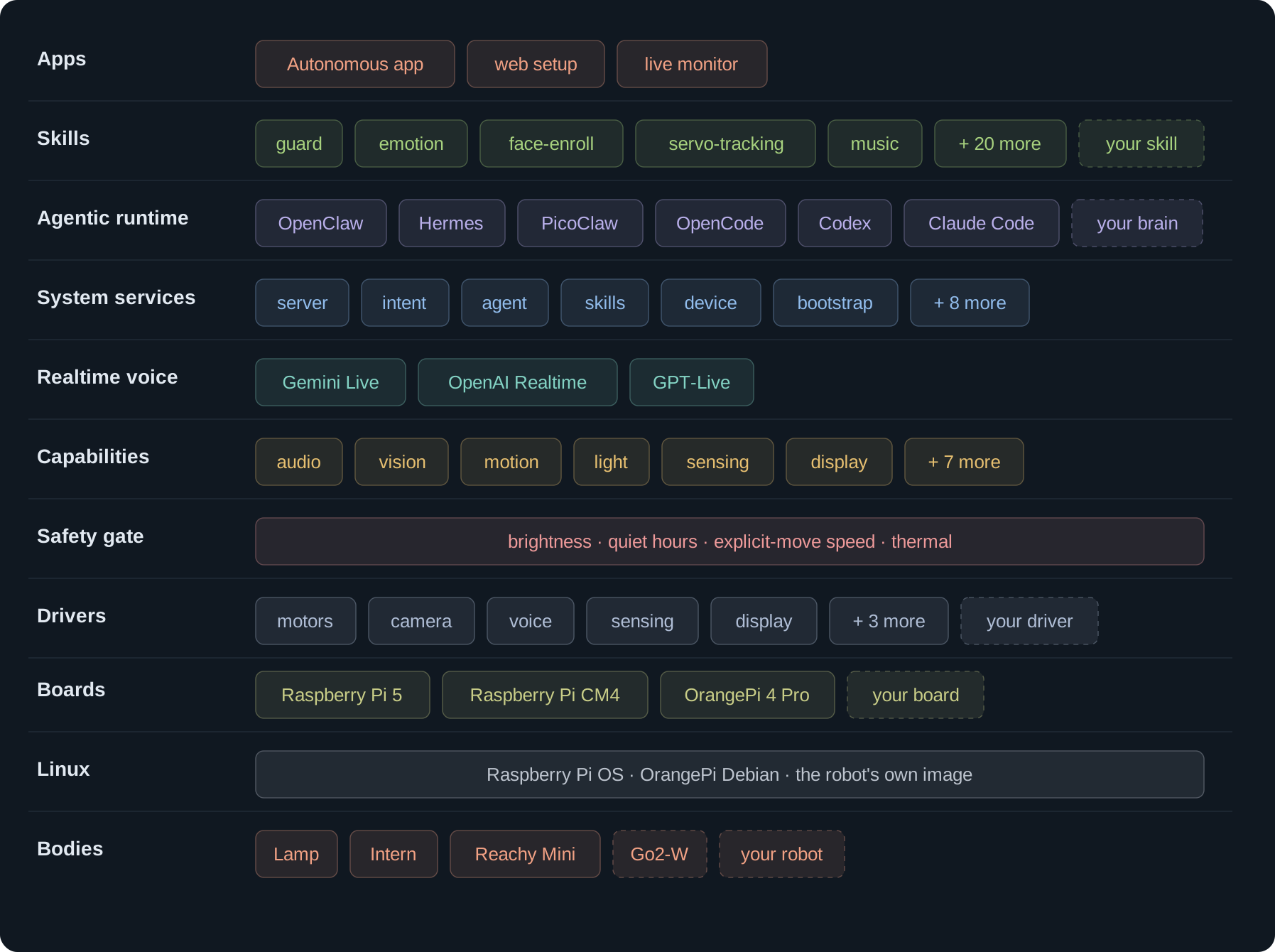
lampOS wants to be the Android of physical AI — a layered stack that plugs agent runtimes into cameras, mics, motors, and LEDs.
Collecting fresh signals — velocity needs a few days of history.
collecting data…
star history
What it does
It’s a full operating-system-style stack that runs on a robot and connects an AI agent runtime to real hardware: cameras, microphones, speakers, motors, lights, and sensors. You pick the brain — Hermes, Claude Code, Codex, OpenClaw, OpenCode, or PicoClaw — and the OS coordinates the body around it. It ships tested on three robots (Lamp, Intern, Reachy Mini) and supports bringing your own via four markdown files.
The interesting bit
The whole robot is described in markdown: ROBOT.md for the body, SOUL.md for personality, SAFETY.md for limits, SKILL.md for behaviors. Skills never touch GPIO directly — they emit [HW:/path:{json}] markers in their replies, and the Go daemon os-server strips them out and dispatches them to the hardware layer before speaking the rest. It’s a clean separation of “thinking” and “wiring.”
Key highlights
- Six agent runtimes behind one 76-method
AgentGateway; switch engines live from the web UI with persona and memory intact - Intent routing with a validated fallback (“Jev”) so “this lamp is too bright” becomes a local dimming command without a model round-trip; uncertain requests go to the main agent
- Delegates coding/research tasks to agents on a paired computer via Harness, and can drive Mac apps through a Buddy companion
- Layered architecture where each layer only uses the one below it — any layer is replaceable
- Two robots placed together will hear each other’s answers and converse until you stop them
Caveats
- Model inference typically uses remote services — the OS runs on the robot, the thinking often doesn’t
- New integrations outside Hermes are disabled by default pending native validation, gated by a Go build switch
- The “Android of physical AI” framing is ambitious; the tested hardware list is currently three robots
Verdict
Worth a look if you’re building voice-driven robots or want your agent to escape the terminal. If you don’t own (or plan to buy) compatible hardware, it’s mostly interesting architecture reading.
Frequently asked
- What is autonomous-ai/lampOS?
- lampOS wants to be the Android of physical AI — a layered stack that plugs agent runtimes into cameras, mics, motors, and LEDs.
- Is lampOS open source?
- Yes — autonomous-ai/lampOS is open source, released under the Apache-2.0 license.
- What language is lampOS written in?
- autonomous-ai/lampOS is primarily written in Python.
- How popular is lampOS?
- autonomous-ai/lampOS has 500 stars on GitHub.
- Where can I find lampOS?
- autonomous-ai/lampOS is on GitHub at https://github.com/autonomous-ai/lampOS.