autonomous-ai/autonomous-computer
Open hardware for a local AI stack that runs hot—literally
It publishes full open-hardware blueprints for building multi-GPU AI workstations that keep your weights local and your prompts private.
Velocity · 7d
+9.3
★ / day
Trend
↗accelerating
star history
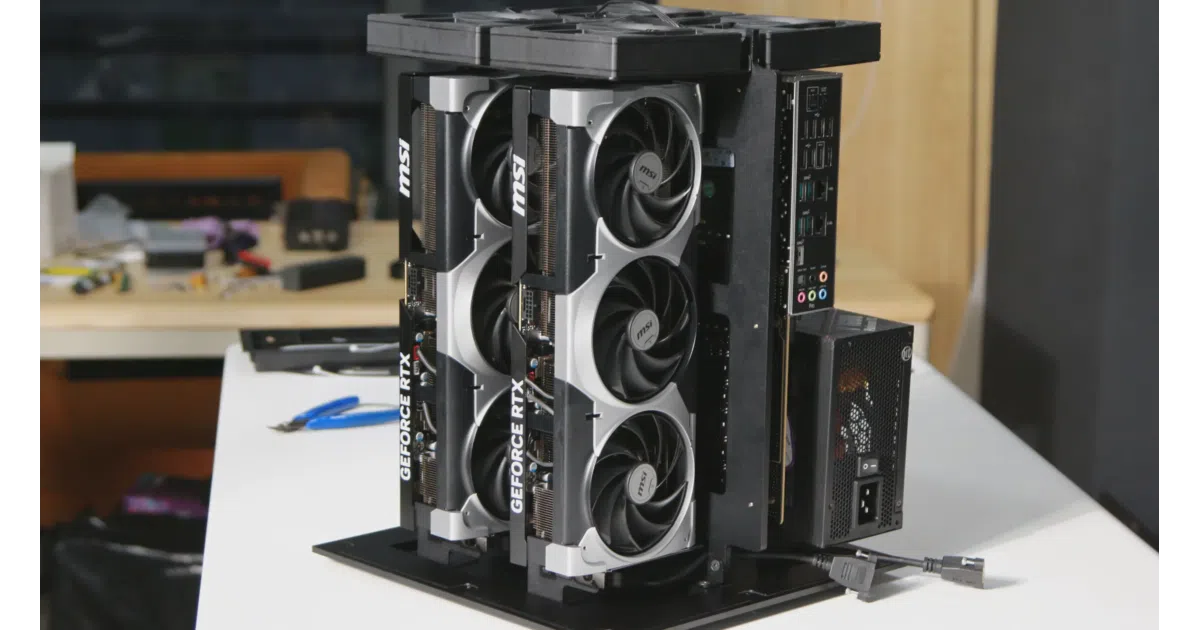
What it does The repository is essentially a build manual for four increasingly excessive GPU workstations, ranging from a dual RTX 5090 desktop up to an eight-GPU tower and a 5U rack server with RTX PRO 6000 cards. For each configuration you get the CAD files, bill of materials, assembly photos, and BIOS tuning notes needed to construct the machine from scratch. The goal is to run open-weight models locally via vLLM, Ollama, llama.cpp, or a separate orchestrator called Grid—no cloud APIs, no metered tokens.
The interesting bit Most local AI guides assume a laptop and a single GPU; this one treats 64 GB to 384 GB of VRAM and a 4,000 W PSU as the starting line. The ideological framing is just as aggressive as the hardware: the README frames cloud AI as a 1970s mainframe rental racket that ends with revocable weights and stolen training data, and pitches these open-source boxes as the personal-computer rebellion.
Key highlights
- Four complete hardware recipes, from a 33 lb entry-level dual-GPU desk unit to a 110 lb eight-GPU on-prem tower and a 5U rack build.
- Open-source down to the physical brackets, PCIe riser layouts, and chassis airflow design.
- Explicit power budgets and thermal footprints: 1,550 W to 5,100 W draw, with dual-chamber or CNC-milled aluminum housings.
- BIOS tuning and multi-GPU stability testing to verify every card links at full PCIe Gen 5 width.
- MIT licensed: fork, modify, and sell the designs without legal friction.
Caveats
- The README’s urgency leans heavily on a speculative 2026 scenario—government model takedowns and gated partner lists—that has not happened yet.
- These are not budget builds; the BOMs center on RTX 5090 and RTX PRO 6000 GPUs, and even the smallest rig draws 1,550 W.
- The software layer is mostly BYO; the repo points to external inference engines and a separate Grid installer, so the hardware is only half the stack.
Verdict Grab these blueprints if you are a homelab veteran or systems engineer who already believes local inference is worth building a space heater for. Skip it if you were hoping for a Raspberry Pi project—these machines pull more current than a kitchen appliance.
Frequently asked
- What is autonomous-ai/autonomous-computer?
- It publishes full open-hardware blueprints for building multi-GPU AI workstations that keep your weights local and your prompts private.
- Is autonomous-computer open source?
- Yes — autonomous-ai/autonomous-computer is open source, released under the MIT license.
- How popular is autonomous-computer?
- autonomous-ai/autonomous-computer has 1.3k stars on GitHub and is currently accelerating.
- Where can I find autonomous-computer?
- autonomous-ai/autonomous-computer is on GitHub at https://github.com/autonomous-ai/autonomous-computer.