arpitbansal297/Cold-Diffusion-Models
Cold diffusion treats blur and snow like Gaussian noise
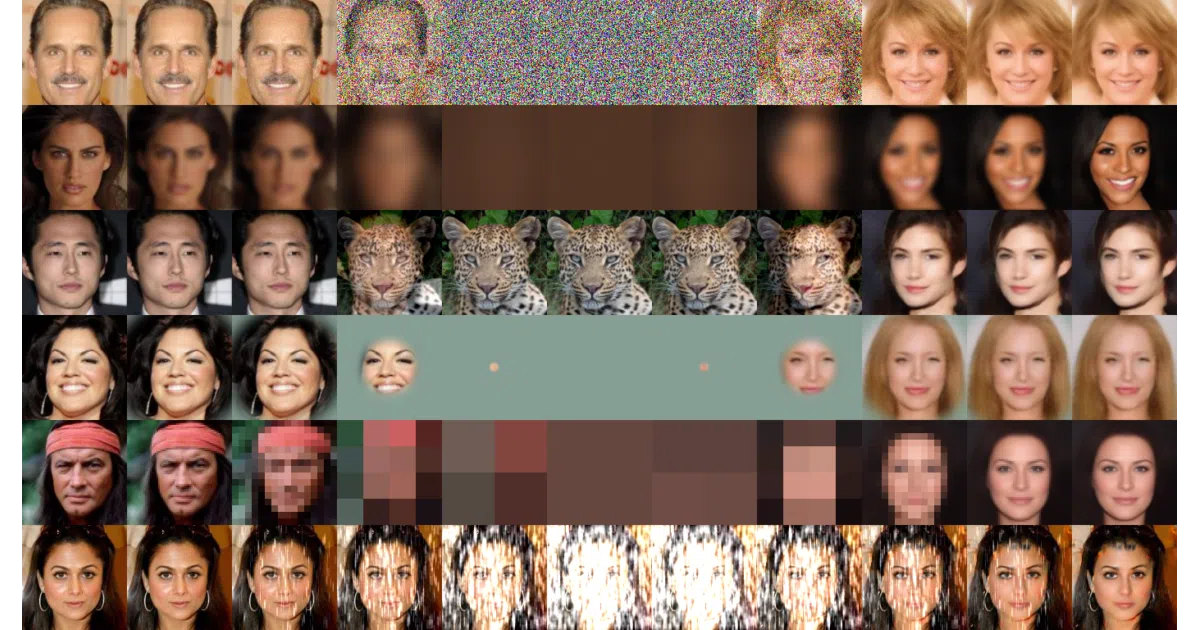
It proves diffusion models can learn to reverse arbitrary image degradations—blur, masking, even animorphosis—without ever adding Gaussian noise.
Not currently ranked — collecting fresh signals.
star history
What it does
This is the official PyTorch release for the Cold Diffusion paper. It trains models to reverse deterministic image corruptions—Gaussian blur, inpainting masks, resolution downsampling, color desaturation, image snow, and animorphosis—treating them exactly like the noise schedule in standard DDPM. The repo includes both standard “hot” denoising diffusion and the new cold variants, built on top of lucidrains/denoising-diffusion-pytorch.
The interesting bit
The code demonstrates that the diffusion framework is not married to Gaussian noise; any degrading transform with a known inverse can slot into the same training and sampling pipeline. The authors even explore “broken symmetry” sampling by fitting a Gaussian mixture model to the fully degraded distribution and nudging it with controlled noise.
Key highlights
- Supports six degradation types: blur, animorphosis, Gaussian mask, downsampling, snow, and desaturation
- Includes pretrained checkpoints for CelebA and AFHQ blur/animorph models
- Provides both conditional generation (restoration) and unconditional generation scripts
- Implements multiple sampling routines: default,
x0_step_down, and DDIM-style estimation - Built as an extension of a well-known DDPM implementation, not from scratch
Caveats
- The README is almost entirely training and testing command templates; conceptual explanation is thin and assumes you’ve read the paper.
- Several degradation sections (snow, desaturation, downsampling) are mentioned in the intro but truncated or missing from the visible documentation.
- Pretrained model availability appears limited to blur and animorphosis on specific datasets.
Verdict
Grab this if you’re researching diffusion theory or need a baseline for non-noise generative corruption. Skip it if you want a polished, general-purpose image generation API—this is research scaffolding.
Frequently asked
- What is arpitbansal297/Cold-Diffusion-Models?
- It proves diffusion models can learn to reverse arbitrary image degradations—blur, masking, even animorphosis—without ever adding Gaussian noise.
- Is Cold-Diffusion-Models open source?
- Yes — arpitbansal297/Cold-Diffusion-Models is an open-source project tracked on heatdrop.
- What language is Cold-Diffusion-Models written in?
- arpitbansal297/Cold-Diffusion-Models is primarily written in Python.
- How popular is Cold-Diffusion-Models?
- arpitbansal297/Cold-Diffusion-Models has 1.1k stars on GitHub.
- Where can I find Cold-Diffusion-Models?
- arpitbansal297/Cold-Diffusion-Models is on GitHub at https://github.com/arpitbansal297/Cold-Diffusion-Models.