arnegiacomo/fugleramme
AI bird ID rendered as hand-cut 1800s natural-history plates
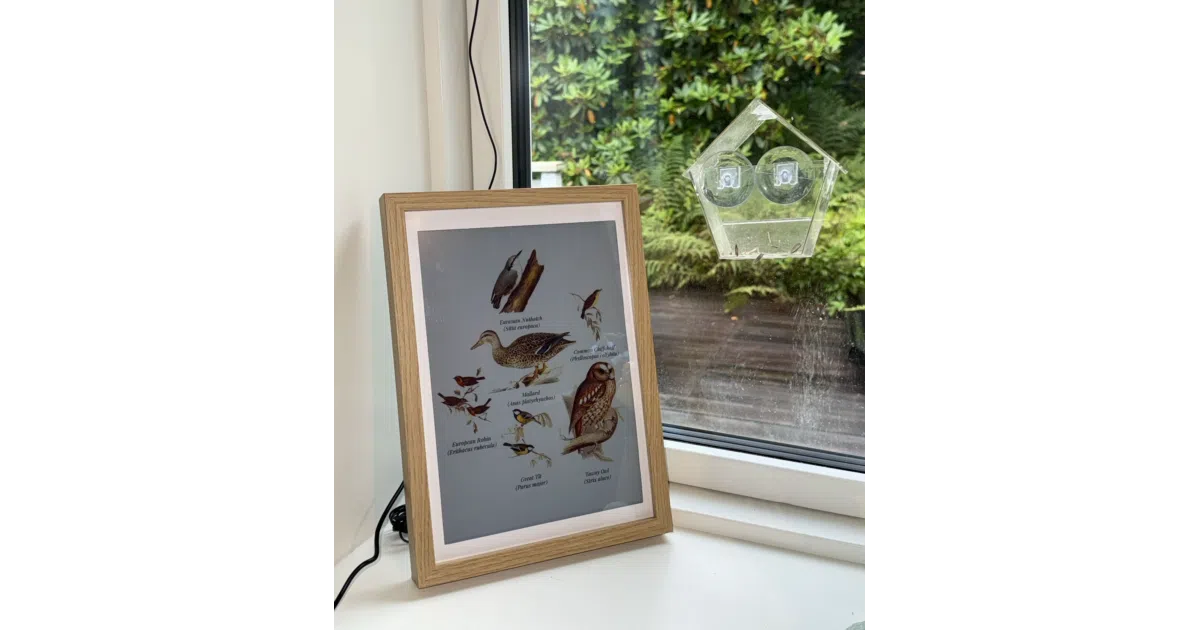
Turns live backyard bird detections into an e-ink collage of hand-cut 1800s public-domain illustrations.
Collecting fresh signals — velocity needs a few days of history.
collecting data…
star history
What it does It sits between a microphone and a display, polling BirdNET-Go for real-time species detections and matching each identified bird to a hand-curated, background-removed illustration from 19th-century natural-history plates. The result is rendered either on a Pimoroni Inky Impression e-ink panel or as a web kiosk, packing birds onto a textured page sized roughly by body mass.
The interesting bit This is essentially a very opinionated, aesthetic display layer for BirdNET-Go. The author has manually cut out over 800 illustrations covering more than 400 species—no AI-generated art here—and the layout algorithm places larger species toward the center of the page. When no birds are present, the frame shows a bare perch, which is a nice touch.
Key highlights
- Fully local AI detection via BirdNET-Go; no cloud required.
- Over 800 hand-curated, public-domain illustrations from real 1800s plates.
- Supports both e-ink (Pimoroni Inky Impression) and standard web kiosk displays.
- Can point to an existing BirdNET-Go instance on the network, or run alongside it.
- Admin page included for configuring what appears on the frame.
Caveats
- Still in early development; the README warns of odd bugs and unpolished edges.
- Illustration coverage is strongest for Scandinavia, the British Isles, and Germany; other regions are sparse.
- Requires a separate BirdNET-Go installation (or container) to handle the actual audio classification.
Verdict Birdwatchers with a Raspberry Pi and a taste for natural-history aesthetics will love this. If you are looking for a generic dashboard or do not care about 19th-century illustration, it is probably overkill.
Frequently asked
- What is arnegiacomo/fugleramme?
- Turns live backyard bird detections into an e-ink collage of hand-cut 1800s public-domain illustrations.
- Is fugleramme open source?
- Yes — arnegiacomo/fugleramme is open source, released under the MIT license.
- What language is fugleramme written in?
- arnegiacomo/fugleramme is primarily written in Python.
- How popular is fugleramme?
- arnegiacomo/fugleramme has 1.5k stars on GitHub.
- Where can I find fugleramme?
- arnegiacomo/fugleramme is on GitHub at https://github.com/arnegiacomo/fugleramme.