argilla-io/distilabel
Synthetic data pipelines that put LLMs to work as judges
Distilabel is a framework for engineers who need to synthesize training data and collect AI feedback from any LLM provider using research-backed, scalable pipelines.
Not currently ranked — collecting fresh signals.
star history
What it does
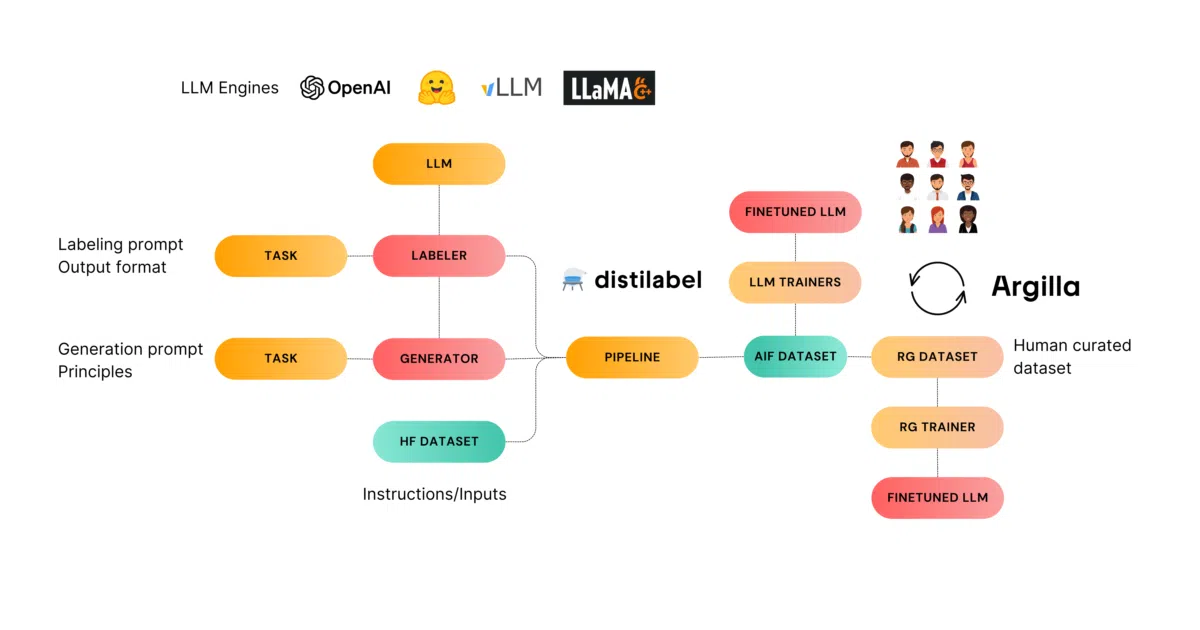
Distilabel is a Python framework for building pipelines that generate synthetic datasets and collect AI feedback. It targets the usual LLM fine-tuning chores—instruction following, dialogue generation, preference judging—plus traditional NLP tasks like classification and extraction. The idea is to stop writing one-off scripts and instead assemble reproducible pipelines that scale from a laptop to a Ray cluster.
The interesting bit
The framework wrangles a small army of LLM providers behind a single API, then layers on structured generation via outlines or instructor, duplicate detection, and text clustering. It also claims to ground its techniques in verified research papers, which is the boring part that actually matters if you are trying to justify your data generation strategy to a skeptical reviewer (or yourself).
Key highlights
- Unified LLM backend: swaps between OpenAI, Anthropic, Cohere, Groq, Hugging Face Inference Endpoints, Transformers, vLLM, LlamaCpp, Ollama, Vertex AI, MLX, and LiteLLM without rewriting pipeline code.
- Built-in data hygiene: optional extras for MinHash duplicate detection, FAISS embeddings, and UMAP/scikit-learn text clustering.
- Scalability hook: Ray integration for distributing pipeline steps when your synthetic dataset ambitions outgrow a single process.
- Structured generation support: plugs into
outlinesandinstructorto constrain LLM outputs instead of hoping the model follows the format. - Community maintenance: the project is under active community stewardship after the original authors moved on, with current work happening on the
developbranch.
Caveats
- The original authors have moved on, and community collaborators are currently shepherding the next release; stability and roadmap details are unclear from the README alone.
- The README advertises “verified research papers” but does not list them or explain the verification criteria, so you will have to trust the methodology (or read the source).
Verdict If you are fine-tuning LLMs and tired of cobbling together ad-hoc data generation scripts, Distilabel offers a coherent, provider-agnostic pipeline framework. If you need a mature project with a full-time core team and published benchmarks, the current transition period might give you pause.
Frequently asked
- What is argilla-io/distilabel?
- Distilabel is a framework for engineers who need to synthesize training data and collect AI feedback from any LLM provider using research-backed, scalable pipelines.
- Is distilabel open source?
- Yes — argilla-io/distilabel is open source, released under the Apache-2.0 license.
- What language is distilabel written in?
- argilla-io/distilabel is primarily written in Python.
- How popular is distilabel?
- argilla-io/distilabel has 3.4k stars on GitHub.
- Where can I find distilabel?
- argilla-io/distilabel is on GitHub at https://github.com/argilla-io/distilabel.