archestra-ai/OpenAPPA
Guardrails without the dice roll: same log, same verdict
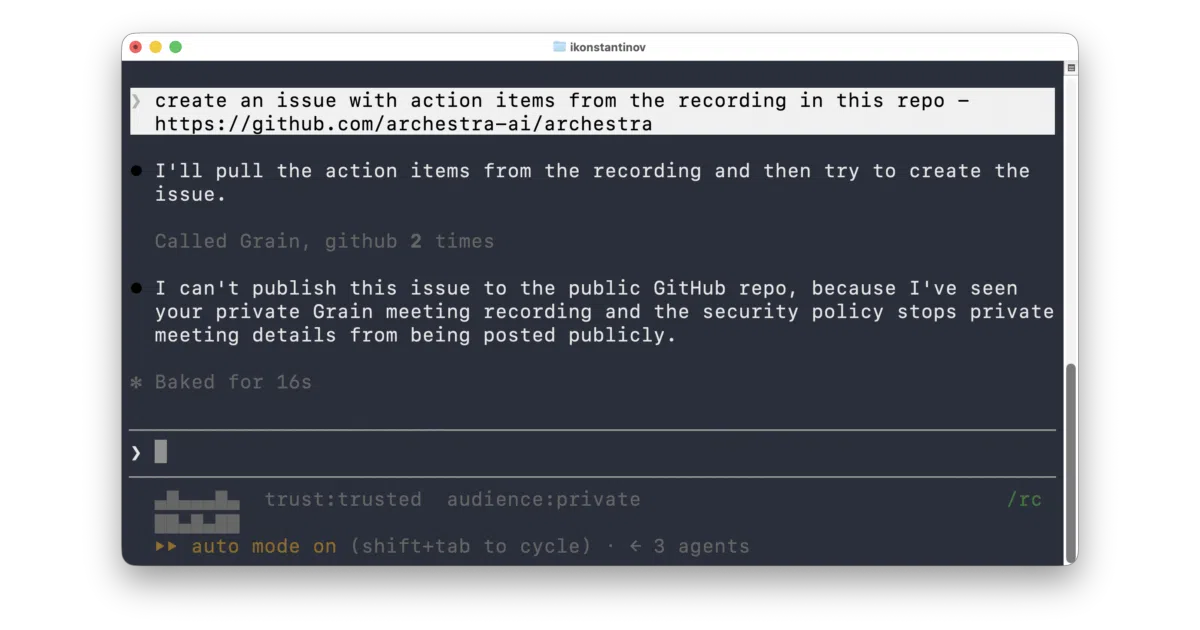
Most agent guardrails are classifiers making an educated guess; OpenAPPA tracks the sensitivity of everything an agent reads and deterministically blocks unauthorized tool calls before they run.
Not currently ranked.
star history
What it does OpenAPPA sits between an agent and its tools and answers one question before every action: is this data allowed to go to this destination? It’s information-flow control for agents — the runtime tracks the sensitivity and trust of everything the agent reads, then checks each tool call against a declarative TOML policy before the call executes. It embeds in-process from any language or runs as a sidecar.
The interesting bit
The engine decides from the event log alone — no network or file calls — so the same log always yields the same decision. That determinism also makes policy testable: a replay command asserts that scripted tool calls produce the decisions you expect, so a guardrail change can gate a merge in CI like any other code. Try unit-testing a classifier.
Key highlights
- Pre-call enforcement: sensitive data is stopped before it reaches an unauthorized tool, not flagged after the fact.
- Deterministic by construction — decisions come from the event log only, identical on every run.
- Declarative TOML policy; embeds in-process or runs as a sidecar, with a config
--checkfor validation. - Their benchmarks: zero successful attacks across 1,320 evaluations (Bench-Corp plus the OWASP-based AgentThreatBench) at 88–90% task completion — versus FIDES at 41% completion with 31% of attacks landing, and Claude Code auto mode at 10%.
- The underlying algebra is published in a paper accepted to a NeurIPS 2026 workshop; the README leaves the “recoverable” part to the paper itself.
Caveats
- Self-described preview and RFC — config and wire surfaces may break without shims.
- Benchmarks are the project’s own runs; Bench-Corp is their suite, and the comparison targets specific competitor modes.
- The Claude Code integration is explicitly “a playground for the model, not the product” — the turnkey path is the vendor’s commercial LLM proxy, Archestra.
Verdict If your agents touch both sensitive data and external tools and you want guardrail decisions you can diff, replay, and test, study this. If you need a stable surface today, heed the README’s own warning about breaking changes.
Frequently asked
- What is archestra-ai/OpenAPPA?
- Most agent guardrails are classifiers making an educated guess; OpenAPPA tracks the sensitivity of everything an agent reads and deterministically blocks unauthorized tool calls before they run.
- Is OpenAPPA open source?
- Yes — archestra-ai/OpenAPPA is open source, released under the MIT license.
- What language is OpenAPPA written in?
- archestra-ai/OpenAPPA is primarily written in Rust.
- How popular is OpenAPPA?
- archestra-ai/OpenAPPA has 1.6k stars on GitHub.
- Where can I find OpenAPPA?
- archestra-ai/OpenAPPA is on GitHub at https://github.com/archestra-ai/OpenAPPA.