araffin/robotics-rl-srl
A retired toolbox that taught robots to learn what matters
This archived Python project bundled RL algorithms with state-representation learning to see if robots could learn useful abstractions from raw pixels before making decisions.
Not currently ranked — collecting fresh signals.
star history
What it does
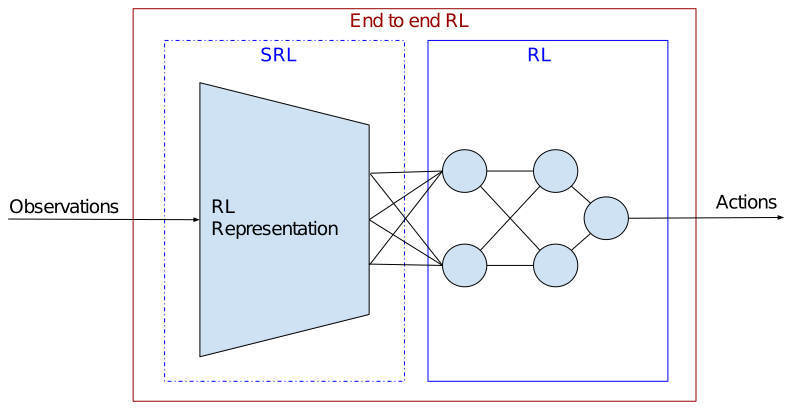
S-RL Toolbox was a research framework that married ten RL algorithms (PPO, SAC, DDPG, etc.) with state-representation learning methods for robotics. It shipped with PyBullet simulation environments—Kuka arm variants, mobile robots, a racing car—plus real-robot support for Baxter and ROS-based setups. The goal: test whether learning a compact “understanding” of the world from camera pixels helps robots reach targets more efficiently than end-to-end RL.
The interesting bit
The authors decoupled feature extraction from policy learning, letting you swap in different SRL methods (autoencoders, forward models, etc.) and compare them head-to-head. The environments expose “ground truth” robot position as an alternative to pixels, so you can measure exactly how much your fancy representation is costing you in sample efficiency.
Key highlights
- 10 RL algorithms integrated via Stable Baselines, with hyperparameter search (Hyperband, Hyperopt)
- Custom Gym environments running at ~250 FPS in PyBullet on an 8-core machine
- One-line switch between raw pixels and ground-truth state with
--srl-model - Docker and Anaconda setup; claimed 1M steps/hour on 8-core CPU + Titan X GPU
- Published research with arXiv papers and video demos
Caveats
- Explicitly unmaintained; the authors redirect to Stable-Baselines3 and RL Baselines3 Zoo
- Python 3 only; depends on the older
stable-baselinesfork, not the modern SB3 - Real-robot integration (Baxter, Robobo) requires ROS, adding setup friction
Verdict
Worth a look if you’re reproducing 2018 SRL-for-robotics papers or studying how representation learning affects sample efficiency. Skip it if you want production RL code—use Stable-Baselines3 instead.
Frequently asked
- What is araffin/robotics-rl-srl?
- This archived Python project bundled RL algorithms with state-representation learning to see if robots could learn useful abstractions from raw pixels before making decisions.
- Is robotics-rl-srl open source?
- Yes — araffin/robotics-rl-srl is open source, released under the MIT license.
- What language is robotics-rl-srl written in?
- araffin/robotics-rl-srl is primarily written in Python.
- How popular is robotics-rl-srl?
- araffin/robotics-rl-srl has 655 stars on GitHub.
- Where can I find robotics-rl-srl?
- araffin/robotics-rl-srl is on GitHub at https://github.com/araffin/robotics-rl-srl.