algorithmicsuperintelligence/optillm
Buy accuracy with compute: a proxy that makes small models punch up
OptiLLM sits between your app and any OpenAI-compatible API, spending extra inference-time compute to squeeze frontier-level reasoning out of cheaper models.
Velocity · 7d
+1.7
★ / day
Trend
↘cooling
star history
What it does
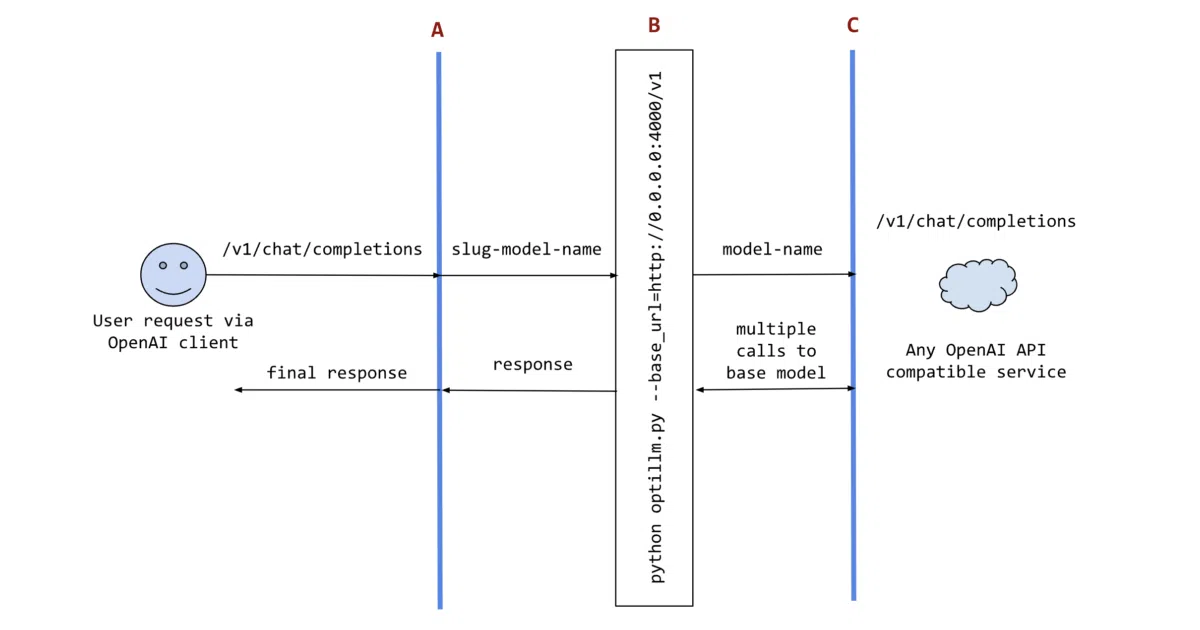
OptiLLM is an OpenAI API-compatible proxy that wraps your existing LLM calls in 20+ inference-time optimization techniques — best-of-N, self-consistency, MCTS, Mixture of Agents, plan search, and friends. You pick a technique by prefixing the model name (e.g. moa-gpt-4o-mini) and the proxy does the rest: multiple calls, reflection, voting, or search behind one ordinary chat completion. No training, no fine-tuning, no changes to your client beyond the base URL.
The interesting bit It’s essentially a vending machine for test-time compute. The README’s benchmark table claims things like MARS lifting Gemini 2.5 Flash Lite from 43.3 to 73.3 on AIME 2025, and MOA on GPT-4o-mini matching GPT-4 on Arena-Hard-Auto — the trade is always the same: more API calls and tokens for more accuracy.
Key highlights
- 20+ approaches, from simple
bonsampling to MCTS, Z3-backed logic solving, and the CePO pipeline from Cerebras - Plugin layer adds extras: PII anonymization, URL fetching, code execution, structured JSON output, MCP client, and a learned router that picks the approach per prompt
- Multi-provider via LiteLLM — OpenAI, Anthropic, Google, Cerebras, 100+ models
- Docker variants include a fully offline image and a lightweight proxy-only one
- Runs as a plain drop-in; existing OpenAI clients work unchanged
Caveats
- The accuracy gains are bought with extra inference calls, so latency and token costs go up — the README doesn’t dwell on this, but it’s the whole business model
- Several techniques (Deep Confidence, CoT decoding, AutoThink) are marked N/A for proxy use, so the menu is smaller than the headline count suggests
- Benchmark numbers are self-reported per-technique; your task may not resemble AIME or LiveCodeBench
Verdict Worth a look if you have token budget to burn and want cheap models to reason like expensive ones. Skip it if you’re latency-sensitive or your tasks don’t benefit from sampling-and-voting tricks.
Frequently asked
- What is algorithmicsuperintelligence/optillm?
- OptiLLM sits between your app and any OpenAI-compatible API, spending extra inference-time compute to squeeze frontier-level reasoning out of cheaper models.
- Is optillm open source?
- Yes — algorithmicsuperintelligence/optillm is open source, released under the Apache-2.0 license.
- What language is optillm written in?
- algorithmicsuperintelligence/optillm is primarily written in Python.
- How popular is optillm?
- algorithmicsuperintelligence/optillm has 4.3k stars on GitHub and is currently cooling off.
- Where can I find optillm?
- algorithmicsuperintelligence/optillm is on GitHub at https://github.com/algorithmicsuperintelligence/optillm.