alfredxw/denova
The writing IDE that moonlights as an AI game master
Denova is a local-first creative workspace that treats novel-writing and interactive fiction as two sides of the same coin, using structured lore databases and agent workflows to keep long-form AI context from collapsing into token soup.
Velocity · 7d
+4.9
★ / day
Trend
→steady
star history
What it does
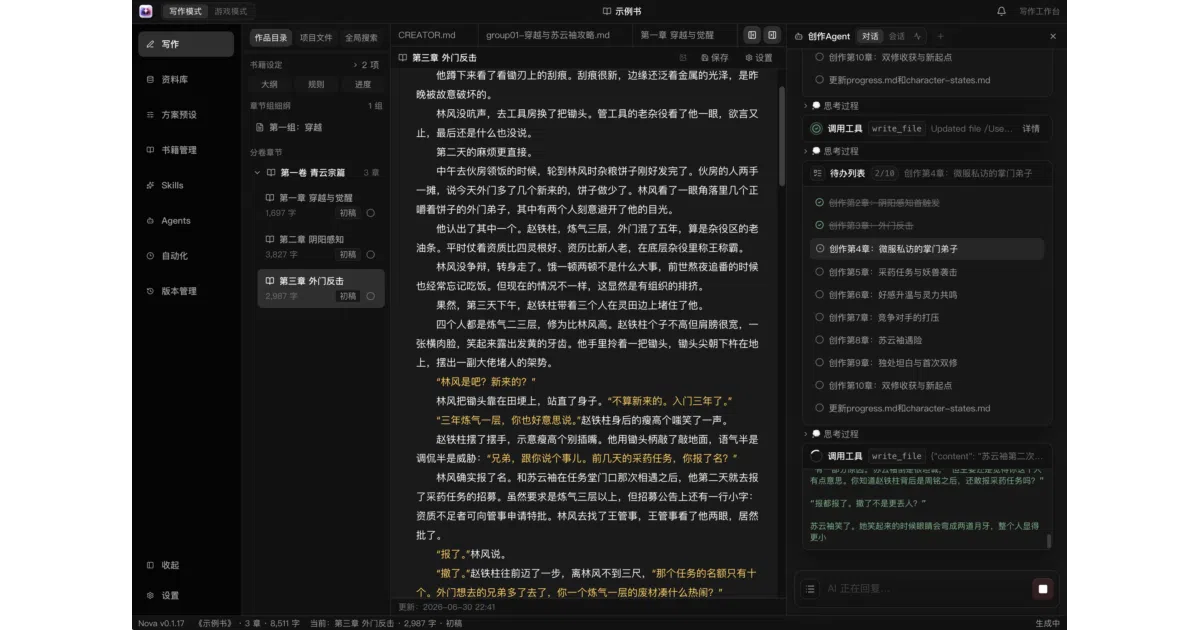
Denova is a desktop-grade creative platform built in Go and Node.js that gives authors two dedicated workbenches: a Markdown-based writing IDE for long-form fiction, and a game mode for running interactive text adventures. Both modes draw from a shared, structured lore database—characters, locations, factions, rules—to feed AI agents exactly the context they need without dumping the entire manuscript into the prompt. A built-in agent framework handles writing tasks, image generation, and automated reviews through composable Skills and subagent workflows, while local Git versioning tracks every AI edit with diff review and undo.
The interesting bit
The game mode includes a “Director” that acts as an invisible game master, using the lore database and event packs to manage plot branches, actor states, and even TRPG-style dice checks, all while trying to respect established canon. Rather than letting the model’s context window fill with raw chat logs, the app partitions memory into bounded turn histories, cached checkpoints, and stable lore entries.
Key highlights
- Dual-mode workspace: a novel-writing IDE with outlines and progress tracking, plus an interactive RPG engine with turn history and actor state management.
- Structured lore database keeps characters, world settings, and items organized so AI agents reference stable facts instead of hallucinating from an unbounded prompt history.
- Agent system with Skills, Subagents, and automations for generation, review, and image creation; changes accumulate in a reviewable Diff before acceptance.
- Local Git-based version control and a workspace change ledger provide undo/redo for AI edits and automatic snapshots.
- Runs locally or self-hosted with OpenAI-compatible model support, LAN access, and a PWA option for mobile use.
Caveats
- The project is explicitly in Beta (v0.3.0) and iterating quickly, so expect shifting features and rough edges.
- Writing progress and game mode do not automatically share state; stable information must be manually copied or referenced into the lore database to cross over.
- The context management and director logic are sophisticated, which means effective use likely requires upfront investment in organizing lore and presets.
Verdict
Authors and tabletop game masters who want AI assistance but need structured memory and version control will find this compelling. If you just want a minimalist AI notepad or a drop-in chat interface, this is overbuilt.
Frequently asked
- What is alfredxw/denova?
- Denova is a local-first creative workspace that treats novel-writing and interactive fiction as two sides of the same coin, using structured lore databases and agent workflows to keep long-form AI context from collapsing into token soup.
- Is denova open source?
- Yes — alfredxw/denova is open source, released under the Apache-2.0 license.
- What language is denova written in?
- alfredxw/denova is primarily written in Go.
- How popular is denova?
- alfredxw/denova has 972 stars on GitHub and is currently holding steady.
- Where can I find denova?
- alfredxw/denova is on GitHub at https://github.com/alfredxw/denova.