alexeyw/lot-map
A radar screen for your agent's tool calls
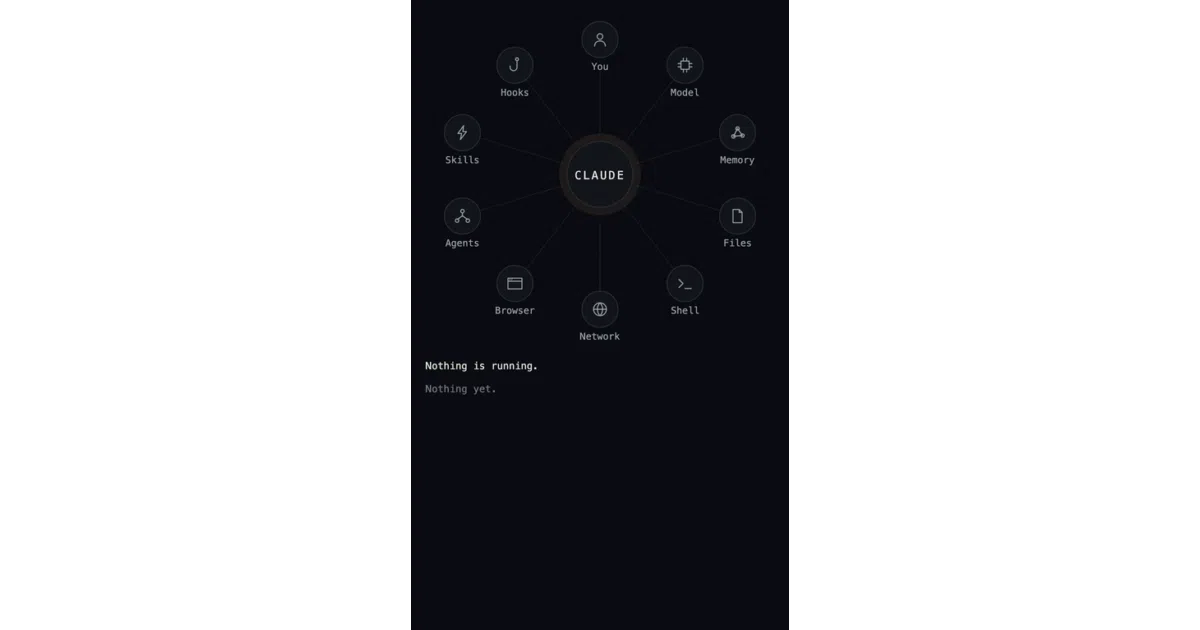
lot-map turns Claude Code's activity into a live radial map — every tool call, hook and subagent pulses out to its own station beside the chat.
Collecting fresh signals — velocity needs a few days of history.
collecting data…
star history
What it does It’s a Claude Code plugin that draws a live map in a pane next to the chat. Stations ring a central core — You, Model, Files, Shell, Network, Browser, Agents, Skills, Hooks, Memory — and each call sends a pulse from the centre to its station, returning when the call ends. Errors and refusals turn red and leave a counted dot behind. Below the map sits a rolling feed of the last 16 events with timings.
The interesting bit
The map is cumulative, not just live: spokes grow thicker the more a station is used, so at the end of a session you can literally see where the work went. It also classifies shell commands by name — curl and git push light Network, sed and mv light Files, npx only counts as Network with -y — a heuristic the README is refreshingly honest about (python -c that opens a socket still shows as Shell). And in terminals that support it, it paints the animated map as a picture at up to 30 fps, using public-domain bitmap fonts.
Key highlights
- Context window shown as a filling ring around the centre, amber at 70%, red at 90%
- Background tasks and subagents stay lit with growing clock hands until they finish; subagents orbit the Agents station as dots
- Model switches ring the centre and log rows like
opus 5.5 → fable 5.2 - Local only, with labels in 7 languages and deep theming (13 overridable colours, layout flip, reduced motion)
- Memory gets its own station, with solid vs. hollow pulses distinguishing asked-for reads from hook-injected context
Caveats
- Built and tested on Claude Code 2.1.321 on macOS; Windows works per user reports, but isn’t the tested path
- Terminal mode needs ≥144 columns for the pane, and the picture view only works in image-capable terminals (iTerm2 3.5+, kitty, Ghostty) with some fiddly
cellShapetuning - Shell classification is by command name, so scripts doing network I/O themselves won’t light Network
Verdict Worth a look if you run long Claude Code sessions and want a glanceable sense of what the agent is actually doing — and where your context budget went. If you’re happy reading a command log, it’s decoration.
Frequently asked
- What is alexeyw/lot-map?
- lot-map turns Claude Code's activity into a live radial map — every tool call, hook and subagent pulses out to its own station beside the chat.
- Is lot-map open source?
- Yes — alexeyw/lot-map is open source, released under the MIT license.
- What language is lot-map written in?
- alexeyw/lot-map is primarily written in TypeScript.
- How popular is lot-map?
- alexeyw/lot-map has 617 stars on GitHub.
- Where can I find lot-map?
- alexeyw/lot-map is on GitHub at https://github.com/alexeyw/lot-map.