airbnb/chronon
Airbnb's answer to the feature store headache
Chronon tries to close the gap between batch backfills and real-time serving so ML engineers stop building bespoke data pipelines.
Not currently ranked — collecting fresh signals.
star history
What it does
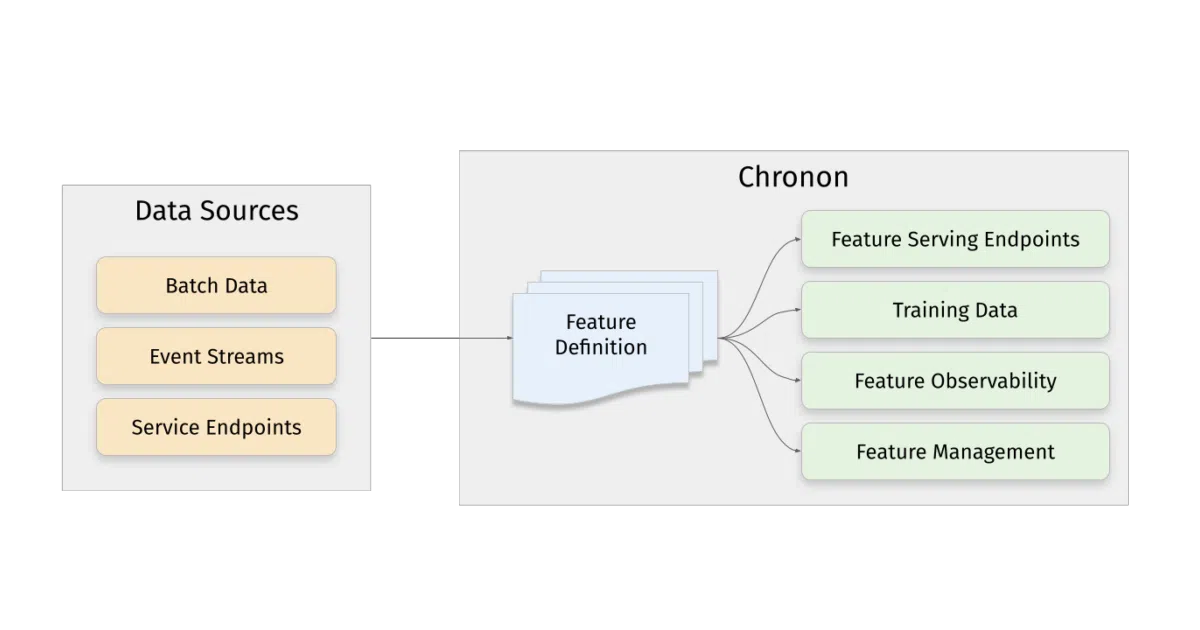
Chronon is Airbnb’s open-source feature platform. You write Python definitions that declare how raw data—batch tables, event streams, or entity snapshots—should be transformed into features. Chronon then handles batch and streaming computation, backfills, low-latency serving, and monitors data freshness and consistency between training and production.
The interesting bit
The core abstraction is a Join that isn’t just a database join. It defines the exact timestamps and keys for point-in-time backfills, guaranteeing that training data matches what the model will see at inference time. This is the subtle part that usually breaks silently in homegrown pipelines.
Key highlights
- Declarative Python API:
GroupByfor aggregations,Joinfor combining feature sets into training datasets - Point-in-time accurate backfills with guaranteed consistency against online serving
- Managed pipelines for both batch and streaming computation
- Built-in observability: data freshness, online/offline consistency checks
- Docker quickstart with fabricated retail-fraud dataset to test the full flow
Caveats
- README is truncated mid-sentence in the online serving section, so some operational details are unclear
- Quickstart explicitly excludes streaming jobs and model training steps
- Scala project with Python API surface; the Spark/Thrift compilation step adds a layer of indirection
Verdict
Worth evaluating if you’re currently maintaining separate systems for feature backfills and real-time serving, or if you’ve been bitten by training-serving skew. Probably overkill for teams with simple, low-velocity feature sets or those already happy with a commercial feature store.
Frequently asked
- What is airbnb/chronon?
- Chronon tries to close the gap between batch backfills and real-time serving so ML engineers stop building bespoke data pipelines.
- Is chronon open source?
- Yes — airbnb/chronon is open source, released under the Apache-2.0 license.
- What language is chronon written in?
- airbnb/chronon is primarily written in Scala.
- How popular is chronon?
- airbnb/chronon has 1.1k stars on GitHub.
- Where can I find chronon?
- airbnb/chronon is on GitHub at https://github.com/airbnb/chronon.