aiff22/DPED
Turning phone snapshots into DSLR fakes, 2017-style
A research artifact that taught neural networks to mimic expensive cameras by training on paired smartphone and DSLR photos.
Not currently ranked — collecting fresh signals.
star history
What it does
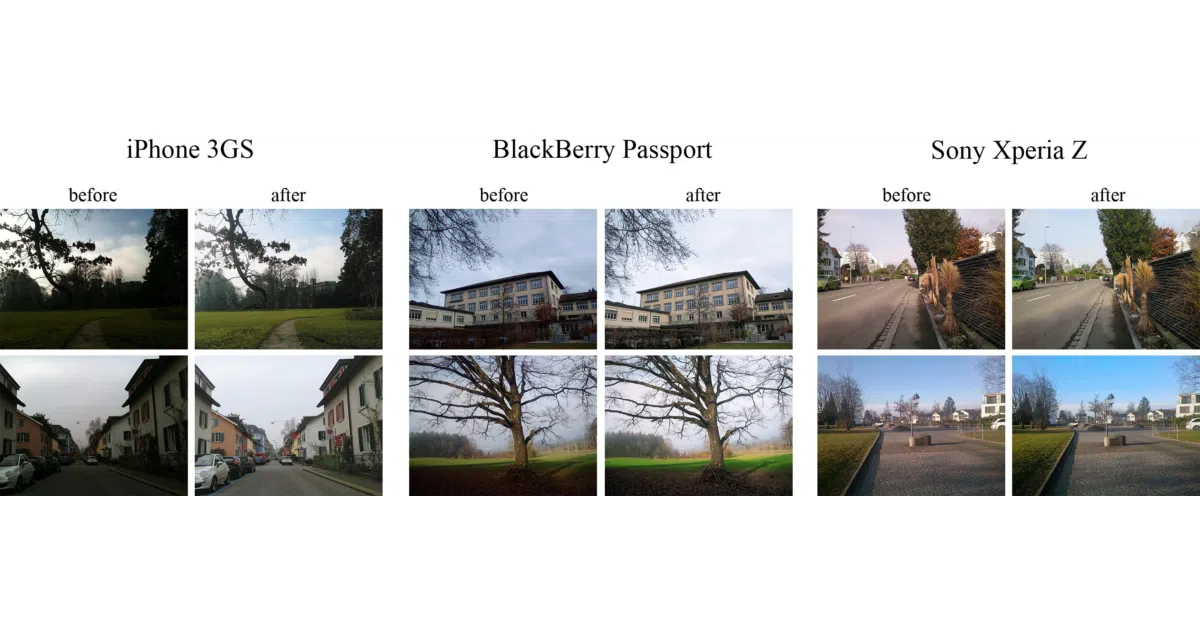
DPED is the reference implementation of a 2017 ICCV paper that learns to translate low-quality smartphone photos into images that look like they came from a DSLR. It ships with pre-trained models for iPhone, Blackberry, and Sony phone cameras, plus the ResNet-based enhancement network and adversarial training code to build your own.
The interesting bit
The project treats image enhancement as a supervised style transfer problem: paired photos from a phone and a DSLR, aligned and fed into a network that learns color, texture, and content losses jointly. The adversarial loss is weighted at 1.0 against a content loss of 10.0 and a total variation loss of 2000.0 — the authors were clearly more worried about smoothness than fooling a discriminator.
Key highlights
- Pre-trained models for three vintage smartphone cameras (iPhone, Blackberry, Sony)
- Supports arbitrary resolution at test time, though training happens on patches
- Requires TensorFlow 1.x/2.x, CUDA, and an Nvidia GPU; CPU fallback exists but takes ~5 minutes per image
- Loss weights are fully exposed as CLI flags for experimentation
- Includes VGG-19 perceptual loss and SSIM evaluation
Caveats
- The README warns that smaller batch sizes “can lead to unstable training” and suggests cropping to 800×600 if your GPU runs out of memory
- The Blackberry and Sony targets are niche; most users will only care about the iPhone model
- No mention of modern RAW processing — the authors later built PyNET for that
Verdict
Worth a look if you’re studying classical (pre-diffusion) image enhancement or need a baseline for smartphone-to-DSLR translation. Skip it if you want a drop-in photo enhancer for modern phones; the hardware targets are a decade old and the setup is research-grade fiddly.
Frequently asked
- What is aiff22/DPED?
- A research artifact that taught neural networks to mimic expensive cameras by training on paired smartphone and DSLR photos.
- Is DPED open source?
- Yes — aiff22/DPED is an open-source project tracked on heatdrop.
- What language is DPED written in?
- aiff22/DPED is primarily written in Python.
- How popular is DPED?
- aiff22/DPED has 1.7k stars on GitHub.
- Where can I find DPED?
- aiff22/DPED is on GitHub at https://github.com/aiff22/DPED.