ai4s-research/open-science
Claude Science, But It Lives on Your Hard Drive
An open-source desktop alternative to Claude Science that runs the full research loop—exploration, experiments, papers, and provenance—without leaving your local folders by default.
Velocity · 7d
+6.9
★ / day
Trend
↘cooling
star history
What it does
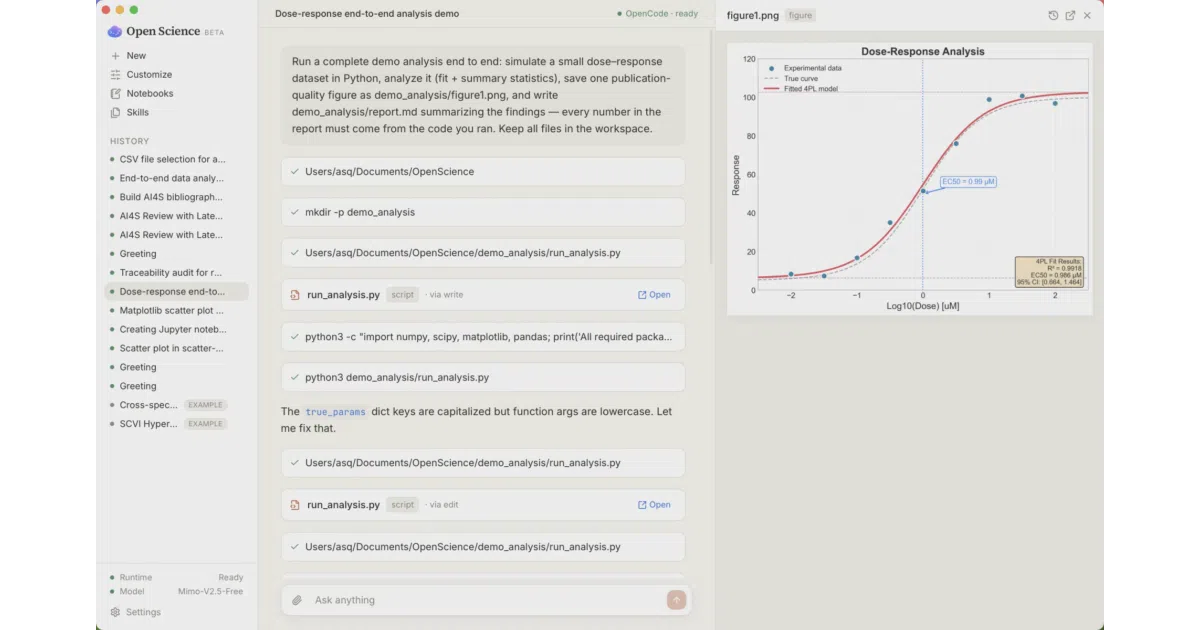
Open Science Desktop wraps the entire research lifecycle into a single Tauri-based desktop app for macOS, Windows, and Linux. You give it a broad direction, and bundled agent skills—exploration, literature survey, experiment design, and paper writing—produce real artifacts: PDFs, Jupyter notebooks, figures, and reproducible run records. Everything stays in local workspace folders by default, with a provenance trail linking every figure and number back to the code and conversation that generated it.
The interesting bit
Instead of treating the LLM as a chatbot, the app treats it as a pipeline orchestrator. Each stage drops an inspectable, gradeable artifact into your filesystem—not just text, but runnable code, rendered LaTeX, and structured data. The built-in OpenCode sidecar makes it model-agnostic, while MCP connectors pull from arXiv, PubMed, Materials Project, and others without forcing you into a single provider’s ecosystem.
Key highlights
- Local-first by default: sessions, notebooks, run logs, and provenance live in local folders; nothing leaves your machine unless you explicitly connect a remote model or compute surface.
- Full provenance tracking:
.openscience/provenance.jsonllinks every artifact to its generating code, inputs, and conversation. - Real notebooks and runs: native
.ipynbsupport with Python/R kernels via bundleduv, plus append-only run logs and a SQLite run index. - Scientific viewers out of the box: molecules, 3D meshes, genome tracks, FITS astronomy files, DOSCAR band structures, and standard office documents.
- Human-in-the-loop safety: command execution, file deletion, dependency installation, and remote connections require explicit approval in the UI.
- Multi-language UI: English, Chinese, Japanese, Spanish, German, French, and Korean.
Caveats
- Builds are not code-signed or notarized yet, so macOS Gatekeeper and Windows SmartScreen will complain.
- The project is explicitly a working MVP in active development; expect rough edges and shifting internals.
- Portuguese and Arabic are registered as interface languages but not yet selectable.
Verdict
Worth a spin if you want a local, model-agnostic lab notebook that actually produces files instead of chat bubbles. Skip it if you need code-signed installers or a finished product—the README itself bills this as a working MVP with unsigned builds.
Frequently asked
- What is ai4s-research/open-science?
- An open-source desktop alternative to Claude Science that runs the full research loop—exploration, experiments, papers, and provenance—without leaving your local folders by default.
- Is open-science open source?
- Yes — ai4s-research/open-science is an open-source project tracked on heatdrop.
- What language is open-science written in?
- ai4s-research/open-science is primarily written in TypeScript.
- How popular is open-science?
- ai4s-research/open-science has 1.8k stars on GitHub and is currently cooling off.
- Where can I find open-science?
- ai4s-research/open-science is on GitHub at https://github.com/ai4s-research/open-science.