agent-substrate/substrate
Your agents are mostly idle. This control plane treats them that way.
To run large fleets of stateful agents on a small Kubernetes footprint by suspending idle actors and resuming them in under a second.
Velocity · 7d
+71
★ / day
Trend
↘cooling
star history
What it does Agent Substrate is a control plane that sits on top of Kubernetes and manages the full lifecycle of sandboxed “actors”—typically AI agents or similar long-running, stateful applications. It maps a large registry of actors onto a much smaller pool of physical worker pods, suspending idle ones via full-state snapshots that preserve both RAM and filesystem state, then resuming them elsewhere in sub-second time. It handles real-time assignment, traffic routing, and supports multiple sandbox backends including gVisor and microVMs.
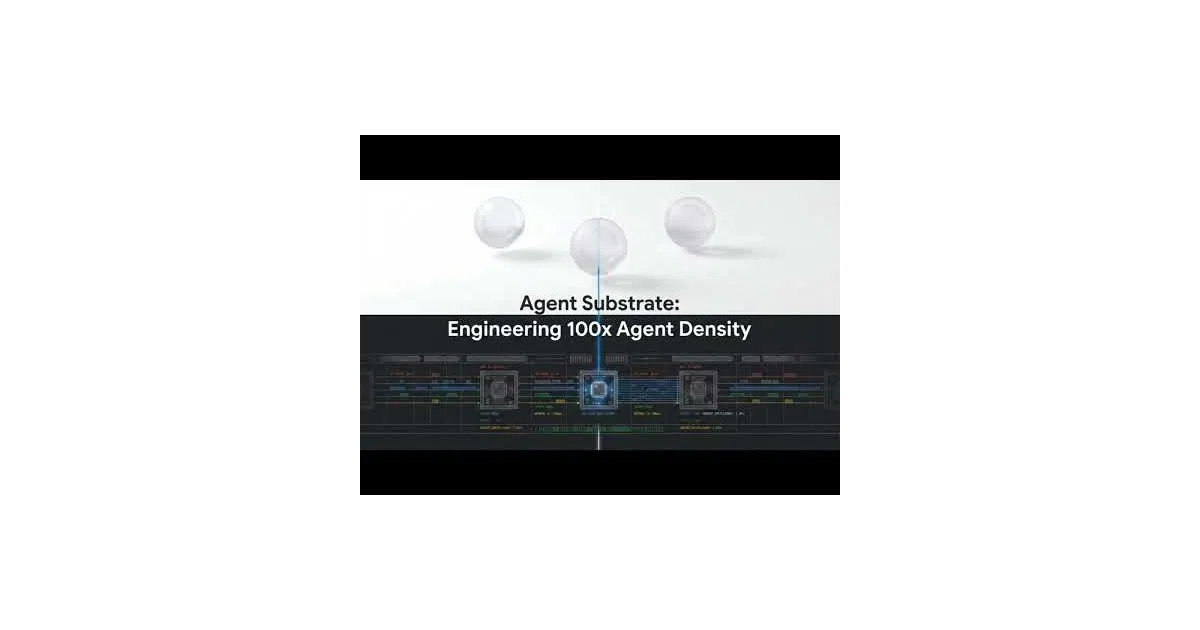
The interesting bit The system treats agent idle time as a compressible resource, essentially time-sharing for containers on Kubernetes. Because it snapshots complete volatile state, an actor can teleport to an entirely different worker and wake up with its memory and filesystem intact—allowing 30× or more oversubscription of stateful actors onto a tiny pool of physical pods.
Key highlights
- Sub-second suspend and resume for sandboxed actors, with full RAM and filesystem state preserved across hibernation.
- Framework-agnostic runtime for standard OCI containers via gVisor or microVMs; hosts ADK, LangChain, Claude Code, or MCP workloads indiscriminately.
- Built on Kubernetes for worker provisioning and autoscaling, but adds agent-specific scheduling and traffic routing to cut latency.
- Designed for high-density deployments: the demo multiplexes roughly 250 stateful actors across eight physical pods.
- Includes a threat model, benchmarking harness, and request-parking router that holds inbound traffic during transient saturation.
Caveats
- The project is explicitly in early development: APIs will change, backward compatibility is not guaranteed, and it is not production-ready.
- It requires a Kubernetes cluster and currently targets only the latest stable and previous minor Kubernetes release.
- Some documentation and component descriptions (such as the
ateom-gvisorhelper) are truncated or incomplete in the public README.
Verdict Worth exploring if you are building infrastructure to host large fleets of long-running, stateful agents and want to squeeze more utilization out of existing Kubernetes hardware. Skip it if you need a stable, production-grade control plane today or if your workloads are already efficiently stateless and short-lived.
Frequently asked
- What is agent-substrate/substrate?
- To run large fleets of stateful agents on a small Kubernetes footprint by suspending idle actors and resuming them in under a second.
- Is substrate open source?
- Yes — agent-substrate/substrate is open source, released under the Apache-2.0 license.
- What language is substrate written in?
- agent-substrate/substrate is primarily written in Go.
- How popular is substrate?
- agent-substrate/substrate has 4.5k stars on GitHub and is currently cooling off.
- Where can I find substrate?
- agent-substrate/substrate is on GitHub at https://github.com/agent-substrate/substrate.