affaan-m/ECC
A 249-skill harness for agents that can't remember their job
ECC exists because raw agent harnesses lack persistent memory, token discipline, and security guardrails, so it layers reusable skills, session hooks, and audit rules on top of them.
Feature · 10 Jun 2026
The Config Pack That Treats AI Agents Like a Production Stack
ECC is a cross-harness operator system that packages institutional knowledge for Claude Code, Cursor, Codex, and OpenCode—because prompt engineering alone doesn't scale.
Read the in-depth article →
Velocity · 7d
+799
★ / day
Trend
↘cooling
star history
What it does
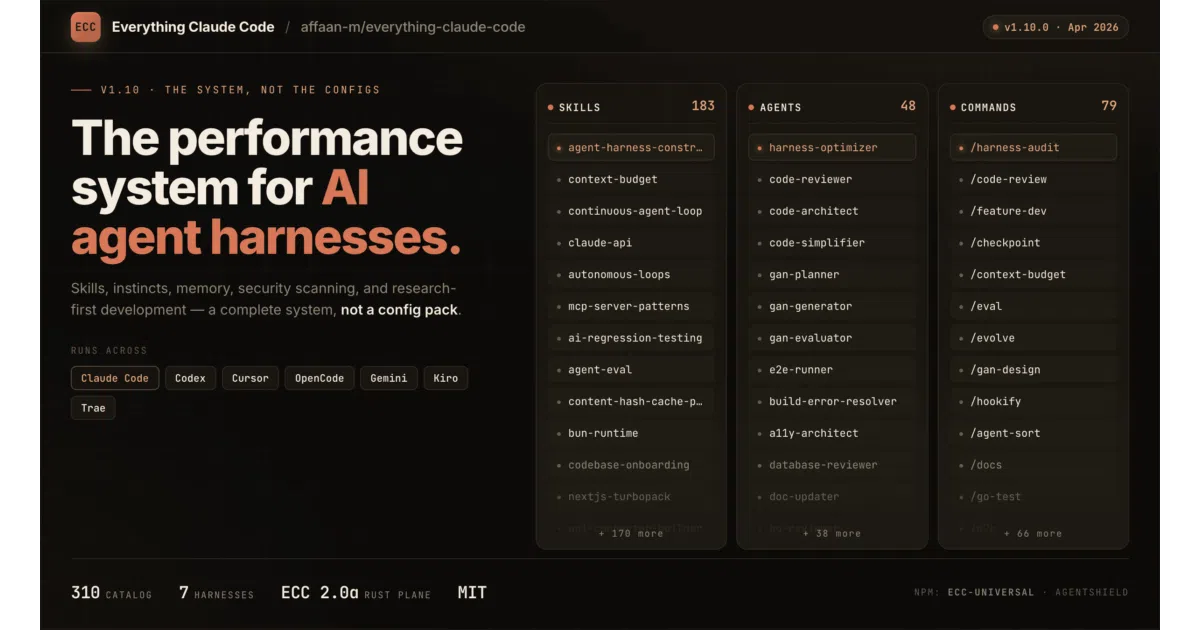
ECC is an operator system for AI coding agents. It bundles hundreds of pre-built skills, session hooks, security rules, and MCP configurations for Claude Code, Cursor, Codex, OpenCode, and similar harnesses, aiming to make agentic workflows production-ready rather than experimental. The repo also includes a Tkinter dashboard, a Rust control-plane prototype, and a GitHub App for private repository audits.
The interesting bit
Instead of treating each IDE agent as a standalone tool, ECC frames them as a single harness that needs shared memory, token optimization, and continuous learning. The documentation is literally hosted as X threads, which feels either brilliantly concise or mildly unhinged.
Key highlights
- Cross-harness support for Claude Code, Cursor, Codex, OpenCode, Gemini, Zed, and Copilot with tightened behavior parity across all of them.
- 249 skills, 63 agents, and 79 legacy command shims covering framework patterns, media tooling, and prediction-market research.
- SQLite-backed memory persistence and session hooks that automatically save and reload context across restarts.
- AgentShield security scanning, sandboxing, and cost-audit controls baked into the workflow layer.
- Manifest-driven selective install architecture so you can ingest only the agents and skills you actually need.
Caveats
- The main guides explaining the system are X/Twitter threads, not in-repo documentation, which makes deep research awkward.
- The ECC 2.0 Rust control plane is explicitly alpha-quality and “not yet a general release.”
- The project is maintained by a single developer shipping weekly across seven harnesses, so bus factor is a real concern.
Verdict
Worth exploring if you live inside AI agent harnesses daily and need opinionated guardrails, memory, and skill reuse across multiple tools. Skip it if you want a lightweight drop-in config or a mature framework with a broad maintainer pool.
Frequently asked
- What is affaan-m/ECC?
- ECC exists because raw agent harnesses lack persistent memory, token discipline, and security guardrails, so it layers reusable skills, session hooks, and audit rules on top of them.
- Is ECC open source?
- Yes — affaan-m/ECC is open source, released under the MIT license.
- What language is ECC written in?
- affaan-m/ECC is primarily written in JavaScript.
- How popular is ECC?
- affaan-m/ECC has 288.9k stars on GitHub and is currently cooling off.
- Where can I find ECC?
- affaan-m/ECC is on GitHub at https://github.com/affaan-m/ECC.