ZSeven-W/openpencil
Your vector editor now takes pull requests from Claude
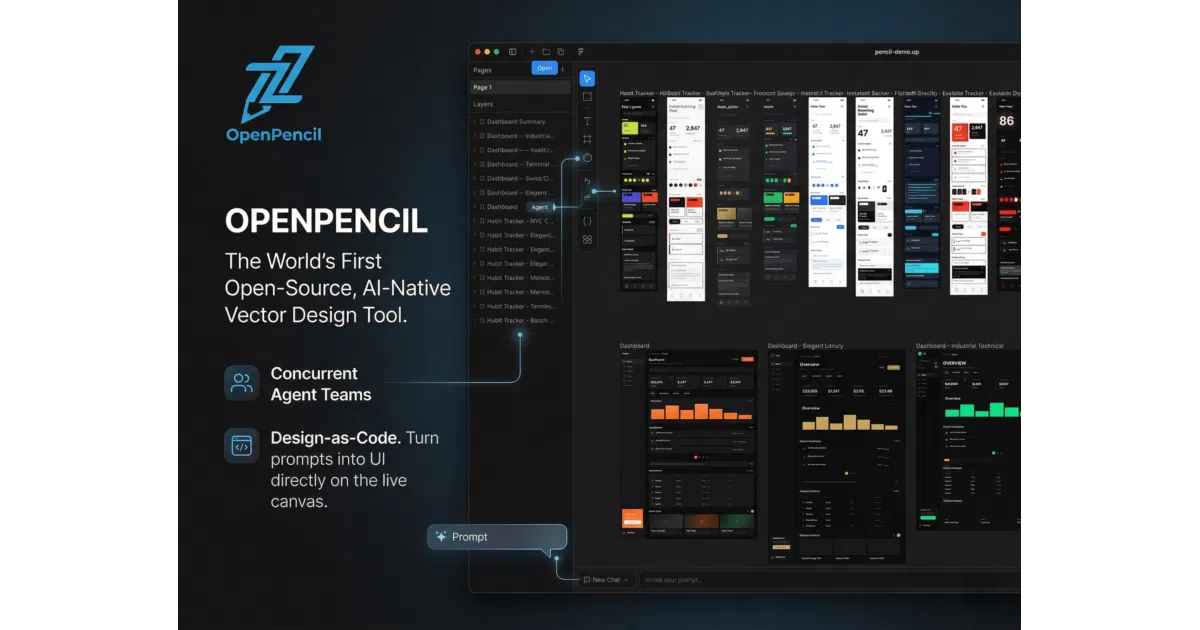
An open-source vector design tool that turns text prompts into live UI by orchestrating concurrent AI agents to draw, refine, and export code.
Velocity · 7d
+73
★ / day
Trend
↗accelerating
star history
What it does
OpenPencil is an AI-native vector design tool built around an infinite canvas. You describe a UI in plain text, and the tool generates it in real time while multiple AI agents work on separate sections—hero, features, footer—simultaneously. The resulting .op files are JSON-based design-as-code artifacts that export to React, Vue, Svelte, Flutter, SwiftUI, and others.
The interesting bit
The orchestrator decomposes complex pages into spatial sub-tasks and dispatches them to concurrent “Agent Teams,” each with their own canvas indicator. It also adapts its prompts to the model tier: Claude gets full reasoning prompts, GPT-4o and Gemini get thinking disabled, and smaller models like Qwen or Llama receive simplified nested-JSON instructions so they don’t hallucinate the layout.
Key highlights
- Built-in MCP server (
pen-mcp) exposes the canvas to Claude Code, Codex, Gemini CLI, and Copilot, so you can read and mutate.opfiles from your terminal .opfiles are diffable JSON with CSS custom properties; the CLI (op) supports piping design DSL from stdin- Multi-platform code export covers web frameworks, mobile (React Native, Jetpack Compose, SwiftUI), and desktop
- Includes an embeddable headless engine (
pen-engine) and React SDK (pen-react) if you want the canvas inside your own app - “Anti-slop” cross-generation diversity tracking to keep the agents from repeating the same boring layout
Caveats
- The README notes a namesake project also called OpenPencil that focuses on Figma-compatible real-time collaboration; this one is strictly design-to-code
- Auto-layout and some canvas features are mentioned but the feature list is truncated, so the full scope of vector editing capabilities is unclear
- Desktop builds rely on Electron, which may not excite everyone
Verdict
Worth a look if you want a generative design tool that treats UI as version-controlled code and doesn’t lock you into a single model provider. Skip it if you’re after a mature, Figma-like collaborative pixel editor—this is closer to an AI-native IDE for visual interfaces.
Frequently asked
- What is ZSeven-W/openpencil?
- An open-source vector design tool that turns text prompts into live UI by orchestrating concurrent AI agents to draw, refine, and export code.
- Is openpencil open source?
- Yes — ZSeven-W/openpencil is open source, released under the MIT license.
- What language is openpencil written in?
- ZSeven-W/openpencil is primarily written in Rust.
- How popular is openpencil?
- ZSeven-W/openpencil has 6.7k stars on GitHub and is currently accelerating.
- Where can I find openpencil?
- ZSeven-W/openpencil is on GitHub at https://github.com/ZSeven-W/openpencil.