XPixelGroup/HYPIR
SIGGRAPH paper turns Stable Diffusion into a restoration engine
It exists to squeeze image restoration and super-resolution out of Stable Diffusion's score priors without retraining the entire backbone from scratch.
Not currently ranked — collecting fresh signals.
star history
What it does
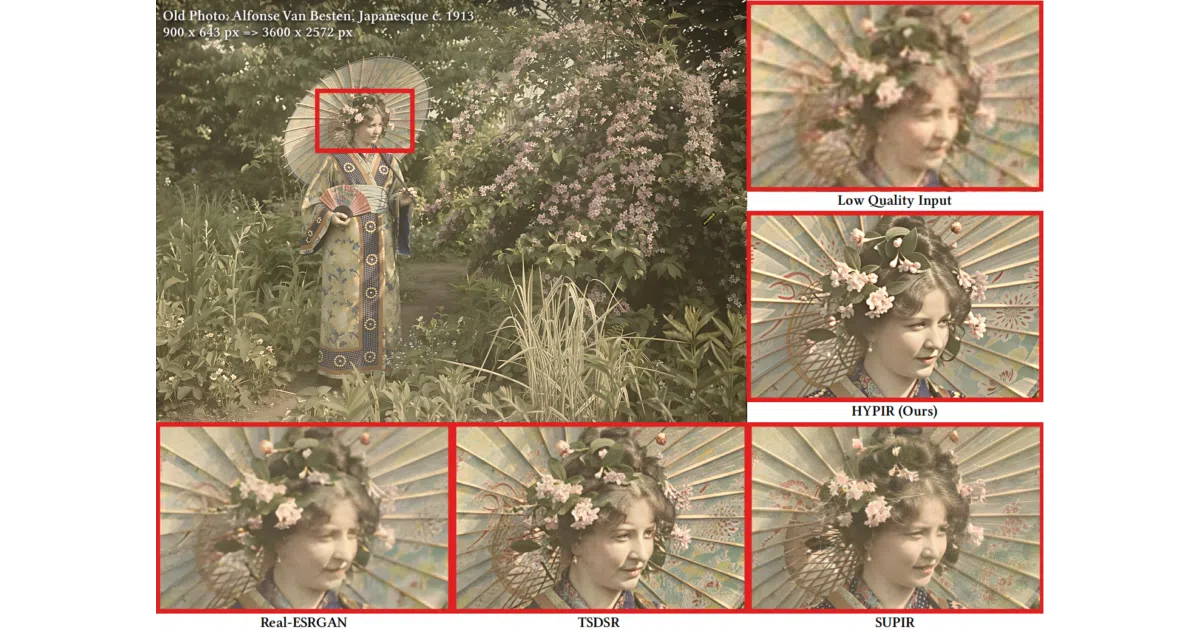
HYPIR is a research implementation that repurposes Stable Diffusion 2.1 for image restoration—specifically upscaling and super-resolution—by harnessing what the authors call “diffusion-yielded score priors.” The open-source release ships as LoRA weights (HYPIR_sd2.pth) that patch into the base model, so you are not redownloading gigabytes of duplicated backbone parameters. It handles high-resolution images via tiled inference and can run on modest hardware; the authors note a free Colab T4 GPU is sufficient.
The interesting bit
Instead of treating diffusion purely as a generative black box, the method uses its internal score functions as structural priors to guide restoration. The README is light on the underlying math, but the practical twist is clear: they trained a small LoRA adapter at batch size 1024 on curated data, aiming for stability without rebuilding the entire diffusion stack from scratch.
Key highlights
- Built on Stable Diffusion 2.1 with rank-256 LoRA adapters; no full model redistribution needed.
- Supports high-resolution upscaling (gallery examples are above 2K) via patch-based inference with configurable stride and overlap.
- Runs on consumer GPUs; authors validate it on free Colab T4 instances.
- Includes optional GPT-4o-mini integration to auto-generate text prompts for the restoration pipeline.
- Licensed strictly for non-commercial use; commercial rights require separate permission from the authors.
Caveats
- The README warns that an unauthorized third-party site (
hypir.org) is scraping their comparison images, so verify you are using official weights and demos. - The open-source release is explicitly a lighter SD2.1-based preview; the authors’ “most advanced model” is hosted separately on
suppixel.aiand not included in this repository. - Training setup requires manual parquet file generation and YAML configuration, suggesting the codebase is still research-grade rather than plug-and-play.
Verdict
Worth a look if you are researching diffusion-based inverse problems or need a non-commercial super-resolution baseline with a SIGGRAPH pedigree. Skip it if you need a commercially deployable drop-in replacement for your product pipeline.
Frequently asked
- What is XPixelGroup/HYPIR?
- It exists to squeeze image restoration and super-resolution out of Stable Diffusion's score priors without retraining the entire backbone from scratch.
- Is HYPIR open source?
- Yes — XPixelGroup/HYPIR is an open-source project tracked on heatdrop.
- What language is HYPIR written in?
- XPixelGroup/HYPIR is primarily written in Python.
- How popular is HYPIR?
- XPixelGroup/HYPIR has 1.2k stars on GitHub.
- Where can I find HYPIR?
- XPixelGroup/HYPIR is on GitHub at https://github.com/XPixelGroup/HYPIR.