WeBankFinTech/Prophecis
WeBank open-sources its five-factory ML assembly line
Prophecis integrates Jupyter Lab, KubeSphere, and multiple ML frameworks into one platform so teams can move from notebook to production without leaving the building.
Collecting fresh signals — velocity needs a few days of history.
collecting data…
star history
What it does
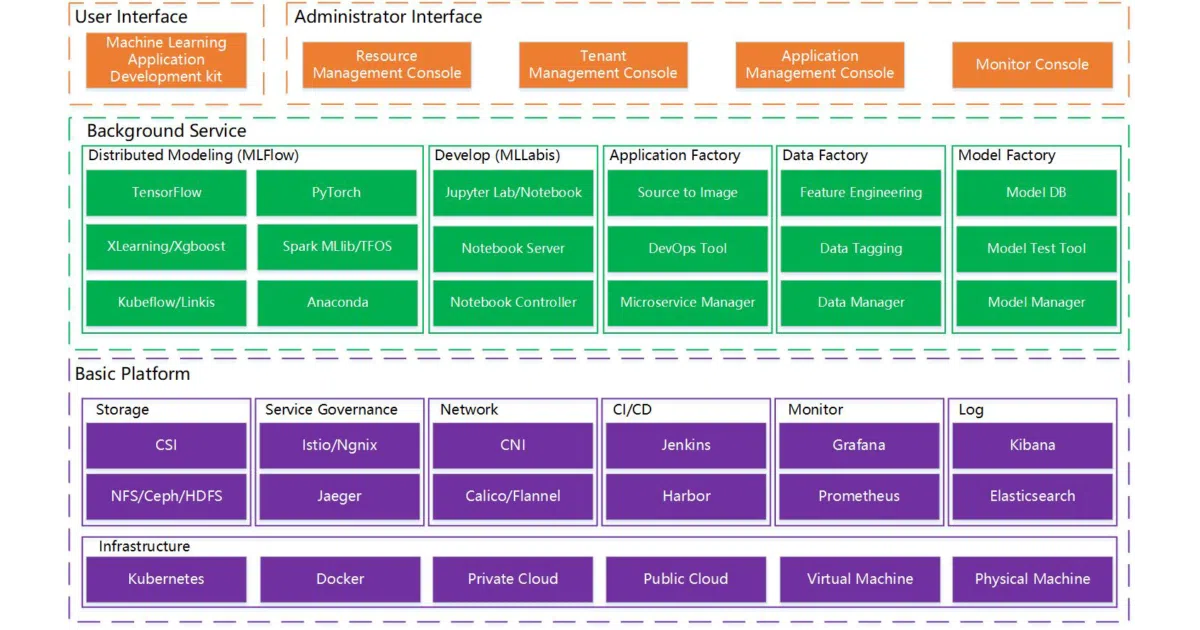
Prophecis is an enterprise machine learning platform developed by WeBank that packages open-source tools into five services: a distributed training flow, a Jupyter Lab-based IDE called MLLabis, a model factory for deployment and A/B testing, a data factory for feature engineering, and an application factory built on KubeSphere for CI/CD and GPU monitoring. It aims to give multi-tenant teams a single containerized path from experimentation to production.
The interesting bit
Instead of inventing new frameworks, Prophecis acts as an integration layer, wiring together TensorFlow, XGBoost, and Jupyter Lab under one lifecycle manager that plugs into WeBank’s DataSphere Studio workflow. The premise is that large enterprises would rather adopt an opinionated full-stack platform than maintain their own patchwork of notebook servers and deployment scripts.
Key highlights
- Five specialized services cover the full ML lifecycle: Machine Learning Flow for training, MLLabis for notebooks, Model Factory for serving, Data Factory for labeling, and Application Factory for DevOps.
- MLLabis supports Python, R, and Julia on GPU and Hadoop clusters, with TensorBoard and debug plugins included.
- Models can be deployed as RESTful or RPC endpoints with one click, according to the README.
- The platform is built on top of KubeSphere and integrates with DataSphere Studio via an AppJoint interface.
- Multi-tenant cluster management and GPU monitoring are pitched as first-class production features.
Caveats
- The README contains visible rough edges, including the misspelled “Propheics MLLabis” and awkward phrasing that suggests documentation is still maturing.
- With 512 stars, the project appears tightly coupled to the broader WeBank open-source ecosystem.
- Several core components are explicitly described as customizations of existing open-source projects, so judge whether you need the wrapper or just the underlying tools.
Verdict
Worth evaluating if you are already using DataSphere Studio or want a pre-integrated, bank-hardened ML platform. Otherwise, you might get farther faster with the individual tools it wraps.
Frequently asked
- What is WeBankFinTech/Prophecis?
- Prophecis integrates Jupyter Lab, KubeSphere, and multiple ML frameworks into one platform so teams can move from notebook to production without leaving the building.
- Is Prophecis open source?
- Yes — WeBankFinTech/Prophecis is open source, released under the Apache-2.0 license.
- What language is Prophecis written in?
- WeBankFinTech/Prophecis is primarily written in Go.
- How popular is Prophecis?
- WeBankFinTech/Prophecis has 512 stars on GitHub.
- Where can I find Prophecis?
- WeBankFinTech/Prophecis is on GitHub at https://github.com/WeBankFinTech/Prophecis.