Volcomix/virtual-background
Three ML models and a shader walk into a browser tab
A browser demo that compares three ML segmentation models to find the least-bad way to fake your background in real time.
Not currently ranked — collecting fresh signals.
star history
What it does
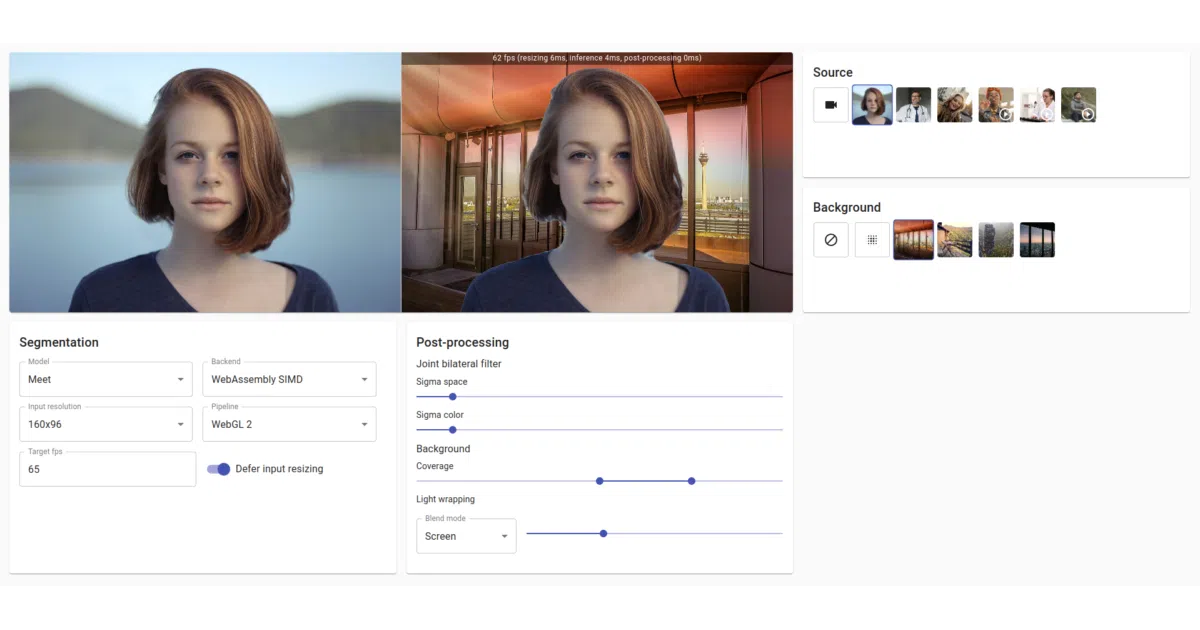
This demo replaces your real background with a virtual one during live video calls, entirely in the browser. It grabs frames from your webcam, runs person segmentation through one of three ML models, then composites you over a new backdrop using either Canvas 2D or custom WebGL 2 shaders. The whole pipeline stays client-side; no server required.
The interesting bit
The author didn’t just import TensorFlow.js and call it a day. For Google’s Meet segmentation model—available only as a TensorFlow Lite file—they compiled a custom WASM inference runtime with XNNPACK and SIMD support, then built a full WebGL 2 rendering pipeline with joint bilateral filtering and light wrapping. It is essentially a from-scratch reconstruction of Google Meet’s background pipeline, running in a single browser tab.
Key highlights
- Side-by-side comparison of
BodyPix, MediaPipeMeet, andML KitSelfie Segmentation. - Custom TFLite
WASMruntime built with Emscripten and Bazel, calling C++ directly from JavaScript. WebGL 2pipeline handles resizing, softmax, edge-preserving smoothing, background blur, and light wrapping in GLSL.- On a Pixel 3, the
Meetmodel reaches 60 FPS at 160×96 resolution when usingWASM SIMDand theWebGL 2renderer. BodyPixuses standard TensorFlow.js but is described as “not really usable” on mobile and less precise thanMeet.
Caveats
- The
Meetsegmentation model’s license shifted from Apache 2.0 to Google’s Terms of Service in January 2021, so its legal status for reuse is unclear. BodyPixperformance on mobile is poor, and theML Kitmodel underperformsMeetdespite similar architecture because it requires a higher input resolution.- The repository is explicitly a demo and research testbed, not a production library.
Verdict
Study this if you’re building browser-based video effects or comparing ML inference strategies across WASM and WebGL. Look elsewhere if you need a polished, drop-in virtual background SDK.
Frequently asked
- What is Volcomix/virtual-background?
- A browser demo that compares three ML segmentation models to find the least-bad way to fake your background in real time.
- Is virtual-background open source?
- Yes — Volcomix/virtual-background is open source, released under the Apache-2.0 license.
- What language is virtual-background written in?
- Volcomix/virtual-background is primarily written in TypeScript.
- How popular is virtual-background?
- Volcomix/virtual-background has 524 stars on GitHub.
- Where can I find virtual-background?
- Volcomix/virtual-background is on GitHub at https://github.com/Volcomix/virtual-background.