VITA-MLLM/Woodpecker
Pecking Away at MLLM Hallucinations After Generation
Woodpecker is a training-free, post-hoc pipeline that corrects hallucinated objects and claims in multimodal LLM output by validating text against the actual image content.
Not currently ranked — collecting fresh signals.
star history
What it does
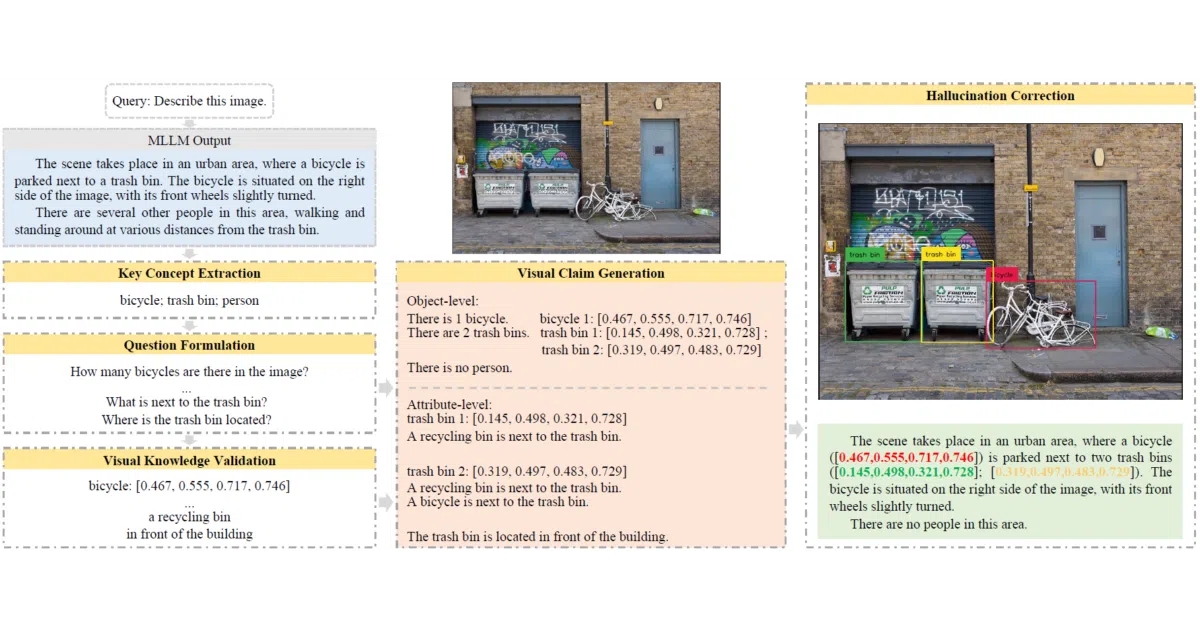
Woodpecker acts as a post-processing fact-checker for multimodal large language models. It ingests an image and a model-generated caption, extracts key objects and claims, validates them against the actual image using an open-set detector, and returns a corrected version of the text with hallucinations removed. Because it operates after generation, it can be attached to existing MLLMs—such as LLaVA, MiniGPT-4, mPLUG-Owl, or Otter—without retraining or modifying their weights.
The interesting bit
The project treats hallucination as a curable symptom rather than a chronic architectural flaw. Its five-stage pipeline—concept extraction, question formulation, visual knowledge validation, claim generation, and final correction—exposes intermediate reasoning via intermediate_view.json, so you can inspect exactly what the system caught and why.
Key highlights
- Training-free: no fine-tuning or weight updates required for the target MLLM.
- Model-agnostic: evaluated on four different baseline models.
- Interpretable: outputs intermediate stage results by default.
- Benchmark gains: authors report accuracy improvements of roughly 30.66% on MiniGPT-4 and 24.33% on mPLUG-Owl under the POPE object-hallucination benchmark.
- External tooling: relies on GroundingDINO for visual validation and spacy for text processing.
Caveats
- Not fully offline: the inference pipeline requires an API key, implying dependence on an external service.
- Several external dependencies: deployment involves GroundingDINO, spacy language models, and the target MLLM itself, so it is more of a research integration than a drop-in library.
Verdict
Worth a look if you are building on top of existing open MLLMs and need a quick, interpretable hedge against hallucinated objects and claims without retraining. Skip it if you need a lightweight, fully offline, or production-hardened correction layer—the current release is research code with multiple external moving parts.
Frequently asked
- What is VITA-MLLM/Woodpecker?
- Woodpecker is a training-free, post-hoc pipeline that corrects hallucinated objects and claims in multimodal LLM output by validating text against the actual image content.
- Is Woodpecker open source?
- Yes — VITA-MLLM/Woodpecker is an open-source project tracked on heatdrop.
- What language is Woodpecker written in?
- VITA-MLLM/Woodpecker is primarily written in Python.
- How popular is Woodpecker?
- VITA-MLLM/Woodpecker has 650 stars on GitHub.
- Where can I find Woodpecker?
- VITA-MLLM/Woodpecker is on GitHub at https://github.com/VITA-MLLM/Woodpecker.