Unity-Technologies/obstacle-tower-env
Unity's procedurally generated torture tower for AI agents
A gym-compatible 3D environment designed to break reinforcement learning agents that memorize instead of generalize.
Not currently ranked — collecting fresh signals.
star history
What it does
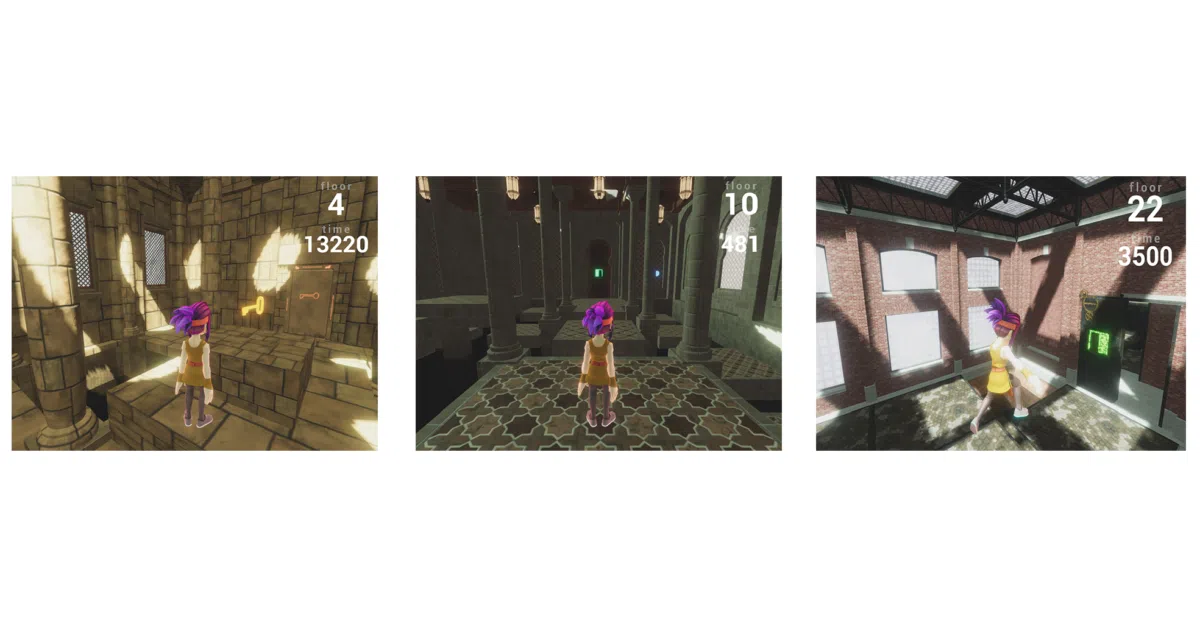
Obstacle Tower is a Unity-built, OpenAI Gym-compatible benchmark where an agent climbs procedurally generated floors—each a maze of platforming, puzzles, and enemies—to reach stairs and advance. Difficulty scales as the agent progresses, and visual themes, room layouts, and puzzle configurations shuffle on every run. Unity provides pre-built binaries for Linux, macOS, and Windows, with auto-download on first gym instantiation.
The interesting bit
The procedural generation isn’t window dressing; it’s the core thesis. Because floors recombine elements in unseen ways, agents can’t coast on memorized paths. The environment explicitly tests whether your RL agent actually learned vision, locomotion, and planning—or just overfit to a static level. There’s also a “Player Mode” for human control, presumably so you can personally experience why your algorithm is struggling.
Key highlights
- Up to 100 floors in generated towers (v2.0+)
- Extensive reset parameters for customizing difficulty, visual themes, and content
- Built-in evaluation wrapper with benchmarking guidelines and pre-defined seeds
- Auto-downloads platform binaries via gym wrapper registry (v4.0+)
- Includes GCP + Dopamine Rainbow training guide and Jupyter notebook examples
- Source code openly available in separate obstacle-tower-source repo
Caveats
- Requires Python 3.6+ and Unity ML-Agents 1.x; version lock-in may complicate integration with newer ML-Agents releases
- Long version history (4.1) with repeated hotfixes for determinism, reset parameter application, and memory leaks suggests the environment has been finicky in production
- Docker memory leaks and environment freezes on higher floors were patched but may linger as edge cases
Verdict
Worth a look if you’re researching generalization in RL or need a visually rich, non-trivial 3D benchmark. Skip it if you want a stable, low-maintenance environment for quick algorithm prototyping—the Unity binary dependency and version-specific ML-Agents requirement add friction.
Frequently asked
- What is Unity-Technologies/obstacle-tower-env?
- A gym-compatible 3D environment designed to break reinforcement learning agents that memorize instead of generalize.
- Is obstacle-tower-env open source?
- Yes — Unity-Technologies/obstacle-tower-env is open source, released under the Apache-2.0 license.
- What language is obstacle-tower-env written in?
- Unity-Technologies/obstacle-tower-env is primarily written in Python.
- How popular is obstacle-tower-env?
- Unity-Technologies/obstacle-tower-env has 545 stars on GitHub.
- Where can I find obstacle-tower-env?
- Unity-Technologies/obstacle-tower-env is on GitHub at https://github.com/Unity-Technologies/obstacle-tower-env.