UFund-Me/Qbot
Qbot: Quant Trading by Way of Duct Tape and Deep Learning
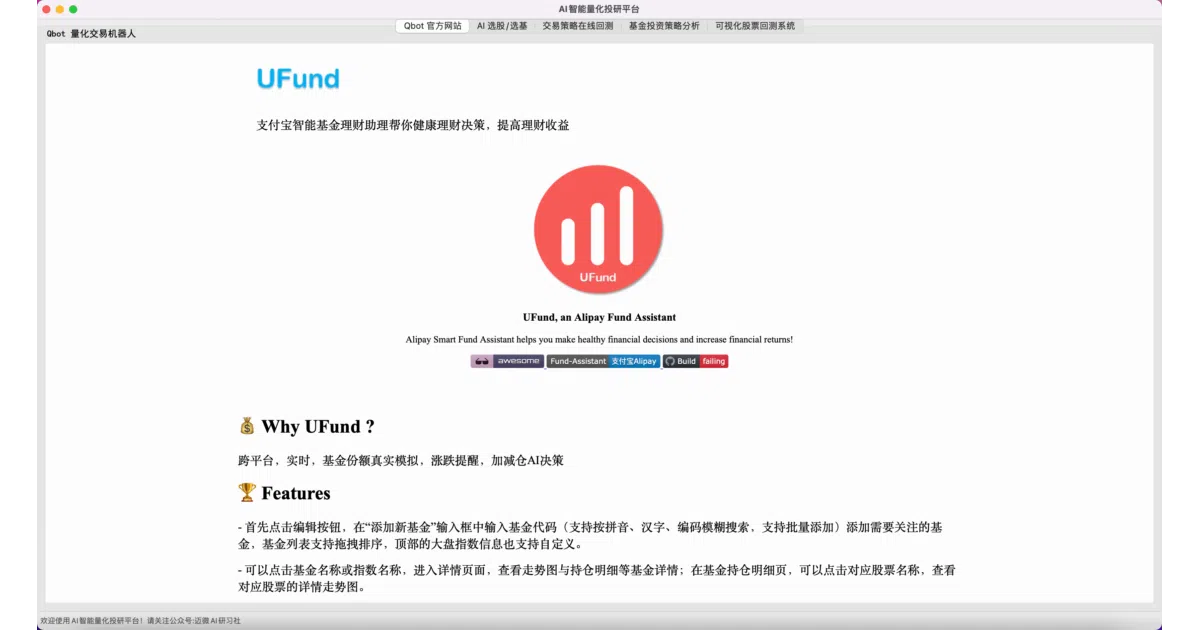
It gives retail traders a local GUI for stitching together data feeds, backtesters, and execution frameworks into an AI-themed quant workflow.
Velocity · 7d
+4.6
★ / day
Trend
↘cooling
star history
What it does
Qbot is a locally-deployed quantitative investment platform that stitches together data pipelines, strategy backtesting, and automated trading for stocks, funds, futures, and crypto. It offers a GUI frontend and an event-driven backend meant to carry a strategy from research through simulated execution to live trading. The project emphasizes machine learning and reinforcement learning strategy development alongside traditional multi-factor models.
The interesting bit
Rather than reinventing the wheel, Qbot acts as an integration layer—gluing together existing quant tools like backtrader, vnpy, qlib, and quantstats under one modular roof. The pitch is the “AI strategy” angle, with support for supervised learning, market dynamics modeling, and RL agents, though the README stays vague on what those models actually accomplish or how they perform.
Key highlights
- Modular three-layer design: data, strategy, and execution engines
- Abstracted interfaces support stocks, funds, futures, and virtual currencies
- Bundles notifications across email, Feishu, WeChat, and desktop popups
- Runs fully offline and local, with no cloud dependency claimed
- Explicitly tested only on Python 3.8 and 3.9
Caveats
- The “AI” branding is aspirational: the README mentions ML and RL paradigms but offers no concrete model performance, benchmarks, or training details
- It is fundamentally glue code—an orchestration layer over established quant libraries rather than a novel engine
- The interface and documentation mix Chinese and English, which may slow down international users
Verdict
Worth a look if you want a pre-packaged local quant workstation and don’t mind digging through integration code. Skip it if you’re expecting a novel trading engine or polished, benchmarked AI strategies out of the box.
Frequently asked
- What is UFund-Me/Qbot?
- It gives retail traders a local GUI for stitching together data feeds, backtesters, and execution frameworks into an AI-themed quant workflow.
- Is Qbot open source?
- Yes — UFund-Me/Qbot is open source, released under the MIT license.
- What language is Qbot written in?
- UFund-Me/Qbot is primarily written in Jupyter Notebook.
- How popular is Qbot?
- UFund-Me/Qbot has 18.7k stars on GitHub and is currently cooling off.
- Where can I find Qbot?
- UFund-Me/Qbot is on GitHub at https://github.com/UFund-Me/Qbot.