TraderAlice/OpenAlice
A Self-Hosted AI Trader That Treats Orders Like Git Commits
OpenAlice runs an AI trading agent on your own hardware because broker keys and real money are not things you outsource to the cloud.
Velocity · 7d
+9.7
★ / day
Trend
↗accelerating
star history
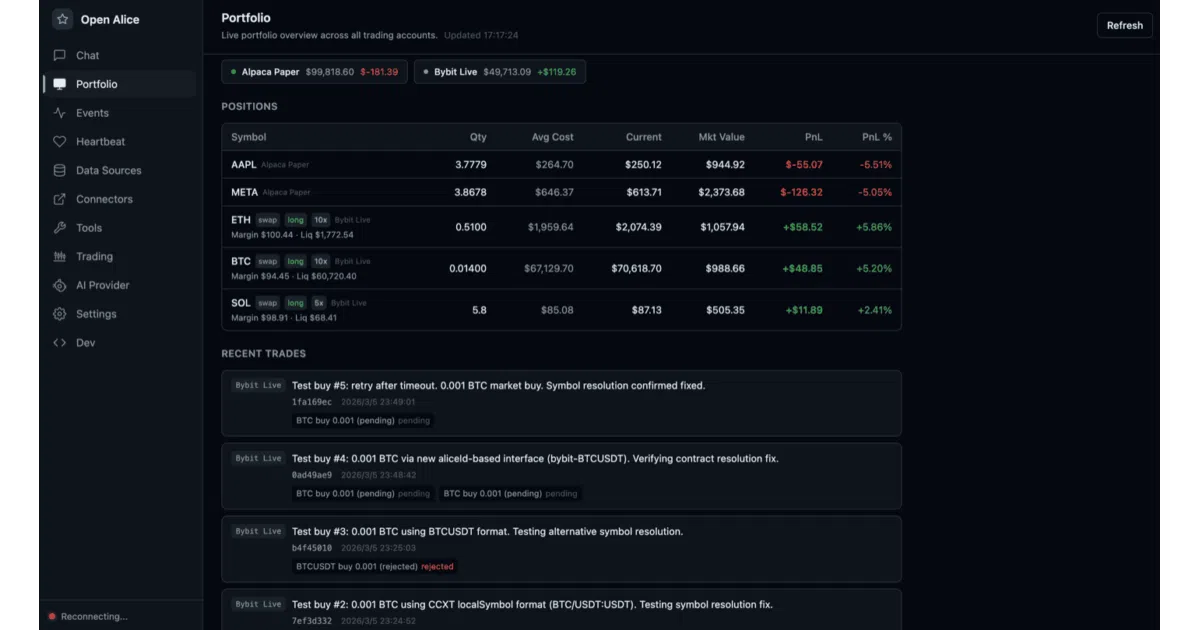
What it does OpenAlice is a self-hosted TypeScript stack that automates research and trading across equities, crypto, commodities, forex, and macro. It wraps multiple brokers into Unified Trading Accounts, feeds market data and news through a TypeScript-native OpenBB engine, and surfaces everything in a web UI with portfolio dashboards and workspace chat. The agent handles the full lifecycle — research, entry, position monitoring, risk management, and exit — though every order requires your explicit approval before it hits the market.
The interesting bit The architecture splits decision-making from execution like a hardware wallet: the Alice process holds the AI runtime and research tools but never touches broker credentials, while the UTA service owns the keys, order state machine, and a “Trading-as-Git” workflow where you stage, commit, and push orders to execute. That separation is designed so the credential-holding half can eventually run on a home box or phone while the brain lives on a VPS.
Key highlights
- Trading-as-Git workflow with staged orders, commit messages, and an 8-character hash history; pre-execution guard rails enforce position limits, cooldowns, and symbol whitelists per account
- Split-process architecture isolates broker credentials in the UTA service (bound to
127.0.0.1), while the Alice process drives decisions via a thin HTTP SDK - Multi-provider AI switchable at runtime between Claude (Agent SDK) and Vercel AI SDK (Anthropic, OpenAI, Google) without restarting
- Workspace model pairs a per-task git repo and persistent terminal session (
claude,codex, orshell) with MCP-native tool exposure, so the agent works inside a real CLI rather than a chat shim - Automation scheduling via cron and heartbeat timers is solid, though the execution layer that wires triggers into workspace tasks is still being rebuilt
Caveats
- Explicitly experimental: many interfaces are incomplete, breaking changes are expected, and the authors warn against using it for live trading with real funds
- Fundamental research is deepest for equities and still expanding to other asset classes
- The automation “last mile” — scheduled triggers firing inside a workspace session — is intentionally minimal until the Workspace scheduler lands
Verdict Worth a look if you want to experiment with algorithmic trading without shipping your API keys to a SaaS, but treat it as a sophisticated sandbox rather than a production system. Anyone expecting a polished, fire-and-forget money printer should stay away.
Frequently asked
- What is TraderAlice/OpenAlice?
- OpenAlice runs an AI trading agent on your own hardware because broker keys and real money are not things you outsource to the cloud.
- Is OpenAlice open source?
- Yes — TraderAlice/OpenAlice is open source, released under the AGPL-3.0 license.
- What language is OpenAlice written in?
- TraderAlice/OpenAlice is primarily written in TypeScript.
- How popular is OpenAlice?
- TraderAlice/OpenAlice has 7.4k stars on GitHub and is currently accelerating.
- Where can I find OpenAlice?
- TraderAlice/OpenAlice is on GitHub at https://github.com/TraderAlice/OpenAlice.