THU-MIG/yoloe
Open-vocabulary YOLO that re-parameterizes away its own overhead
YOLOE unifies text, visual, and prompt-free object detection and segmentation in a single model, then collapses back into a standard YOLO at inference time.
Not currently ranked — collecting fresh signals.
star history
What it does
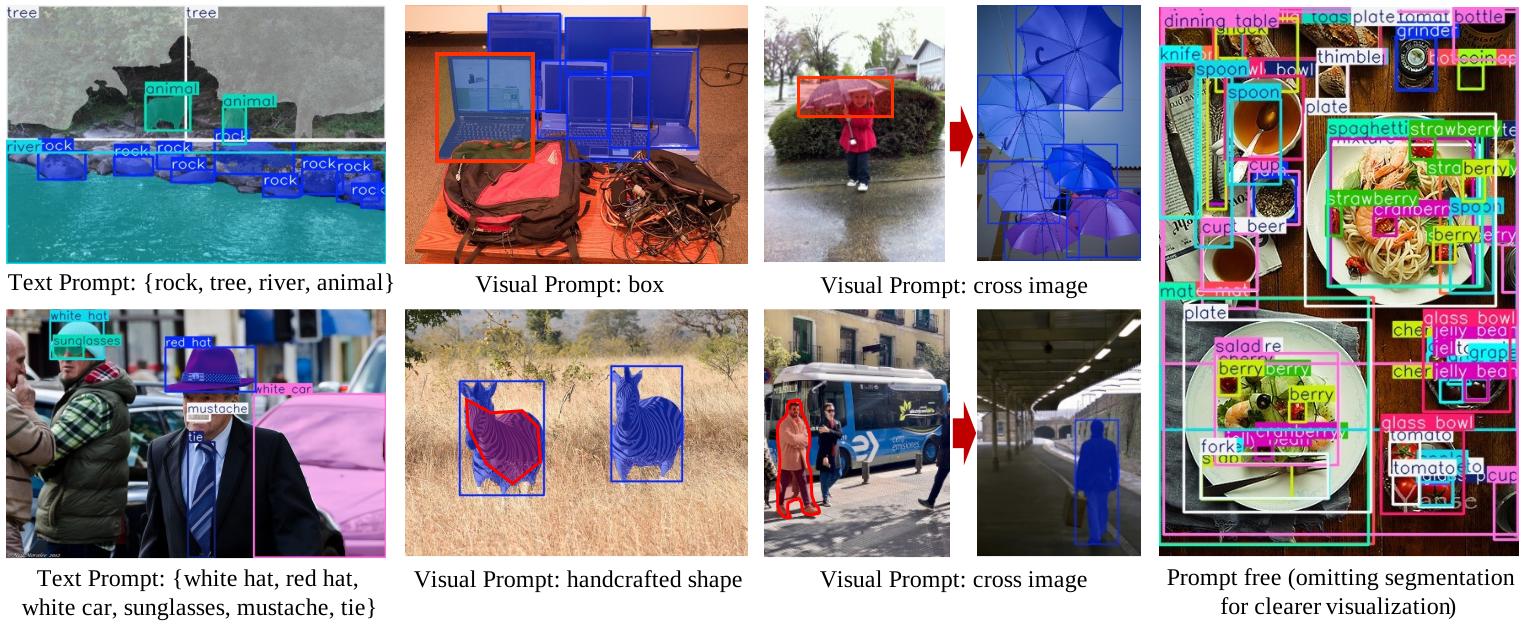
YOLOE is an open-vocabulary detector and segmenter built on the YOLO architecture. It handles three prompt styles—text, visual cues, or none at all—to find and mask objects without fixed category lists. Once trained, the auxiliary prompt machinery is re-parameterized into the base weights, leaving a runtime model that is architecturally identical to a plain closed-set YOLO.
The interesting bit
The authors avoid the usual open-vocabulary tax with two tricks: a lightweight re-parameterizable network that refines text embeddings for zero-cost alignment at runtime, and a decoupled semantic-and-activation encoder for visual prompts that adds minimal complexity. In prompt-free mode, the model leans on a built-in large vocabulary instead of calling an external language model, which keeps latency down and deployment simple.
Key highlights
- Prompt-free mode runs without calling an external language model, using a built-in vocabulary and specialized embeddings instead.
- On LVIS, the small variant reportedly trains in one-third the time of YOLO-Worldv2-S, runs 1.4× faster, and scores 3.5 AP higher.
- When transferred to COCO, YOLOE-v8-L claims nearly 4× less training time than closed-set YOLOv8-L while beating its box and mask accuracy.
- Benchmarked on both server GPUs (TensorRT on T4) and mobile silicon (CoreML on iPhone 12).
Caveats
- Visual prompts, especially handcrafted shapes or cross-image references, may need a lower confidence threshold to avoid missing objects.
Verdict
A strong candidate if you want open-vocabulary perception inside the YOLO toolchain without sacrificing the familiar deployment story. Less compelling if your object categories are already fixed and you have no patience for prompt engineering or threshold tuning.
Frequently asked
- What is THU-MIG/yoloe?
- YOLOE unifies text, visual, and prompt-free object detection and segmentation in a single model, then collapses back into a standard YOLO at inference time.
- Is yoloe open source?
- Yes — THU-MIG/yoloe is open source, released under the AGPL-3.0 license.
- What language is yoloe written in?
- THU-MIG/yoloe is primarily written in Python.
- How popular is yoloe?
- THU-MIG/yoloe has 2.2k stars on GitHub.
- Where can I find yoloe?
- THU-MIG/yoloe is on GitHub at https://github.com/THU-MIG/yoloe.