SummitKwan/transparent_latent_gan
Retrofitting a pre-trained face GAN with interpretable dials
TL-GAN reverse-engineers control axes inside an existing face generator so you can tweak features like beard or smile without retraining the model.
Not currently ranked — collecting fresh signals.
star history
What it does
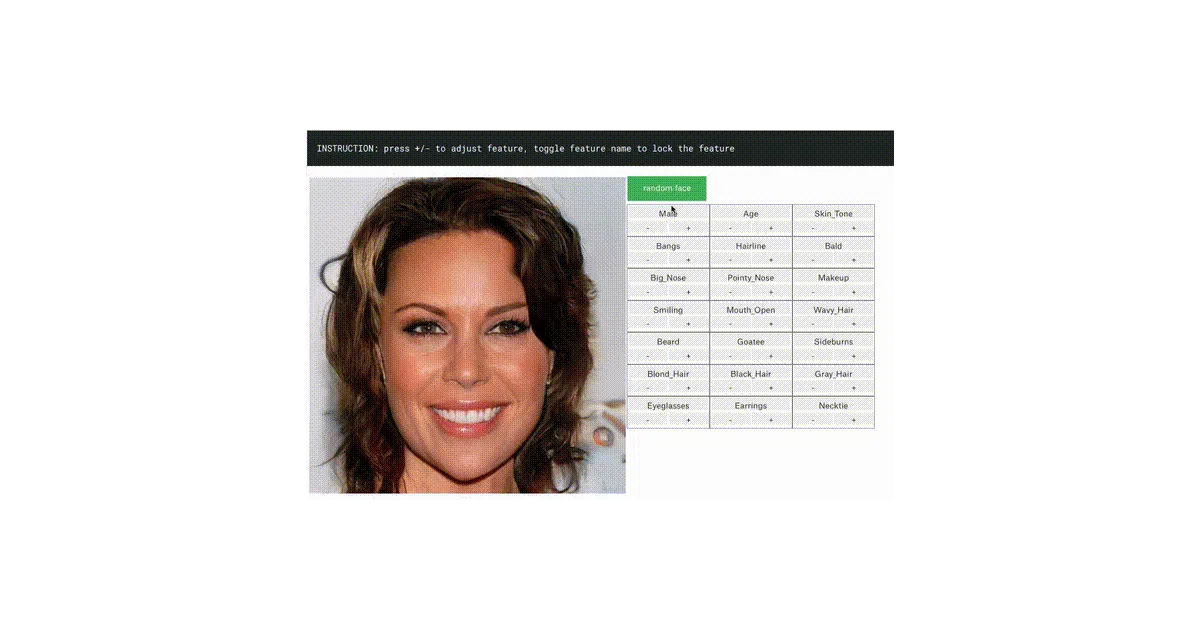
The project takes Nvidia’s already-trained PG-GAN checkpoint and makes its latent space navigable. It couples the generator with a CNN feature extractor trained on labeled face attributes, then discovers feature axes in the noise vectors. Moving a latent vector along one of these axes morphs the output along a human-interpretable dimension—think “Male” or “Beard”—effectively adding knobs to an otherwise random image synthesizer.
The interesting bit The clever part is that the generator itself is left completely untouched. Instead of retraining the GAN, the author correlates latent vectors with features extracted from the generated images. The README claims you can add dozens of new control knobs in under an hour, which is a pragmatic hack around the usual black-box problem of unsupervised models.
Key highlights
- Works on top of an existing, unmodified
PG-GANcheckpoint from Nvidia. - Discovers feature axes in latent space using a coupled CNN attribute classifier.
- Offers an interactive demo via a Kaggle notebook (free GPU) and a local Jupyter GUI.
- Claims under an hour to add 40 control features without retraining the generator.
- Supports locking one feature while tweaking another (e.g., lock “Male” while adjusting “Beard”).
Caveats
- The README is littered with typos and incomplete sections; the “train on your own” instructions literally trail off with “to be continued…”
- Local setup requires manually downloading model weights, a feature extractor, and discovered axes from a personal Dropbox link, then placing them in a rigid directory tree.
- Code targets a dated stack: Nvidia K80, CUDA 9.0, and Anaconda Python 3.6, which may frustrate modern environments.
Verdict Worth a look if you’re researching latent-space interpretability or need a quick proof-of-concept for controlling legacy GANs. Skip it if you want a maintained, production-ready editing pipeline or modern CUDA support.
Frequently asked
- What is SummitKwan/transparent_latent_gan?
- TL-GAN reverse-engineers control axes inside an existing face generator so you can tweak features like beard or smile without retraining the model.
- Is transparent_latent_gan open source?
- Yes — SummitKwan/transparent_latent_gan is open source, released under the MIT license.
- What language is transparent_latent_gan written in?
- SummitKwan/transparent_latent_gan is primarily written in Python.
- How popular is transparent_latent_gan?
- SummitKwan/transparent_latent_gan has 2k stars on GitHub.
- Where can I find transparent_latent_gan?
- SummitKwan/transparent_latent_gan is on GitHub at https://github.com/SummitKwan/transparent_latent_gan.