StreetLamb/tribe
Drag-and-drop LangGraph: build agent teams without the boilerplate
Tribe wraps LangGraph in a low-code UI so you can assemble sequential or hierarchical agent teams instead of wiring state machines by hand.
Not currently ranked — collecting fresh signals.
star history
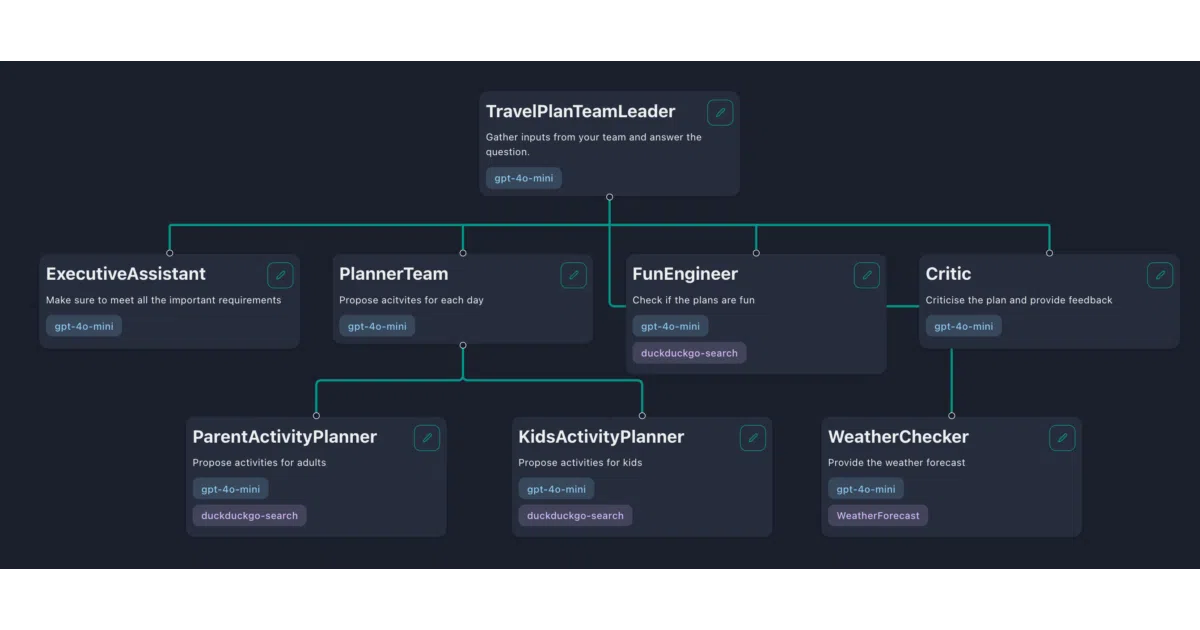
What it does Tribe is a web UI and API for building multi-agent workflows. You define agents, assign them skills (web search, custom HTTP endpoints, or LangChain tools), and wire them into sequential pipelines or org-chart hierarchies. Under the hood it runs on LangGraph, but you never touch the graph code directly.
The interesting bit The hierarchy model is the unusual part: a “team leader” agent decomposes tasks and delegates to members, then reassembles their outputs. That pattern is tedious to code in raw LangGraph, but here it is a checkbox-and-dropdown configuration. The trade-off is opacity—you configure behavior through forms, not code.
Key highlights
- Two workflow modes: sequential (deterministic hand-offs) or hierarchical (manager-delegation with re-evaluation loops)
- Skill system: built-in DuckDuckGo, Wikipedia, Yahoo Finance; custom skills via JSON API definitions or LangChain code
- Human-in-the-loop: optional approval gate before tool execution in sequential flows
- RAG + open-source models: bring your own embeddings, or run Llama/Gemma/Phi via Ollama
- Multi-tenancy, persistent chat, LangSmith observability, Docker deployment
Caveats
- The README warns the project is “under heavy development” and significant changes may occur
- Default
.envvalues likechangethismust be manually rotated before deployment - The LangChain custom-skill documentation is truncated in the README; expect to read source code
Verdict Worth a spin if you want to prototype agent orchestration without writing graph nodes, but skip it if you need fine-grained control over state transitions or are allergic to UI-heavy frameworks.
Frequently asked
- What is StreetLamb/tribe?
- Tribe wraps LangGraph in a low-code UI so you can assemble sequential or hierarchical agent teams instead of wiring state machines by hand.
- Is tribe open source?
- Yes — StreetLamb/tribe is open source, released under the MIT license.
- What language is tribe written in?
- StreetLamb/tribe is primarily written in TypeScript.
- How popular is tribe?
- StreetLamb/tribe has 1.1k stars on GitHub.
- Where can I find tribe?
- StreetLamb/tribe is on GitHub at https://github.com/StreetLamb/tribe.