StanfordVL/GibsonEnv
Your robot trained in a real house, without breaking any furniture
A simulator that virtualizes actual scanned spaces so embodied agents learn perception in semantically real environments, not game-engine fantasy.
Not currently ranked — collecting fresh signals.
star history
What it does
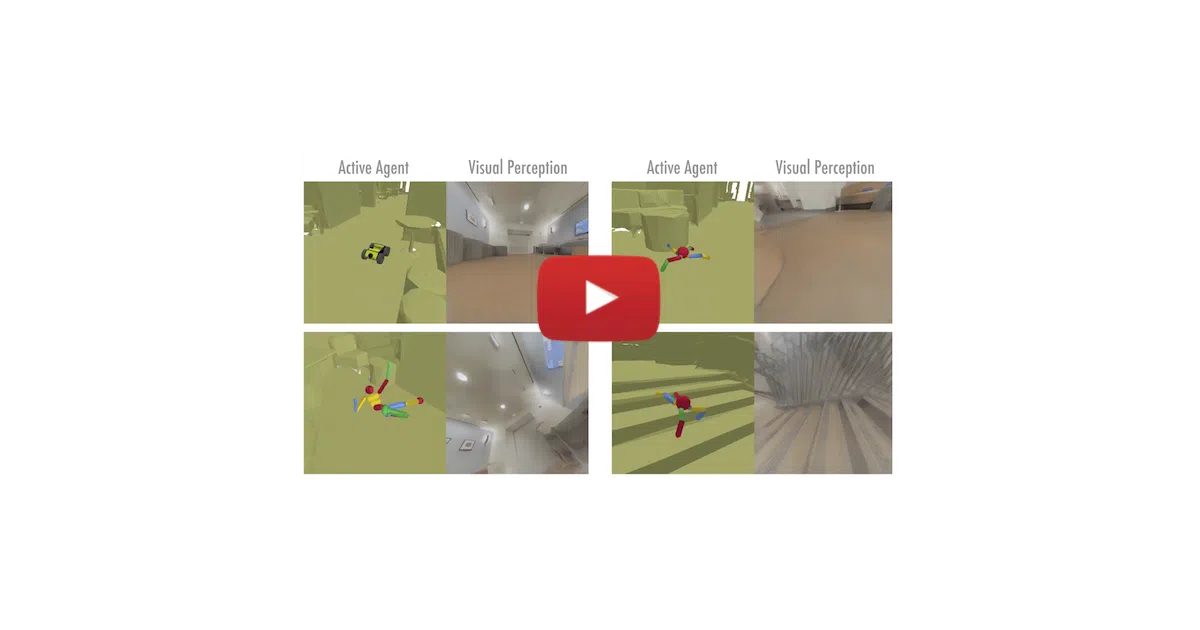
Gibson is a robotics simulator built around a simple premise: train your agent in spaces that actually exist. It virtualizes 572 real-world buildings (1,440 floors) scanned into 3D, then drops in a physics engine (Bullet) and a robot body with actual motion constraints. The result is an RL environment where a Husky rover or a legged ant learns hallway navigation with RGB-D camera input, subject to real spatial limits rather than Unity-style open worlds.
The interesting bit
The “Goggles” function—an explicit baked-in mechanism for sim-to-real transfer. The authors don’t just hope the policy generalizes; they built a transfer channel into the environment itself. Also, the name is a flex: James J. Gibson wrote “The Ecological Approach to Visual Perception” in 1979, and the project takes his “we must move in order to perceive” literally.
Key highlights
- 572 real scanned spaces, plus integrations with Stanford 2D3DS and Matterport3D datasets
- Docker-first distribution (nvidia-docker2) with headless-server support via x11vnc
- Physics-backed embodiment through Bulletphysics integration
- CVPR 2018 Spotlight Oral; framerate benchmarks provided (e.g., 109.1 FPS at 128×128 RGBD pre-network on V100)
- ROS configuration and OpenAI Baselines demos included (PPO1/2)
Caveats
- Minimum VRAM requirement is 6GB; CUDA 8+ and specific driver versions required
- Source build is dependency-heavy (GLEW, GLM, Assimp, Boost, OpenMPI, plus pinned PyTorch 0.3.1 and TensorFlow 1.3)
- Core asset package is deliberately slim (39 spaces); full dataset requires separate download and license agreement
Verdict
Grab this if you’re doing embodied RL or sim-to-real robotics research and need semantically realistic indoor navigation. Skip it if you want lightweight, game-engine aesthetics or modern PyTorch/TensorFlow versions—the stack is frozen circa 2018.
Frequently asked
- What is StanfordVL/GibsonEnv?
- A simulator that virtualizes actual scanned spaces so embodied agents learn perception in semantically real environments, not game-engine fantasy.
- Is GibsonEnv open source?
- Yes — StanfordVL/GibsonEnv is open source, released under the MIT license.
- What language is GibsonEnv written in?
- StanfordVL/GibsonEnv is primarily written in C.
- How popular is GibsonEnv?
- StanfordVL/GibsonEnv has 947 stars on GitHub.
- Where can I find GibsonEnv?
- StanfordVL/GibsonEnv is on GitHub at https://github.com/StanfordVL/GibsonEnv.